The question arrived after the machine had already done its job. A patient with an implanted cardiac device would sit across from Shanti Bansal and ask whether the doctor knew about a shock, or an episode of atrial fibrillation, captured somewhere in the device's memory. Bansal was the electrophysiologist. Responsibility landed on his desk. Yet the information had taken the scenic route.
There is no romance in a missing report. There is merely an uncomfortable conversation, followed by the stubborn suspicion that a workflow has failed. Bansal has described those encounters as the frustration behind Octagos, the remote-monitoring company he founded in Houston. He did not begin by trying to change medicine at large. He built a platform for his own clinic, where the shortcomings were close enough to touch and impossible to explain away.
That origin gives Octagos a precise kind of character. Its subject is cardiac data, but its real business is attention: which transmission matters, who should see it, how quickly it reaches a record, and what human labor gets consumed along the way. Every device can speak. A clinic still has to listen without going deaf from the noise.
“No unwasted effort. If you fail, you'll be better next time; if you succeed, keep on going.”Shanti Bansal, reflecting on entrepreneurship
The long route back to code
Bansal had been trained for this junction before he knew it existed. At Johns Hopkins, from 1996 to 2000, he studied biomedical engineering and computer science, graduating with honors in engineering. Then the itinerary became distinctly medical: an MD from Rush Medical College, internal-medicine training at the University of Chicago, fellowship work at Yale-New Haven, and advanced electrophysiology training at Harbor-UCLA.
Electrophysiology is a specialty of signals. It deals with the timing and circuitry of the heart, using devices and procedures to diagnose or correct rhythm disorders. Software, meanwhile, is also a discipline of signals, although programmers are fortunate that a compiler rarely asks for a bedside manner. Bansal could read both worlds. His public physician biography adds a charming detail: away from the office, he enjoyed making websites and programming, along with basketball.
One career, four working languages
- Engineering
Biomedical systems and computer science - Medicine
Clinical judgment and patient responsibility - Electrophysiology
Devices, rhythm and signal interpretation - Octagos
Software, service and workflow at scale
The company that emerged in 2020 was therefore less a departure from medicine than a reunion of Bansal's earlier selves. The engineer understood systems. The programmer understood automation. The physician understood the cost of a bad handoff. The specialist understood why an alert can be both technically accurate and practically useless.
His credentials are almost comically well matched to the nuisance he chose. Public records list board certifications in internal medicine, cardiovascular disease and nuclear cardiology, along with later electrophysiology certification. He trained in device implantation and management, ablation and the close reading of electrical activity. When he says a clinic is overwhelmed by transmissions, he is describing a queue he knows from the receiving end, not a market category discovered in a consultant's slide deck.
That distinction helps explain why the first version stayed close to reporting. A cardiac device does not deliver a neat conclusion. It produces evidence that must be sorted, interpreted, documented and connected with what a clinic already knows. Each additional portal may be defensible on its own and maddening in aggregate. The founder's job was to make those systems behave like colleagues who had finally agreed to use the same filing cabinet.
A company born in the unflattering middle
Founders prefer problems that photograph well. Remote-monitoring administration does not. It is a landscape of portals, reports, device makers, electronic records, billing rules and queues. The most consequential work may look suspiciously like moving information from one place to another. Bansal's early platform pulled those pieces together for his practice. When reports improved and the clinic's economics followed, he began commercializing the system.
By a 2022 account from Bansal, Octagos had reached more than 100 clinics and hospitals, hired more than 100 people, and completed a Series A after raising over $8 million. The speed is notable, but the sequence matters more. He had a functioning clinic problem, a local solution, evidence that the solution changed operations, and only then the larger commercial story.
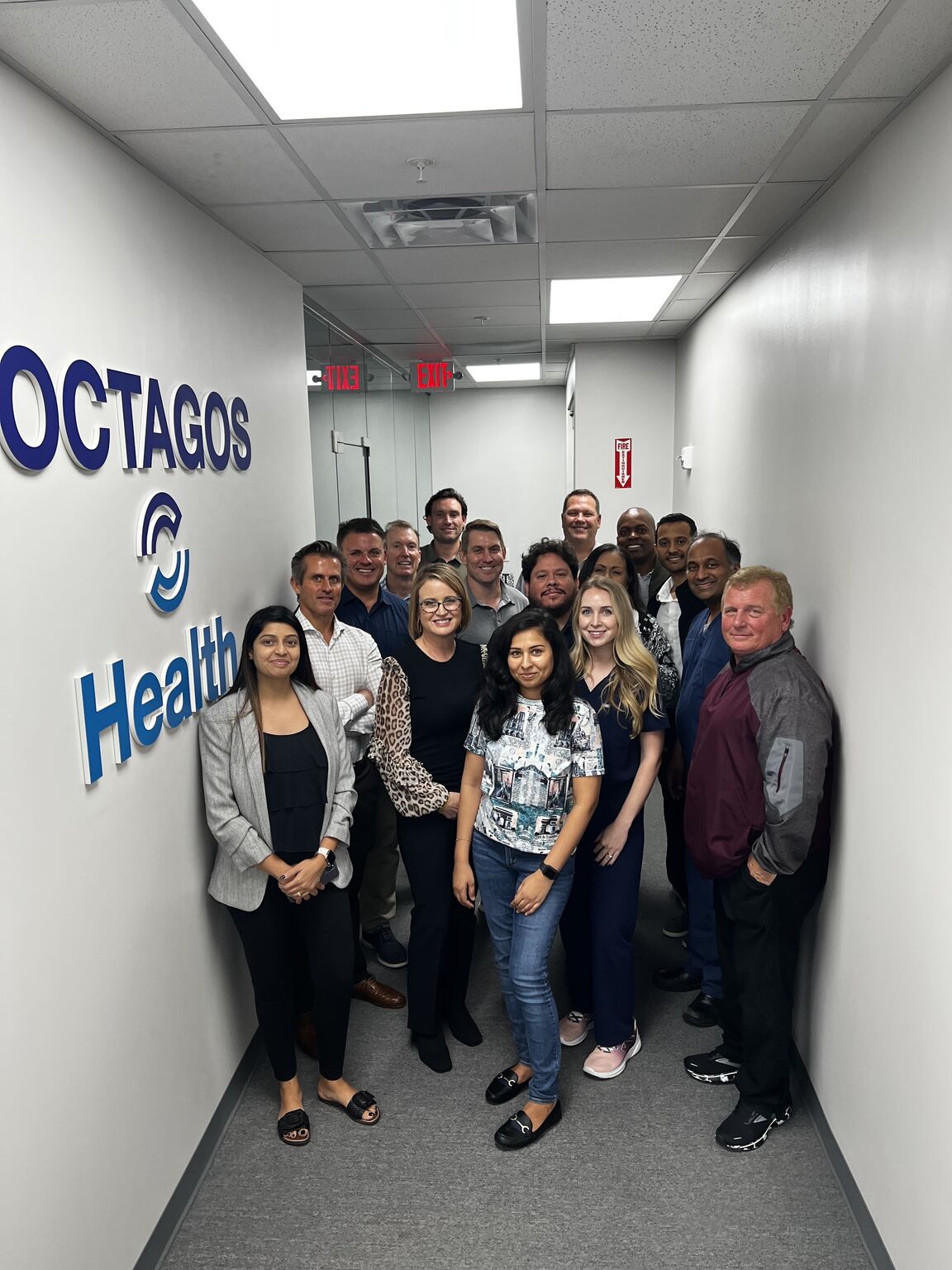
His preferred label for the change in occupation is “doctorpreneur.” The word has all the elegance of two carry-on bags strapped together, yet it suits him. Bansal has not presented entrepreneurship as a clean escape from clinical work. In his own list of founder lessons, he admitted that balance between doctor and entrepreneur was difficult. He advised aspiring clinician-founders to “jump on in” and get dirty in every part of the business.
The price of organized attention
In July 2024, Octagos raised more than $43 million in a Series B led by Morgan Stanley Expansion Capital, with Mucker Capital and other investors participating. The announcement described a plan to widen beyond pacemakers and defibrillators into ambulatory monitors, consumer wearables and other forms of cardiac data. Bansal framed the ambition broadly: a comprehensive, AI-based clinical decision-support engine.
Money at that scale can make a young company sound inevitable. Bansal's own writing is less serene. In a 2025 reflection, he described a remote-monitoring field in which competitors had risen and disappeared. He sorted businesses by their capital and by their operating model: software, service, or the combination. His argument was that durability would require enough funding and an effective marriage of technology with clinical work.
The financing also sharpened the company's obligations. Octagos said it would broaden device integrations, add predictive capabilities and invest in sales, customer service and AI engineering. It planned connections across implantable devices, ambulatory monitors, wearables and other data sources. This is the awkward adulthood of a startup: the original insight must survive contact with many hospitals, many record systems and many local habits. A workflow that feels effortless to one clinic can be an exotic creature to the next.
Bansal's answer has been interoperability, a long word for an ordinary expectation. Information should arrive where clinicians already work. The company has emphasized bidirectional electronic-record connections, customized reports and migration of historical data from older systems. None is the sort of feature that causes a dinner guest to demand a demonstration. Together they determine whether a new platform becomes useful infrastructure or one more password taped beneath a keyboard.
That hybrid model is central to the way Bansal talks about Octagos. AI can filter and prioritize. Integrations can place information into a hospital's existing record system. Trained reviewers can preserve clinical scrutiny. The promise is not a glittering robot doctor. It is a less chaotic Tuesday for the people running a device clinic.
“Clinicians are dealing with an increasing influx of patient data.”Shanti Bansal on the case for a unified system
The founder as translator
Bansal's public persona is unusually literal for a technology founder. His aphorisms concern effort, people, creativity and getting one's hands dirty. He credits shared values and culture with carrying a company through hard periods. The grand vision arrives, but it tends to arrive after the operational verbs: migrate, integrate, filter, review, report.
That ordering may be his advantage. A physician can recognize a clinically significant signal. An engineer can design the path it travels. An operator notices the queue building overnight. A chief executive persuades investors that the path, once cleared, can serve clinics across a country. Bansal has occupied all four chairs, sometimes on the same day.
He has also remained connected to research. His published work predates Octagos and includes cardiovascular studies on cardiac risk and outcomes. More recent work associated with the company's domain examines the use of artificial intelligence to reduce non-actionable alerts and clinic workload. The recurring concern is capacity: not whether medicine can collect another piece of information, but whether someone can use it well.
The software industry likes to speak of scale as though it were a virtue by itself. Clinical scale is less forgiving. A system must grow without blurring the individual judgment that made it valuable. Bansal's answer is a company built with two kinds of intelligence, machine and human, joined to the existing machinery of a clinic rather than floating above it.
The next signal
Octagos has continued adding tools around analytics, predictive insight and clinic operations. In 2026, it introduced Ask Atlas, intended to let device clinics ask questions of their own data. Bansal's remark at the launch was characteristically tidy: access to data is not the same as understanding it. The sentence could serve as a caption for his entire career.
There is a personal symmetry, too. Bansal grew up in New Hampshire, and he has written warmly about working with Dartmouth Health, calling the connection meaningful. The company that began inside one Houston practice now reaches institutions far from its starting room. Yet the emotional unit remains the clinic, the report and the clinician trying to decide what deserves attention next.
One need not turn every inconvenience into a startup. Most inconveniences would object. Bansal chose one that sat exactly where his training converged, and where the consequences of disorder were plain to him. A patient asked whether the doctor had seen what the device had seen. Octagos is his continuing attempt to make the answer less awkward.