Here is a business idea shaped like a physics problem, or maybe a physics problem shaped like a business idea.
The standard way to continuously monitor blood sugar is, when you think about it, a little strange. You wear a small plastic disc on your arm, and out of the bottom of that disc a tiny filament goes into you and stays there, measuring the glucose in the fluid between your cells. It works. Millions of people rely on it. It is also a thing that punctures your skin and needs replacing every week or two, which turns out to be exactly the kind of friction that keeps most people from ever using one. Apollon, a company founded in Seoul in 2021 and now split between Korea and Cambridge, Massachusetts, looked at that arrangement and asked the obvious-in-retrospect question: what if the sensor never touched the inside of you at all?
This is a genre of question that has broken many hearts. Non-invasive glucose monitoring is one of the great white whales of medical devices - a thing so many companies have chased that "we'll measure your blood sugar without breaking the skin" reads, to anyone who's been around the industry, less like a pitch and more like a warning. The graveyard is full. So the interesting thing about Apollon isn't that it's trying. It's how.
The how is Raman spectroscopy, and it is genuinely old and genuinely clever. Shine a laser at a molecule and most of the light bounces back unchanged, but a tiny, tiny fraction comes back at shifted wavelengths - a spectral fingerprint of the molecule's own vibrations. Chemists have used this for a century to identify unknown substances. Apollon's bet is that you can aim that same trick through skin, pick glucose's faint signature out of the noisy chorus of everything else in your tissue, and use machine learning to translate that whisper into a number. No filament. No consumable. No puncture.
“We're not just removing the needle. We're removing the barrier to better care.”
Apollon company mission
The word "barrier" is doing real work in that sentence, because the pitch here is only half about comfort. The other half is math. Fewer than one in ten American diabetics uses a continuous glucose monitor, even though the clinical value of the data is not in dispute. The reasons people give are the boring, human ones: it hurts, it's expensive, my skin reacts to the adhesive, I don't want to reorder a sensor every ten days. Apollon's founder Aram Hong put the logic plainly - eliminate the microneedle, he reasoned, and you make the whole thing more accessible, more affordable, and safer. If that's true, the addressable market isn't the sliver of people already on CGMs. It's the roughly 92% who said no.
The product has a name, and a size
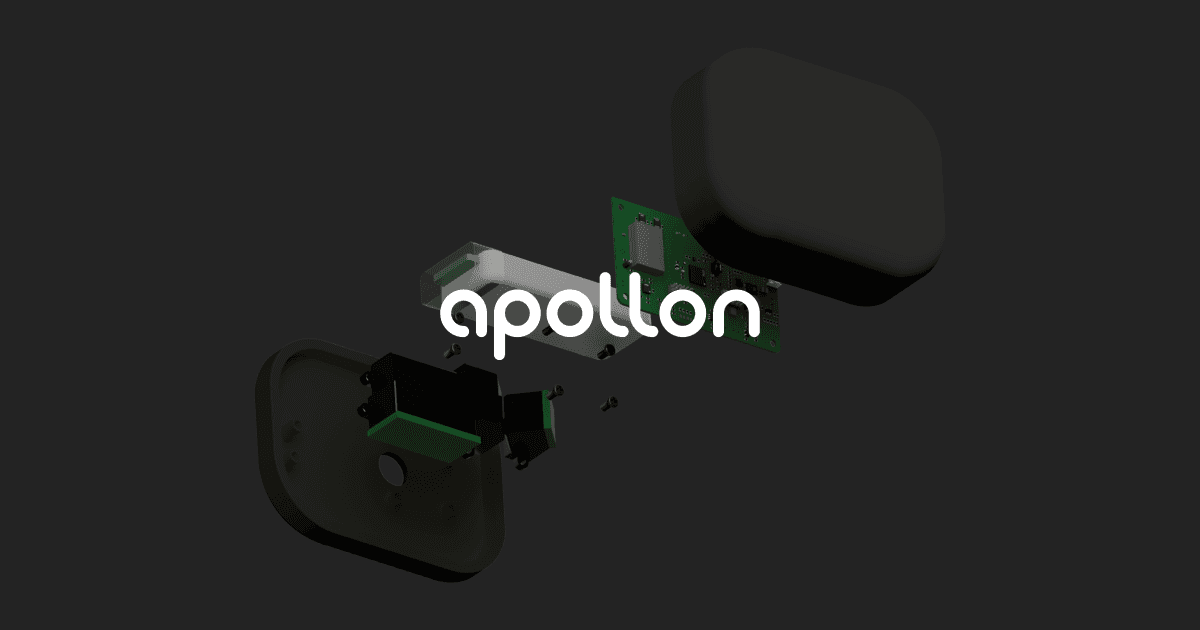
The device is called MOGLU, and its most quietly impressive spec is its dimensions: about 40 by 30 by 16 millimeters, smaller than a matchbox. This matters more than it sounds. Measuring glucose with light in a lab, on an optical bench the size of a desk, is a known quantity. Doing it inside something a person will actually wear, all day, is the entire engineering challenge. The breakthrough Apollon is chasing isn't just "read glucose with a laser." It's "read glucose with a laser using parts small enough to strap to a wrist." Shrinking is the innovation.
There is also a subtle business elegance to the no-filament design, the kind that doesn't fit on a spec sheet. The incumbent CGM model is a razor-and-blades business: cheap-ish reader, endless disposable sensors. Apollon's device has nothing to replace. That's great for the user's wallet and mildly awkward for anyone modeling recurring revenue - a needle-free monitor is also a refill-free monitor. Which is a nice problem to have, and a real one.