At Tower Transit Singapore, Stuart Thomas wanted to improve the systems behind the buses. His operation had reached a steady stage. That gave him the opportunity to ask a deceptively awkward question: could the same business run better? The answer, in his account of adopting Optibus, came partly from allowing schedulers to try again. They could adjust a plan, run another optimization, inspect the result, and repeat. A timetable became something to argue with.
- What it sells: cloud software for routes, vehicles, drivers, and daily transit operations.
- Who buys: agencies, bus operators, shuttle teams, and consultancies.
- The useful trick: compare feasible schedules before committing people and buses.
- The catch: good inputs and sensible priorities still require people who know the service.
The timetable nobody sees
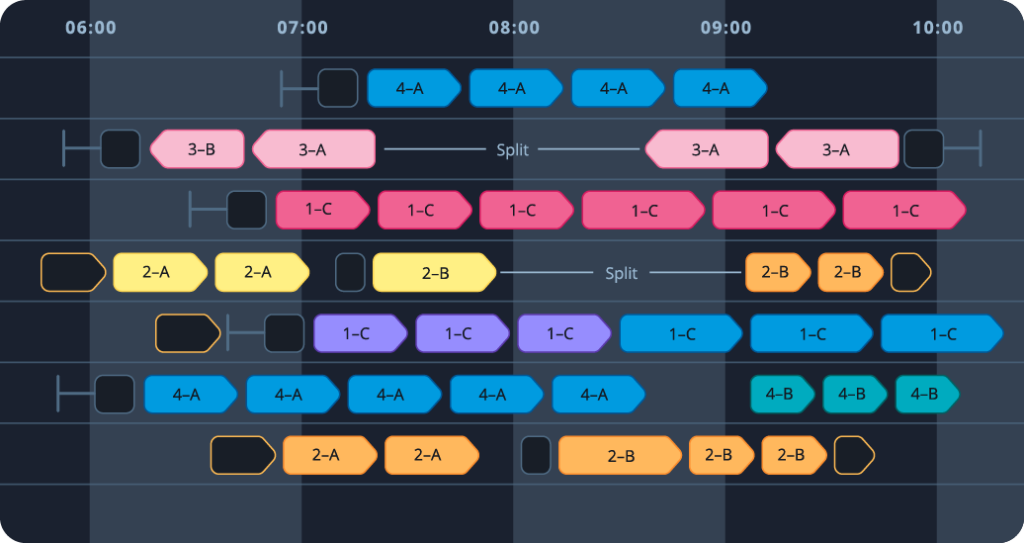
A passenger reads a departure time. Behind it sits a less legible arrangement: which vehicle does the trip, where it comes from, who drives it, when that person rests, and what happens next. Put two departures too close together and the fleet requirement may rise. Move a break carelessly and a neat vehicle plan can become an impossible crew plan. The public timetable is the small, printable surface of a much larger decision.
Optibus sells tools for making those decisions. Planning covers routes, timetables, and network analysis. Scheduling assigns vehicles and creates crew duties. Rostering organizes work across drivers. Operations handles the day’s allocations and changes. The company’s proposition is that these jobs belong in a connected cloud platform, with optimization doing the combinatorial work and staff deciding what constitutes a useful answer.
Its buyers include public authorities, private operators, and consultants. Named customers range from Stagecoach and First Group to LADOT and Marin Transit. The rider is a beneficiary rather than the procurement officer. This distinction matters: Optibus competes for an organization’s operating workflow, not for a place among the journey-planning apps on your phone.
The official origin story starts with Amos Haggiag and Eitan Yanovsky studying mathematics and computer science, then encountering the resource-allocation problems of public transport. They founded Optibus in 2014. Their subject offered an unusual combination: decisions difficult enough to interest an algorithm designer, with consequences ordinary enough to affect somebody waiting in the rain.
The second schedule is the product
Thomas, Tower Transit Singapore’s operations director, described fast optimization and accessible preferences. His team could tweak schedules repeatedly. Manual work had limited the number of runs and made the result depend heavily on what a scheduler could accomplish by hand. His account reported financial and operational savings without publishing a figure. The distinctive point was the change in working rhythm.
“Optimizations are fast and relatively simple to set up with flexible preferences.”
Stuart Thomas · Tower Transit Singapore · 2019
An implication follows: speed changes which questions get asked. If preparing an alternative takes too long, an organization may live with the first workable answer. If another version is affordable to produce, it can examine the trade-off. Would a different departure time reduce the number of buses? Would another relief point improve a duty? A faster calculation makes room for scrutiny.
That is also where buyers should resist an easy sales comparison. GIRO’s HASTUS offers optimization, integrated planning, scheduling, and operations. Trapeze’s FX with Blockbuster provides a web-based scheduling platform and uses cloud technology. Optibus’s case rests on its particular combination of workflow, usability, connected products, and optimization. “Has an algorithm” would make a rather unimpressive purchasing criterion.
A driver is more than an available hour
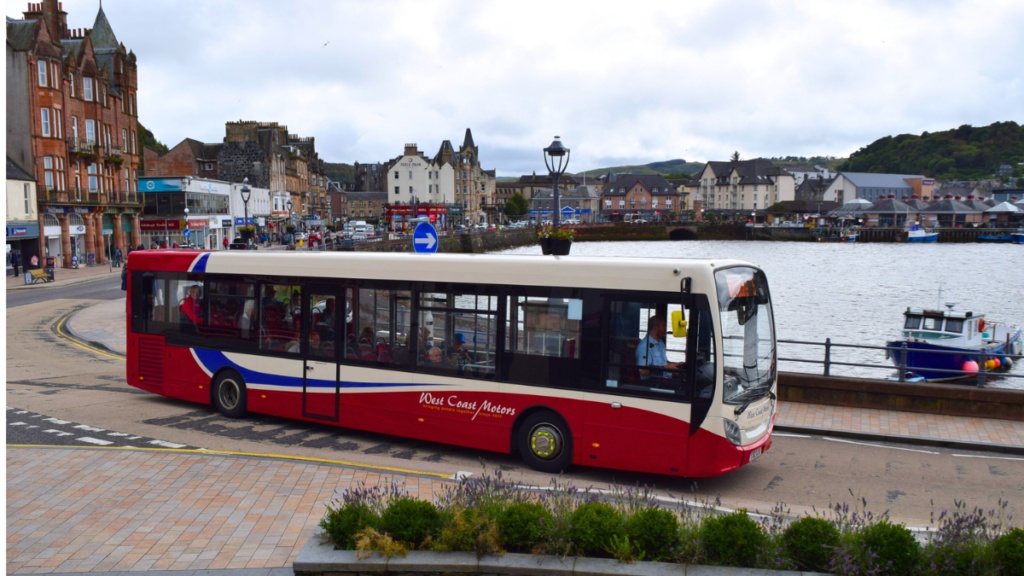
At West Coast Motors in Scotland, Paul Borthwick had seen scheduling evolve from paper bus and crew graphs. The company introduced Optibus in 2021 across an operation with about 600 staff. In its published account, Borthwick said AI powered roughly 60% of schedules and timetabling. His emphasis included driver work-life balance, preferences, relief vehicles, and break rules. A technically feasible duty still has to be a duty a human can live with.
Auto Viação Alpha, in Rio de Janeiro, offers another account of the pressure behind the screen. Its case study describes 18.2 million annual passenger trips and a 23% diesel-price increase between June and November 2023. Alpha reported containing the effect through better allocation while maintaining its contracted trips. Planner Vitória Regina Souza also described creating a scenario with less overtime and more rest.
The same account says planning a line had previously taken a month; subsequent work moved into days. These are customer reports published by the vendor, rather than an independent audit. They are useful evidence of the jobs people give the software: protect service during cost pressure, revisit weak plans sooner, and bring drivers’ needs into the calculation.
A price with the training attached
A September 2022 Valley Transit memorandum makes the purchase unusually concrete. It described manual scheduling and reliance on third parties, then recommended Optibus after a two-proposal procurement. Staff cited compliance with the required scope and a product demonstration. The proposed annual SaaS fee was $42,406 for 2022-2024, rising to $46,646 for 2025-2026. It included configuration, setup, training, integrations, and support; Optibus proposed twelve weeks of training.
September 2022 recommendation · software and implementation support included
The document tells us what was failing first: the existing process made changes and alternatives laborious. It also shows what persuaded this buyer: required functionality, a demonstration, and positive references. For another agency, the sensible imitation is a procurement method: test real duties, real data exchanges, and real constraints. A beautiful demo is less informative than a troublesome Tuesday.
The charger joins the argument
Electrification introduces another scheduling participant. A diesel vehicle and an electric vehicle cannot simply be exchanged in a plan without considering charging time, charger location, and battery reserve. Optibus’s EV scheduling tools incorporate these requirements. The operational question becomes whether a bus can complete its assigned work and recharge in time for what follows.
Volvo Group Venture Capital invested in Optibus in July 2022, linking the relationship to digitalization and electrification. The amount was undisclosed. The fit is understandable: a vehicle manufacturer’s customers need workable fleet plans, and software can help explore them. The investment does not, by itself, establish savings from any particular electric fleet.
There are physical limits. A schedule cannot conjure a charger, repair a bus, or recruit a driver. As a practical inference, inaccurate run times or missing labor constraints can make an attractive scenario misleading. Nor does a lower-cost plan automatically provide better access. The objective and constraints deserve as much attention as the optimization button.
From the depot to the phone
In April 2022, Optibus acquired Trillium, adding GTFS management, alerts, interactive maps, transit websites, and a team of 25 data experts. GTFS is the standardized service data that helps other systems understand a transit network. The acquisition extended the business toward passenger information: once a timetable changes, the usable information about it must change too.
A year earlier, its Geospatial Suite had brought geographic and demographic layers into planning. Schools, clinics, jobs, and bike paths could sit alongside routes. This gives planners context for assessing access. It is a tool for examining consequences; the choice about whose journey deserves protection remains a public decision.
The expansion was financed on venture-capital terms. A $107 million Series C in March 2021 was co-led by Bessemer Venture Partners and Insight Partners. The May 2022 Series D added $100 million, bringing announced funding to $260 million at a $1.3 billion valuation. Those are historical financing figures. The interesting operating question is how much of the service workflow the company can earn the right to handle.
Another interface, the same hard decisions
In June 2026, Optibus launched Agent inside its platform. Its July webinar recap described plain-language help with import errors, scheduling rules, finding available drivers, and drafting disruption messages. Changes require review before application. Launch capabilities were included in existing licenses; more advanced capabilities could be priced separately.
The company’s stated values include being impactful, determined, caring, and innovative. Those words acquire meaning only through the work: whether a planner can inspect a choice, whether a driver receives a workable duty, whether a passenger gets accurate information. Agent provides another way into that work. The optimization engine remains underneath.
The useful lesson travels beyond transport. Put the rules where they can be inspected. Make alternatives cheap enough to examine. Ask the people who must execute the plan what the numbers have missed. A timetable is a promise made in public. Its author ought to have the chance to draft it twice.
Take another look
Explore Optibus, watch the scheduling demo or route-planning demo, and browse the YouTube channel.
Follow LinkedIn, X, Facebook, or the engineering repositories. Read the company blog, the Agent launch announcement, and Globes’s funding coverage.