The Meditation App That Told You to Get Up and Move
Most meditation apps ask you to sit still. Open wants you breathing, moving, and - strangest of all for the category - doing it with other people.
The wellness industry has spent a decade teaching people to do less. Breathe slower. Think quieter. Sleep deeper. The billion-dollar apps that defined the category - Calm, Headspace - are essentially machines for lowering your heart rate, one soft voice at a time. Open, a Los Angeles company founded in 2018, looked at that consensus and did something almost contrarian: it told people to stand up.
Open blends four things most apps keep separate - breathwork, meditation, movement, and sound - into a single practice it calls The Open Method. You can do it alone on your phone at 6 a.m., or you can do it in a room in Venice, California, with a dozen strangers, a sauna down the hall, and a soundtrack by an artist who has been nominated for a Grammy. The company's whole thesis fits in a phrase it keeps returning to: be present, together.
That last word is the interesting one. Mindfulness, as sold by the app economy, is a fundamentally solitary product. You, your earbuds, the dark. Open's founders decided the loneliness was a bug, not a feature - and then raised $14.5 million to prove it.
01 / What it actually doesBreathe, move, meditate - in that order if you like
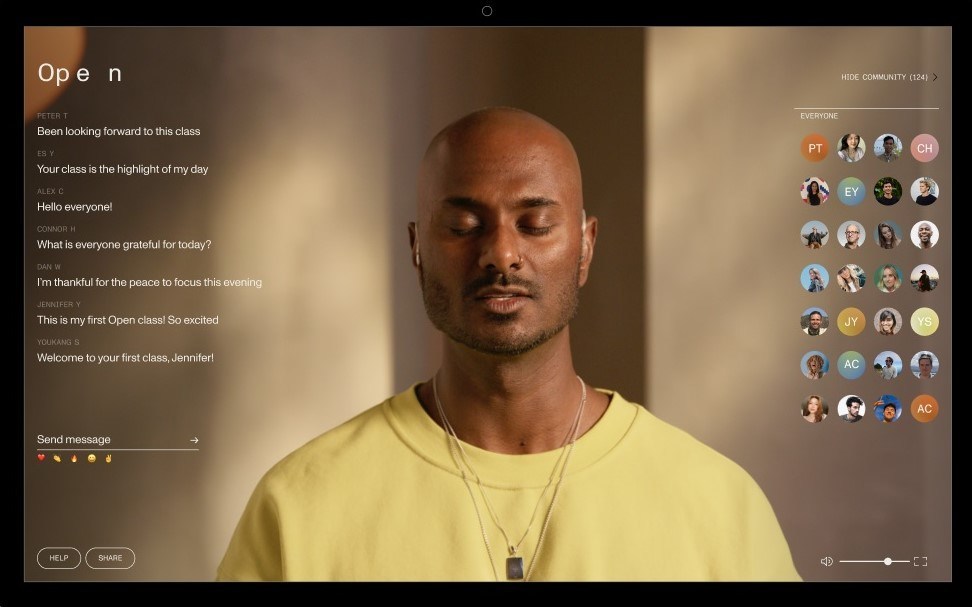
Open the app and you get three doors: Move, Meditate, Breathe. Sessions run from five minutes to an hour and refresh daily, bundled into programs with names like Nervous System Reset, Stress Cleanse, and Mental Detox. There are streaks and badges, the familiar habit-loop furniture. There is also something less familiar: the app can estimate your heart rate and heart-rate variability using nothing but your phone's camera, turning a metric usually locked inside a wearable into feedback anyone can see.
The classes were built with input from people who study neurobiology, and the framing is deliberate. Open does not sell itself only as stress relief. It sells mindfulness as training - the nervous system treated like a muscle you can strengthen, not just a fire you occasionally put out. It is a small shift in copy with a large shift in customer: the person who buys "training" feels ambitious, not anxious.
The library is also a scheduling trick. By putting a two-minute breath exercise next to a forty-minute movement flow, Open covers the whole spread of how much time a person actually has on a given day - the difference between "I don't have time to meditate" and "I have exactly two minutes." Sync with Apple Health closes the loop, and the daily refresh means the app is never quite finished, which is precisely the point for a habit product.
Breathe
Guided breathwork sessions, from a one-minute reset to longer journeys, often set to original music.
Move
Mindful movement - yoga, mobility, low-impact fitness - framed as meditation you do standing up.
Meditate
Traditional seated practice and sound immersion, organized into multi-day programs.
Together
Live and in-studio classes that make the practice communal rather than solitary.
02 / The room is the argumentWhy an app company built a building
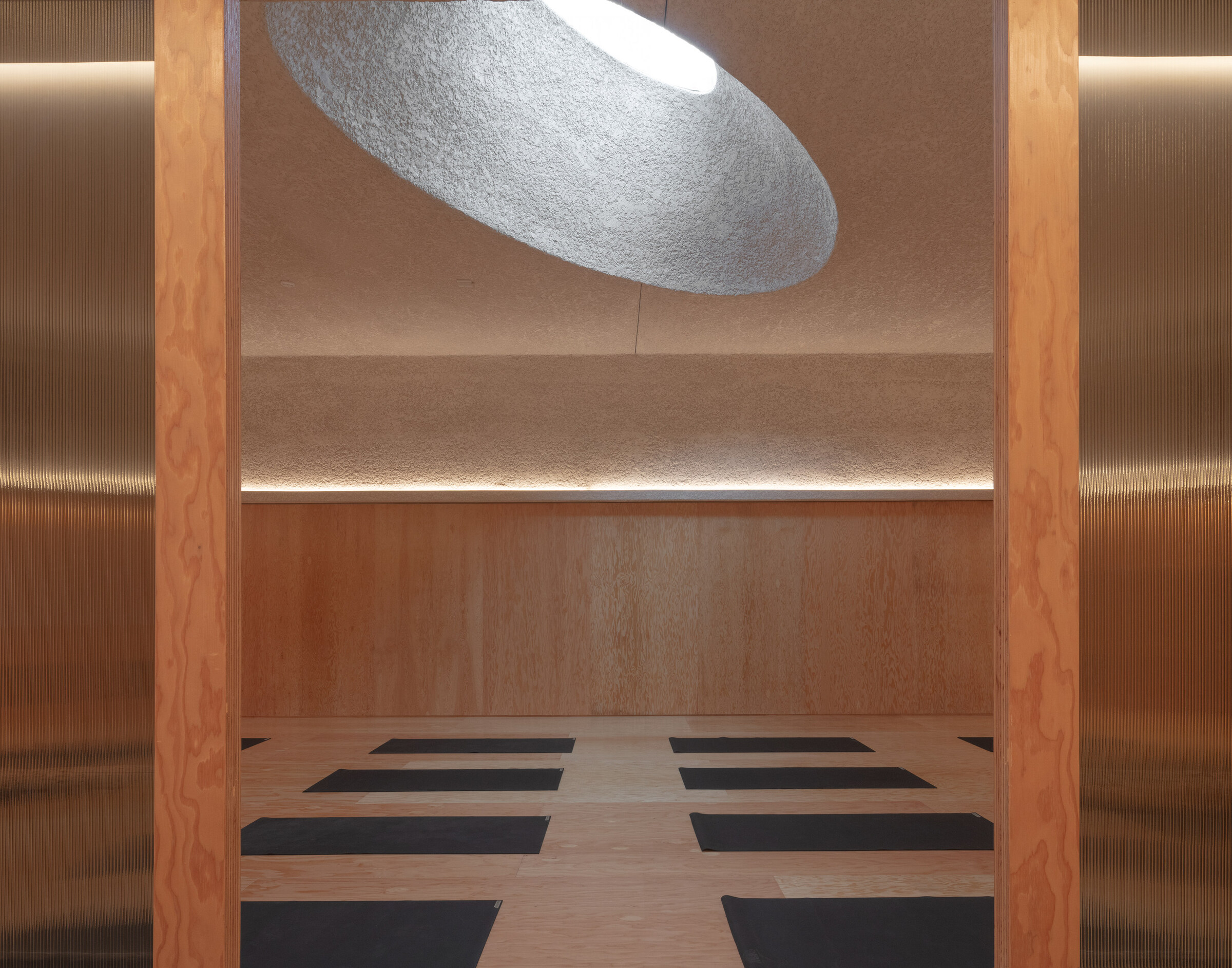
In May 2023, Open did the thing venture-backed software companies are told never to do: it opened a physical location. The flagship sits at 57 Market Street in Venice - roughly 2,400 square feet designed by the architecture studio Leong Leong with architect David Hertz, using adaptive reuse and photovoltaic power. There is an elliptical oculus skylight over the meditation room. There is a dry sauna. There is a cold plunge.
For a business measured on software margins, a studio looks like a liability - rent, staff, a ceiling on how many people fit inside. But read it differently and the studio is the demo the app can never run. It is the one place the "together" in Open's tagline stops being a slogan and becomes a room full of breathing people. The app sells the daily habit; the studio sells the peak experience and the memory that keeps you subscribed.
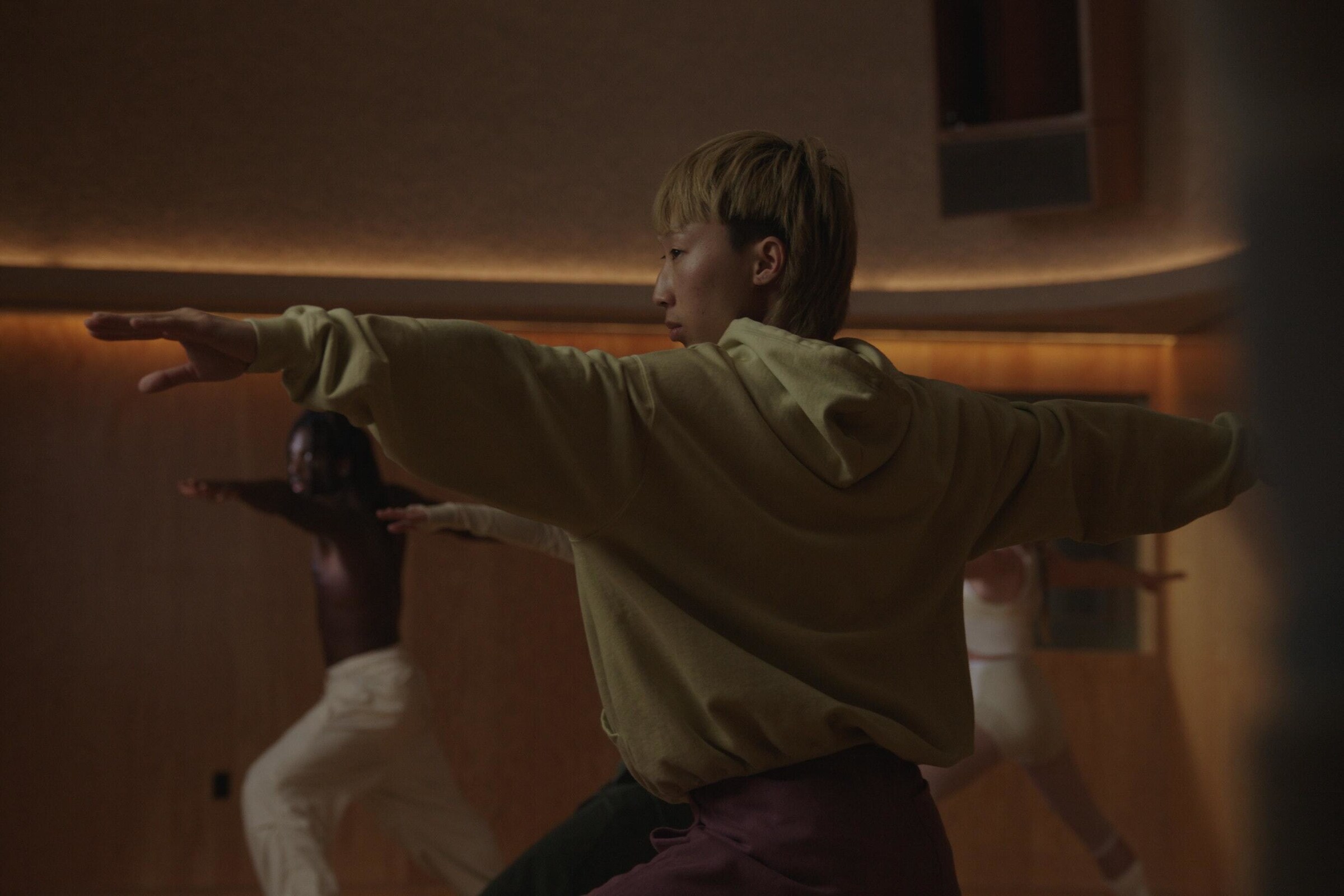
Open extended the same logic outward with Breath + Sound, its signature live class pairing guided breathwork with music. It has run as an activation at Coachella and Public Records in Brooklyn, and in New York, Melbourne, Miami, and Austin. The music is not background: the company has collaborated with recording artists including KAYTRANADA, Blood Orange, and PARTYNEXTDOOR. Breathwork, reframed as something you would actually invite friends to.
03 / The peopleA panic attack, a living room, and a long horizon
Open was co-founded by Raed Khawaja, Manoj Dias, and Peter Tseng. Khawaja, the CEO, came from a background of building consumer brands and scaling startups, and started Open the least scalable way imaginable - hosting group meditations in San Francisco that grew from a handful of people to pop-ups drawing as many as 300. The company's product is, in a sense, an attempt to bottle whatever was happening in those rooms.
Dias, who leads mindfulness, brings the credibility the category badly needs. He was a director at a financial institution until a panic attack pushed him toward Buddhist practice; he went on to co-found one of Australia's first drop-in meditation studios and to teach and write. In a field crowded with founders discovering wellness as a market, a teacher with a lineage is a differentiator you cannot fake.
Khawaja's operating philosophy runs against startup instinct. He talks about deciding on a "generational time horizon," and warns against over-optimizing - "everything in moderation, even moderation itself." For a company selling calm, refusing to sprint is arguably part of the product.
04 / The moneyWho bets on breathing
Open has raised about $14.5 million - a $5.5 million seed followed by a $9 million Series A - led by Founders Fund and A.Capital, with a supporting cast that reads like a consumer-tech who's who: Susa Ventures, Coatue, Maveron, Slow Ventures, and Aglaé Ventures, the fund tied to Bernard Arnault's luxury empire. The angels are the tell. Jack Dorsey, the Twitter and Square co-founder, and Tony Xu, DoorDash's CEO, both put money in. When operators who built famously intense companies invest in a calm startup, it is worth noting what they think is coming.
The business model behind that money is hybrid direct-to-consumer. The app runs about $19.99 a month or $149.99 a year, with a free trial and scholarship spots for people who cannot pay. The Venice studio sells memberships and class credits separately, and its classes can also be booked through ClassPass and Wellhub. Revenue is not public. What is clear is the shape: recurring software income on one side, higher-touch physical experience on the other, each feeding the other.
05 / The competitionFighting giants by not fighting them
On paper, Open competes with Calm and Headspace, plus Insight Timer, Balance, and Waking Up. In practice it has more or less refused the fight on their terms. Those apps compete on library size, personalization, and price - a race Open, at its size, would lose. Instead it competes on things that do not fit in an app comparison chart: a physical room, a soundtrack, a communal feeling, a design sensibility, and breathwork depth. The moat is a feeling you cannot screenshot.
The customer that story attracts is a particular one. Open's users skew toward people who already believe in the practice and want it to feel less clinical and more designed - the crowd that treats a cold plunge as a social occasion and a breathwork class as a Friday night. Its app has earned an Apple Editors' Choice nod and a 4.9-star rating across roughly 17,000 reviews, and by its Series A the company said it had supported more than 80,000 shared practices. Open has been notably reluctant to publish raw download and revenue numbers, which tells you it is optimizing for something other than a leaderboard.
06 / Where it fitsThe premium end of a crowded shelf
Zoom out and Open occupies a specific slot in the wellness market: the design-led, higher-price, community-forward end. Below it sit free and cheap meditation apps competing on volume; beside it sit boutique fitness brands that own the studio experience but not the daily-habit software. Open is trying to hold both at once - to be the app you open every morning and the room you visit on weekends. Very few companies in the space have credibly claimed both, which is either the opportunity or the overreach, depending on how the next few years go.
Whether that holds at scale is the open question - fittingly. Co-founder Dias has floated flagship studios in New York, London, Tokyo, and Melbourne over roughly five years. Every new room is a chance to spread the feeling and a risk of diluting it. Mindfulness is intimate; intimacy is famously hard to franchise. The company that told everyone to get up and move now has to prove it can grow without losing the room.