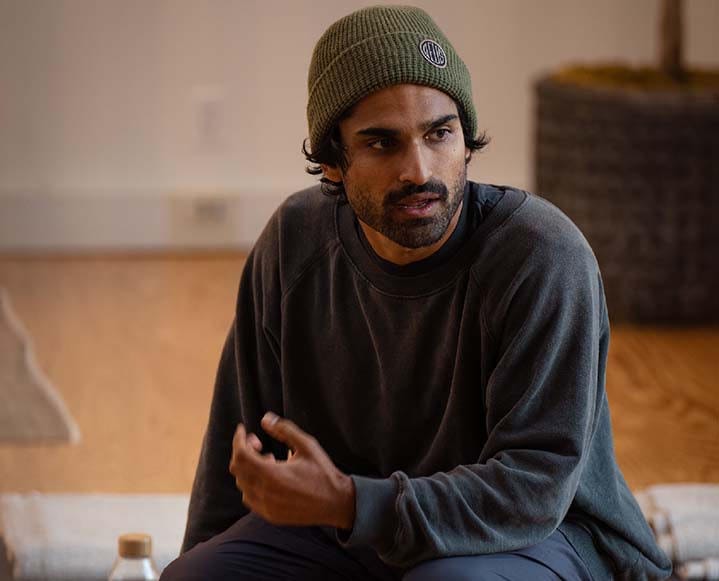
Before Open was an app, a studio, or a venture-backed company, it was a founder watching a room. In San Francisco, Raed Khawaja began hosting group meditations and studying the small moments that separated attendance from connection. Where did people hesitate? What made the experience land? What got in the way of returning? He was not looking for a grand revelation. He was collecting friction.
That instinct explains more about Khawaja than the familiar founder shorthand. He is an economics graduate who moved through banking, a global consumer company, and an early-stage startup before starting Open in 2018. The jobs look like a tour of modern commerce. His attention, however, kept drifting toward an older human problem: how to create a shared experience that leaves people more aware of being in the room.
Open eventually gathered four practices under one roof - breathwork, meditation, movement, and sound. It delivers them through software and in person at a studio in Venice, California. The hybrid shape can look obvious now. It was less obvious when Khawaja and his co-founders Peter Tseng and Manoj Dias began. Consumer software rewarded infinite distribution. Physical rooms came with rent, staffing, and a stubborn fire-code opinion about scale. Khawaja wanted both.
A practical education in attention
Khawaja grew up in a practicing Muslim family in suburban Chicago. In a 2023 conversation, he described being curious enough to visit temples, synagogues, churches, and secular spaces while still young. He was paying attention to communities built around repeated gathering: people returning to a room, sharing language and ritual, and making meaning together. He no longer practices Islam, but the early curiosity remained.
At DePaul University, he chose economics because it could straddle the liberal arts and the technical. He later studied microeconomics and econometrics at the London School of Economics. The discipline gave him two lenses he still uses: the macro view of how a system behaves and the micro view of what actually gets done.
His early career added machinery to those lenses. He began at Bank of America Merrill Lynch, followed by a run at PepsiCo that crossed customer and retail management, strategy and insights, and e-commerce. Then came Jyve, an early-stage technology company where he served as a director from 2016 to 2018. Each stop offered a different education in scale: capital, consumer behavior, distribution, and the improvisation required when a company is still becoming itself.
The leap into Open did not discard that experience. It redirected it. Khawaja had learned how brands create habits and how systems move people. Now he could ask what those tools might look like when the intended outcome was presence rather than another item in a shopping basket.
“We wanted to connect people to the feeling of presence and connection in a reliable way.”Raed Khawaja
The pop-up as product laboratory
In 2019, Open ran more than 100 in-person pop-ups across San Francisco, with groups ranging from 30 people to 300. The events were a prototype hiding in plain sight. Khawaja could see where instruction, music, pacing, and social dynamics reinforced one another. He could also see when they did not. The company was not merely assembling a content library. It was learning the choreography of collective attention.
Then 2020 arrived. The team had begun work on physical studios just as the pandemic made gathering impossible. The room disappeared, so Open concentrated on the app. This was a forced edit, but not a change of thesis. The digital product made classes portable and repeatable. It also preserved the cinematic treatment, sound, and careful pacing that made Open feel different from an audio file with a timer.
Four doors into one experience
Different access points → shared attention
The blend is central to Khawaja's idea of accessibility. Not everyone wants to sit still. Not everyone enters through the same vocabulary or tradition. Movement can be the useful first door for one person, sound for another. Open can remain secular without becoming sterile because the feeling is carried by rhythm, light, instruction, and other people.
In October 2021, the company announced $14.5 million across a $5.5 million seed and a $9 million Series A. Founders Fund and A.Capital Ventures led the investments, with Susa Ventures, Aglaé Ventures, and individual angels participating. The money gave Open room to build digital reach while returning to the physical ambition the pandemic had delayed.
An app gets an address
Open's Venice flagship opened in 2023. Designed by Leong Leong, the space takes cues from the Light and Space artists who once worked nearby. An elliptical oculus floods the main room with daylight. Textured acoustic surfaces shape the sound. Tinted mirrors catch and redirect bodies, light, and movement. A photovoltaic system sits above the poetry and quietly does its job.
For Khawaja, those details are not decorative garnish. He has said the aesthetic is a byproduct of consideration. Careful design signals that the people responsible for the experience have thought about what someone is about to enter. Trust is earned through the visible evidence of choices made well.
This is a particularly useful business insight because it avoids the false choice between beauty and function. The beauty performs a function. The sound system, daylight, materials, and spatial sequence help a participant move from the street into a different quality of attention. The studio is an interface built at architectural scale.
It also makes sense of the hybrid model. The app handles frequency. The studio handles intensity and memory. Software brings the practice to a kitchen, hotel room, or patch of floor beside a bed. Venice offers a room full of people beneath an improbable oval of California sky. One side makes the other easier to understand.
“Make decisions on a generational time horizon. Short-term thinking produces short-term results.”Raed Khawaja
The operator and the anti-guru
Khawaja's public conversations are unusually candid about the mismatch between leading a mindfulness company and feeling permanently composed. Building from scratch takes hard work. Stress appears. Balance goes missing. His version of practice is not an immaculate state sustained by the minute. It is noticing that he has spent days in his head, then returning to the tools that bring him back.
That honesty makes his “anti-guru” description feel earned. He is more interested in curation than revelation, more likely to talk about an experience being crafted than to claim he invented its ancient components. Open's work lies in arrangement: selecting practices, teachers, sound, pacing, software, and space, then making the whole thing approachable enough to repeat.
He also leaves room for play. When a creative problem becomes too tight, Khawaja likes the useful little sound of uncertainty: “Huh.” It allows the subconscious to keep working without forcing every question into immediate logic. In the same conversation, he enthusiastically interrupted himself to praise BjornQorn popcorn, briefly wondering whether its product and branding were so complete that he had once wanted to start a popcorn company. A solemn founder would have edited the detour. Khawaja made it part of the point.
His favorite reminder, borrowed from Eviatar Frankel, is simple: “Remember, it's supposed to be fun.” It does not erase ambition. It keeps ambition from eating the entire experience. Khawaja talks about purpose without insisting every purpose must resemble a venture-backed mission. Caring for family can carry meaning. So can volunteering. So can a sandwich shop whose mission can be tasted before anyone writes it on a wall.
What builders can steal
The portable lesson from Khawaja's story is observation before category. Open did not begin by arguing that the world needed another meditation app. It began by watching what helped people connect to a practice and what interrupted them. The resulting product crossed categories because the original question did.
A second lesson is that a constraint can become a design advantage. Physical space refuses the effortless scale promised by software, but it creates commitment, collective presence, and memory. The app and the studio are not awkwardly competing versions of Open. They are distinct instruments playing the same composition.
The third is Khawaja's long horizon. A generational timescale can sound theatrical in a pitch meeting. In practice, it means choosing the material, teacher, interaction, and business model that will still make sense when the novelty wears off. It means resisting the idea that every decision must flatter the current quarter.
Khawaja's aspiration is larger than a beautiful room, though the room is persuasive. He has spoken about awareness, focused attention, connection, and compassion as capacities needed for people to use technology and knowledge more wisely. Open is his practical contribution: not an answer to every question, but a place to practice meeting one another with fewer tabs open in the mind.
There is a pleasing loop in that work. The economics student who wanted to understand both the macro system and the micro action now runs a company with the same double vision. At the widest angle, Open is an argument about modern attention and collective life. Up close, it is a person stepping into a room, hearing the first sound, and deciding to stay.