A digital product has an awkward property: once you have bought it, what exactly happens next? You might use it, forget it, or recommend it to a friend. Hypermarket built a storefront around another possibility. The customer could become the next seller. A purchase could begin a chain of transactions, with rules about who receives the money along the way.
- Build a branded home for digital products.
- Let customers participate in resale and shared earnings.
- Bring the offer closer to coaches and consultants.
That makes the company interesting for anyone selling knowledge, access or digital goods. The familiar store asks how to get a customer through checkout. Hypermarket’s documented design asks what relationship survives checkout. The distinction sounds small until someone has to build it.
01 / The customer gets another job
Hypermarket describes its purpose with the line “Launch Online Stores That Customers Trust.” Based in Rochester Hills, Michigan, and founded in 2021, it occupies the busy territory between commerce software and community tools. Daniel Budzinski, its founder, had previously built Purpose Prep, an education business that became part of Edgenuity. Digital content was already familiar ground.
Its developer, WeSoftYou, documents custom storefronts, domains, resale and payout groups. Imagine, as an illustration, a creator selling a digital item with permitted resale. A subsequent buyer can become a seller; designated participants can share earnings. The attraction is a continuing commercial relationship. Whether anybody wants that second purchase remains a separate question.
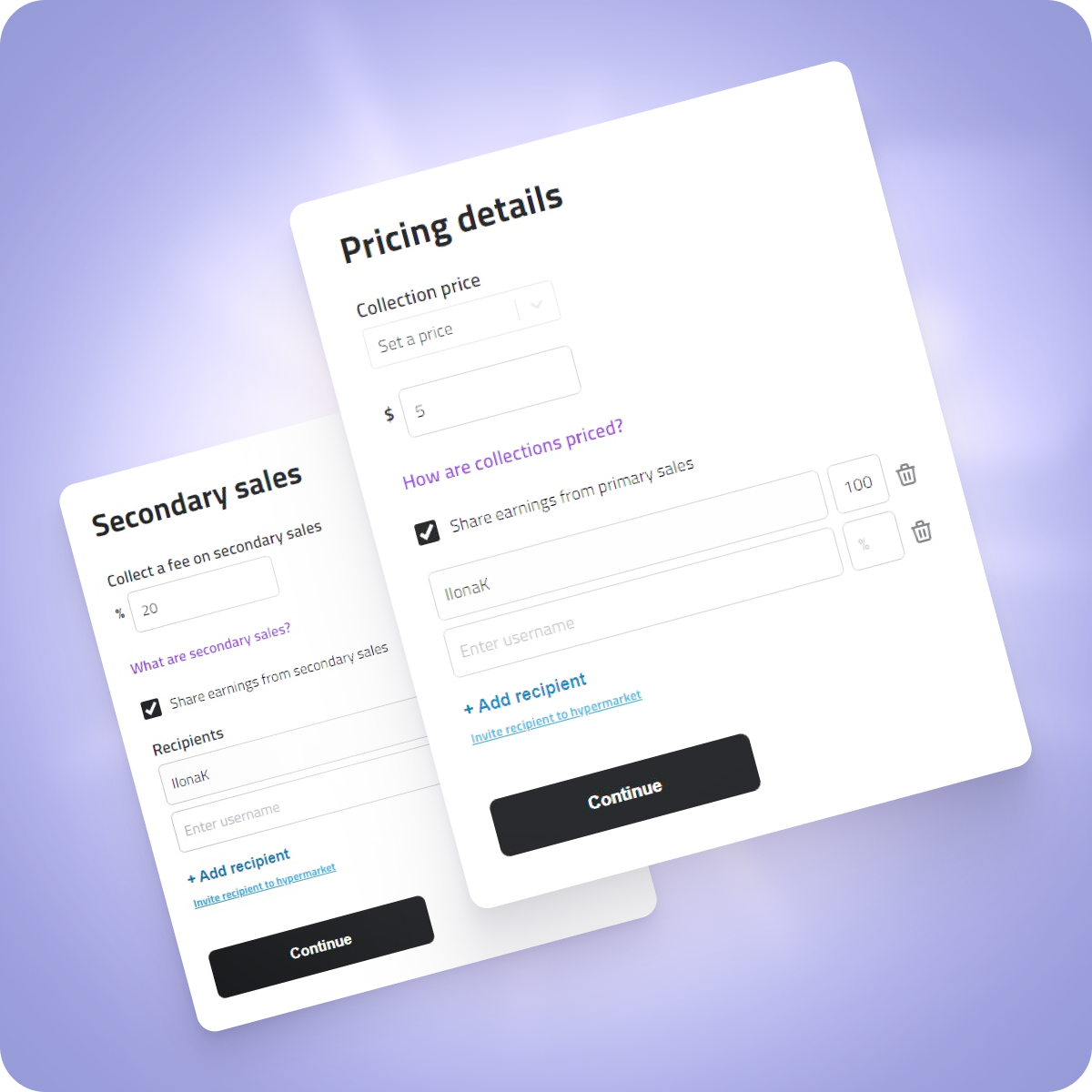
The important word is permission. A resale button cannot manufacture rights a seller does not possess. Nor can it create demand for an unwanted item. This model makes sense when transferring the product is useful, its terms permit that transfer, and another customer values it. Those conditions belong in the product decision before they become a checkout problem.
Configured payout recipients can participate in sale proceeds. Conceptual flow; no earnings or demand implied.
02 / The bill behind the button
There is a useful price tag in Hypermarket’s record. In an April 2024 Clutch review, Budzinski reported a development engagement costing $200,000 to $999,999. That wide reporting band describes work with a contractor. It gives the reader a sense of the build’s scale, rather than an exact total.
Founder-reported Clutch budget band · April 2024 review
His account also supplies the less glamorous beginning: “broad concepts rather than clear, detailed requirements.” The developers helped turn those concepts into a product as requirements evolved. An entrepreneur can copy that feedback loop, provided someone owns the decisions. An open brief becomes expensive when every participant imagines a different finished product.
The engineering challenges named by WeSoftYou included custodial wallets, smart contracts, gas fees and an adaptable payment system. These are the complications underneath the cheerful promise of quick store creation. Each additional rule about ownership or earnings becomes something the software must enforce. Convenience on the screen has an implementation cost behind it.
“broad concepts rather than clear, detailed requirements”
Daniel Budzinski, describing the starting brief in his Clutch review
For a founder considering a similar build, the practical sequence is straightforward: draw the money’s path first. Identify who pays, who receives proceeds, and what happens on another sale. Then decide which rules deserve automation. A handsome storefront is easier to approve than an ambiguous payout policy is to repair.
03 / Three prices, two kinds of sale
The historical pricing image is unusually revealing. It shows monthly plans at $4, $14 and $199, with progressively lower charges on primary and secondary sales. On the displayed $14 Professional plan, those rates are 2% and 0.5%. These are historical interface figures, not a current offer.
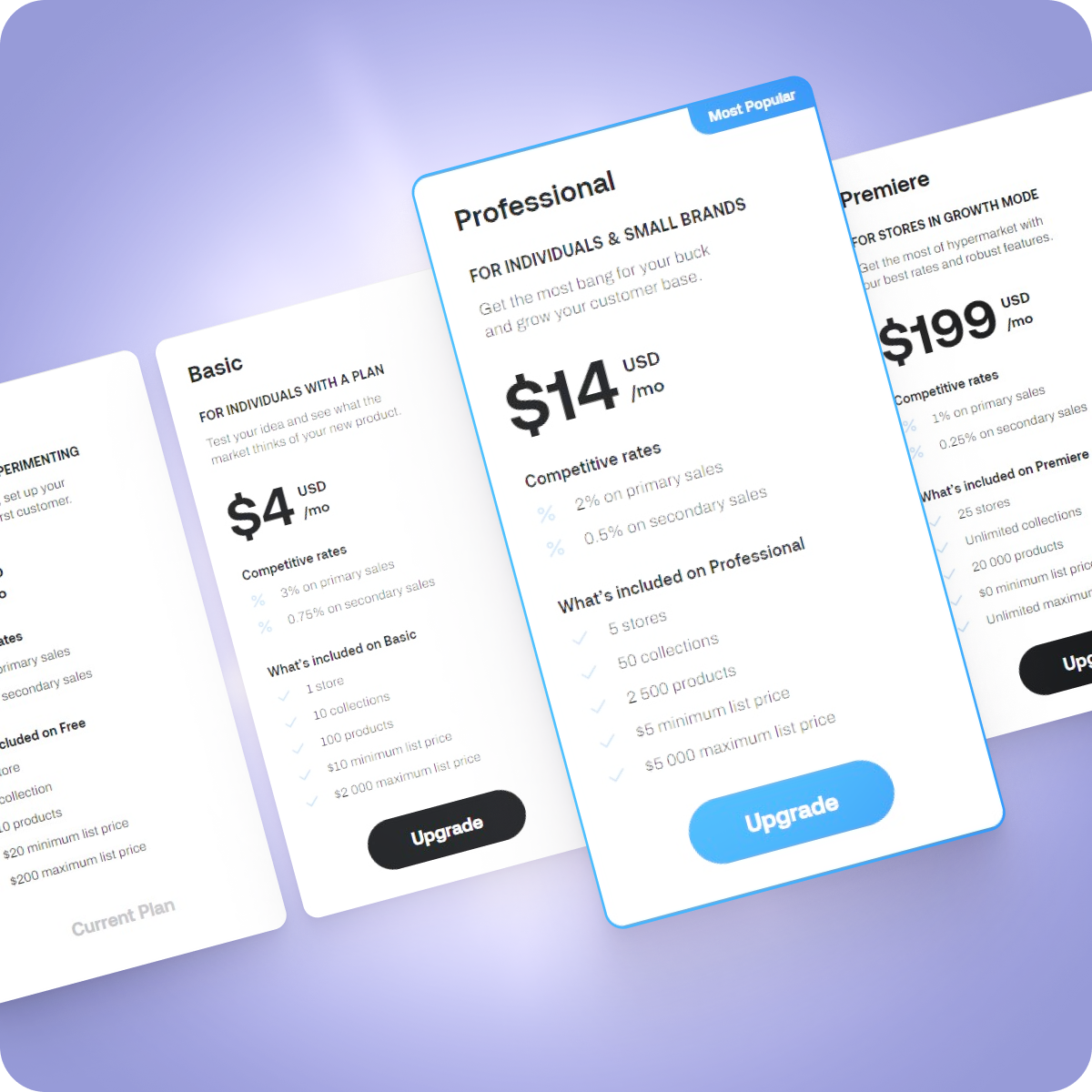
The structure explains the business model: recurring software payments plus participation in transactions. It also gives a prospective merchant something concrete to calculate. Subscription cost alone tells only part of the story. Sales volume, resale activity and the work replaced by the software determine whether a plan earns its place in the budget.
Consider a hypothetical seller making a $100 primary sale under the illustrated Professional rate. The stated platform percentage would account for $2, before any other applicable charges. That arithmetic is simple. Deciding whether the software replaces enough administration, marketing work or separate subscriptions takes more thought. The useful comparison is the cost of running the whole customer journey.
04 / A platform finds a more specific person
By December 2024, Draper Goren Blockchain’s coverage described a more focused offer. Consultants and coaches could launch courses, podcasts, communities and lead-generation pages. Purchase tracking and communication retargeting accompanied one-to-one help launching products. The report also described a funding round preceding the platform launch.

The emphasis had become easier to picture. A coach has expertise to package, prospective clients to reach and existing customers to understand. Connecting those tasks can reduce the handoffs between separate tools. Read as positioning, the change suggests a move toward a clearer customer problem. It does not establish why management changed its emphasis.
There is a difference between offering someone a blank store and helping them decide what belongs in it. The one-to-one support described in that coverage addresses the latter problem. For an expert accustomed to selling time, a course or community requires decisions about packaging, access and follow-up. A launch process can make those decisions explicit before a prospective customer encounters them.
That places Hypermarket in a consideration set spanning storefront builders, digital-download services and course or community software. Its distinctive proposition joins commerce, resale and ongoing engagement. A seller choosing among those approaches should begin with the transaction they actually need, rather than the longest feature list.
A straightforward download sold once may need very little of this machinery. An offering involving several contributors, transferable access or continuing customer contact asks more of its platform. That is the useful dividing line for buyers: complexity should follow the commercial relationship, rather than arrive merely because the software can support it.
The transferable lesson is pleasingly ordinary: give a particular person a complete route from an idea to a customer. Software can arrange the store and distribute the proceeds. The person still needs something worth buying, clear terms and a reason for the customer to return. Hypermarket’s most useful question begins there: what should happen after the sale?