A few years before he was helping creators sell things through a link in their biographies, Faisal Younus was working on a way to avoid a line. His project, Acropay, proposed letting shoppers check out from their phones at physical stores. The premise was agreeably plain: a person who wants to buy something should be allowed to get on with it.
The project appears on his public career record between November 2016 and March 2017. It makes a useful opening to the story of Pillar, the company he later co-founded with Michael Ivkov. Across those years, the setting changed from retail to gaming to the wider creator economy. The practical question remained recognizable. Once somebody is interested, how do you help that interest become an action?
Younus is now Pillar’s co-founder and CEO. The platform brings together creator stores, digital products, and tools for working with brands. Behind that description lies a more human problem: earning an audience gives a person another job. Someone still has to run the business. Applause, regrettably, does not reconcile the accounts.
An argument, then a checkout
Younus’s early public record includes a different kind of performance. At Syosset High School on Long Island, he competed in Congressional Debate. The school’s summer 2016 newsletter names him as a state champion in Student Congress and one of four seniors who placed in the top six at the National Speech and Debate Association tournament in Salt Lake City.
A debate tournament and a software company ask different things of their participants. Still, both involve getting other people to understand a proposition. A useful argument has an audience, a structure, and a reason to care. So does a useful product. That resemblance offers a way to read his trajectory, without pretending a school trophy contained a startup business plan.
At Harvard, Younus studied applied mathematics and computer science; he also identifies economics among his studies. His background includes Harvard Ventures and investing work at Lead Edge Capital. Those interests sit comfortably beside Acropay: technical questions about building a system, commercial questions about who would use it, and the simple inconvenience of waiting to pay.
In August 2020, he appeared on Founders Couch for a conversation about entering Y Combinator and taking leave from Harvard. His company had joined YC’s Summer 2019 batch. By then, the project had become a commitment large enough to shape his education. The public milestone is concrete: a student’s startup was now a company with a co-founder, an accelerator experience, and customers to pursue.
Student Congress
with Athlane
speaking about sales
The games came first
The gaming connection began as participation. In a joint interview in April 2020, Younus and Ivkov described playing Call of Duty and League of Legends during high school and college. They had noticed a gap between wanting to compete professionally and having a believable route into that world. They wanted infrastructure that could help people build careers around gaming.
That ambition gave their company, then called Athlane, a particular point of entry. It developed Terminal, a platform for sourcing, managing, and measuring esports sponsorships. The customer problem involved several parties: streamers and teams doing the work, brands paying for a relationship, and fans whose attention gave the arrangement its value.
“Esports as an industry needs to become more data-driven,” the founders said together. It is a compact explanation of the work. A sponsorship requires more than knowing that someone is popular. The parties need ways to understand the audience and assess the partnership. Otherwise, the next commercial discussion can begin with a great deal of enthusiasm and remarkably little shared information.
Athlane’s $3.3 million funding announcement in July 2020 brought backing from investors including Y Combinator, Global Founders Capital, Romulus Capital, and Seabed VC. Jonathan Kraft and Michael Gordon were also named among the investors. For Younus and Ivkov, this was a business operating at the intersection of entertainment and commerce, where a creator’s relationship with fans had to support a practical arrangement with a sponsor.
A creator needs a business desk
By August 2021, the company was known as Pillar. Its work still concerned the connection between creators and brands. One problem was the uneven distribution of information in sponsorships: creators could do the promotional work without securing access to the sales and engagement data needed to assess it. That left a weak foundation for negotiating the next deal.
Information affects the conversation. A creator who can describe what a partnership achieved has a different starting point from one who can only say that a post appeared. The distinction matters even when everybody involved means well. Clear information makes it possible to discuss the work itself, rather than substituting confidence for evidence.
“By letting creators partner with the companies and products they already love, we believe authenticity begets success.”
Faisal Younus and Michael Ivkov, 2021
There is a delicate commercial bargain in that joint statement. A creator’s appeal depends partly on the relationship with the audience. A brand deal enters that relationship. Selecting a partner therefore involves more than choosing whoever arrives with a budget. The product has to help a creator operate commercially while preserving the reasons people came to watch in the first place.
Pillar’s current offering extends to selling courses, coaching, and other digital products, alongside marketing and brand tools. A creator can use a storefront to organize offers instead of sending every interested person through a fresh explanation. The shop becomes a working part of the creator’s presence: a place where the audience can understand what is available and decide whether to buy.
That expansion gives the company’s history a coherent shape. Sponsorship software helps a creator work with a brand. Store software helps the same kind of person work directly with a customer. Each involves turning an existing relationship into an offer with terms, a next step, and a way to complete it. The paperwork has moved closer to the performance.
Back in the room at Harvard
In 2025, Younus returned to Harvard for the Business School’s Entrepreneurship Summit. The panel topic was entrepreneurial sales: finding a first paid customer and scaling a business. He joined Lou Shipley, Eric Moch, Cameron MacArthur, and Benjamin Pleat. In his account afterward, he emphasized customer acquisition and growth through repeatable processes.
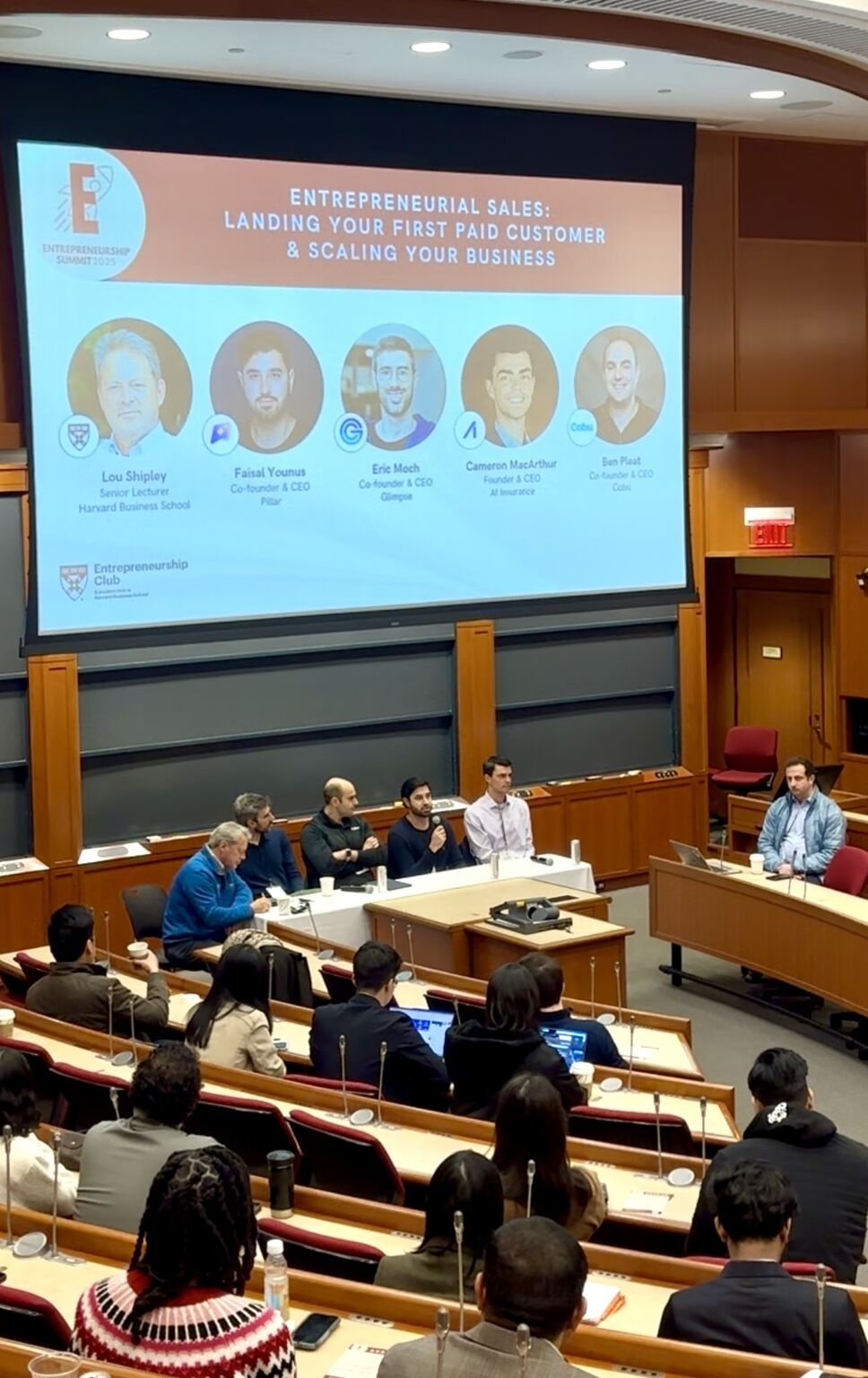
The subject fits a founder whose customers have businesses to run themselves. A process has to be useful more than once. It needs to work for the next inquiry, the next campaign, and the next person trying to understand an offer. A good first sale is encouraging; a method for serving another customer gives a company something it can organize around.
Younus has also described seeking help with Pillar’s own sales operations. A college friend who had gone through YC introduced him to Rampd. He spoke with other founders before working with the adviser to standardize the company’s first sales playbook. His account credits that work with a broader pipeline and better retention, without giving a numerical result.
There is something reassuringly ordinary about that episode. A software founder can build a product for other people’s businesses and still need advice about his own. The problem has layers. Helping someone manage a commercial relationship does not automatically arrange every relationship required to sell the helping tool. Even the people selling organization occasionally need to organize themselves.
The next click has a job
The partnerships Younus announced in 2025 bring the story down to individual moments in a customer’s day. The Interact integration lets creators put quizzes inside their stores. His explanation centered on making audience engagement more personal, rather than repeatedly sending generic messages. A question answered can make the next offer more relevant.
Think of a quiz as a conversation with a little structure. It asks the visitor to contribute information before presenting the next step. Used thoughtfully, that can help a creator understand what someone is looking for. The design challenge is to make the questions useful enough that answering them feels like progress, instead of another small bureaucratic ceremony.
The Snapchat partnership addressed a different difficulty: explaining an audience whose activity is not represented by familiar public counts. In his announcement, Younus highlighted Snapchat analytics in media kits and campaign reports, including Returning Viewer Rate. Pillar published the integration guide on June 28, 2025. The aim was to give creators, agencies, and brands more information for partnership discussions.
In July, he announced a GoFundMe integration that placed a donation portal directly on a Pillar storefront. He said it removed roughly two clicks from the donation flow. The ambition was small enough to count on two fingers and consequential enough to build a partnership around: keep a willing supporter moving toward the action they came to take.
“Every extra click costs you precious support.”
Faisal Younus, announcing the GoFundMe partnership, 2025
That observation echoes the old self-checkout project. Someone has decided to act; the software should make the route understandable. It also explains why Younus’s story can accommodate games, sponsorship data, digital stores, quizzes, and donations without becoming a collection of unrelated ventures. The recurring concern is the work between interest and completion.
He began with games he played and problems he could name. He now runs a company for people who have earned an audience and need to do something practical with it. There is still room for the performance, the personality, and the good idea. Somewhere beside them sits the business desk. Younus’s work is to make that desk easier to use.