Who They Are Now
A media brand that turned itself into a toolkit.
Walk into the Nas universe today and you will not find a man with a camera. You will find a software company. Nas Company sells the picks and shovels of the creator economy: software for running an online community, packaging a course, charging for a membership, and selling a digital product without surrendering a cut of your reputation to whoever owns the feed this year.
The face is still Nuseir Yassin, the one-minute-video maker known to roughly 60 million followers as Nas Daily. The business, though, is now Nas Academy and Nas.io - platforms used by creators who would rather be paid by their audience than rented to advertisers. It is a quieter ambition than going viral, and a far more durable one.
The Problem They Saw
You can have a million followers and own none of them.
Here is the uncomfortable truth at the center of every creator's career: the audience is not yours. It belongs to the platform. The platform decides who sees your work, changes the rules without warning, and can switch off your reach overnight. Creators build castles on rented land and then act surprised when the landlord raises rent.
Yassin learned this firsthand. Nas Daily lived and died by a Facebook algorithm that nearly buried the project twice - on Day 217 and again on Day 230, before a sudden change in Day 271 sent millions of new viewers his way. Being saved by an algorithm is a strange kind of luck. It teaches you, fast, that you never want to need it again.
The Founder's Bet
Teach the thing you did to get famous.
In 2020, Yassin made a bet that looked modest and turned out to be large: that the most valuable thing a creator owns is not their content but their knowledge of how they made it. He launched Nas Academy on the theory that the audience that watched you would happily pay to learn from you.
It was, in the politest sense, a bet against his own glamour. Going viral is exciting; teaching people to use a calendar and a course module is not. But the boring version compounds. Investors agreed - in July 2021 Nas Academy closed an $11 million Series A led by Lightspeed Venture Partners, with backing from a cast of crypto and tech operators including Balaji Srinivasan and Coinbase's Emilie Choi.
The Product
Three doors into the same idea.
Nas Academy lets a creator package what they know into on-demand or live, cohort-based courses and run a branded academy. Nas.io goes further: it is the community layer, handling memberships, digital products, and paid events so a creator can charge their people directly. Nas Daily remains the loud front of house - the media engine that proves the playbook works before selling it.
Around the software sit the human bits: Nas Summit, a gathering that drew more than 1,000 creators to Dubai, and Nas House, a physical flagship in Dubai for communities that, ironically, still want somewhere real to meet. For a company built on screens, it spends a surprising amount of effort getting people into the same room.
The Record
Measured in days, not quarters.
Nas Company keeps its own history in "days" counted from Yassin's first video - a habit that is either charming or slightly exhausting, depending on your tolerance for origin stories. Translated into the calendar the rest of us use:
The Proof
The numbers that earn the pitch.
Plenty of companies talk about empowering creators. The honest test is whether anyone shows up and pays. In its first year, Nas Academy reported recruiting roughly 100 of the world's top creators and a paying audience of about 200,000 students. The broader ecosystem - media, courses, communities, events - reaches hundreds of millions of people every month.
Nas Company, by the numbers
Approximate figures drawn from company statements and press coverage
Bars are scaled for legibility, not arithmetic - 60 million people do not fit on a phone screen.
The investor roster is its own kind of proof. Lightspeed led; the angels skewed toward people who had already built audiences and platforms of their own. When the folks who understand distribution put money behind a distribution-independence company, it is worth noticing.
The Mission
Bring people together, then let them get paid.
"Bring People Together" is a slogan soft enough to fit on a tote bag, which is exactly why it is easy to underrate. Underneath it is a hard commercial argument: communities are more valuable than audiences, because a community transacts and an audience merely watches. Nas Company's whole product line is an attempt to move creators from the second category to the first.
The competition is real - MasterClass, Teachable, Kajabi, Patreon, Circle, and Skool all want a slice of the same creator wallet. Nas Company's wager is that its media DNA, its founder's reach, and its bias toward in-person events give it a flavor of credibility the pure-software players cannot fake.
Why It Matters Tomorrow
The solo business is no longer a hobby.
The number of people trying to earn a living from an audience keeps climbing, and most of them are still building on rented land. The infrastructure to do it independently - to teach, to charge, to gather, to own - is exactly what Nas Company sells. As AI lowers the cost of making content to roughly zero, the scarce thing becomes the relationship with the people who care. That relationship is the asset Nas Company is in business to protect.
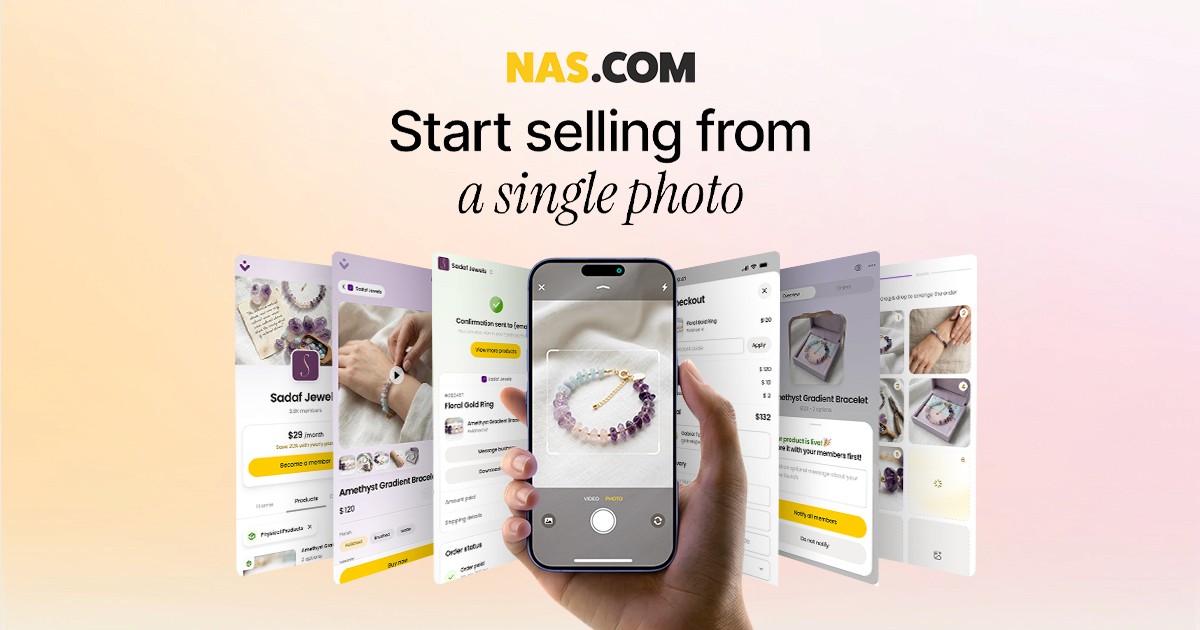
Go back to that opening frame: a phone, a photo, a checkout button. It looks like nothing. That is the point. The whole company exists to make turning attention into a livelihood look as ordinary as taking a picture - and to make sure that when a creator does it, the value lands in their account and not in someone else's feed.