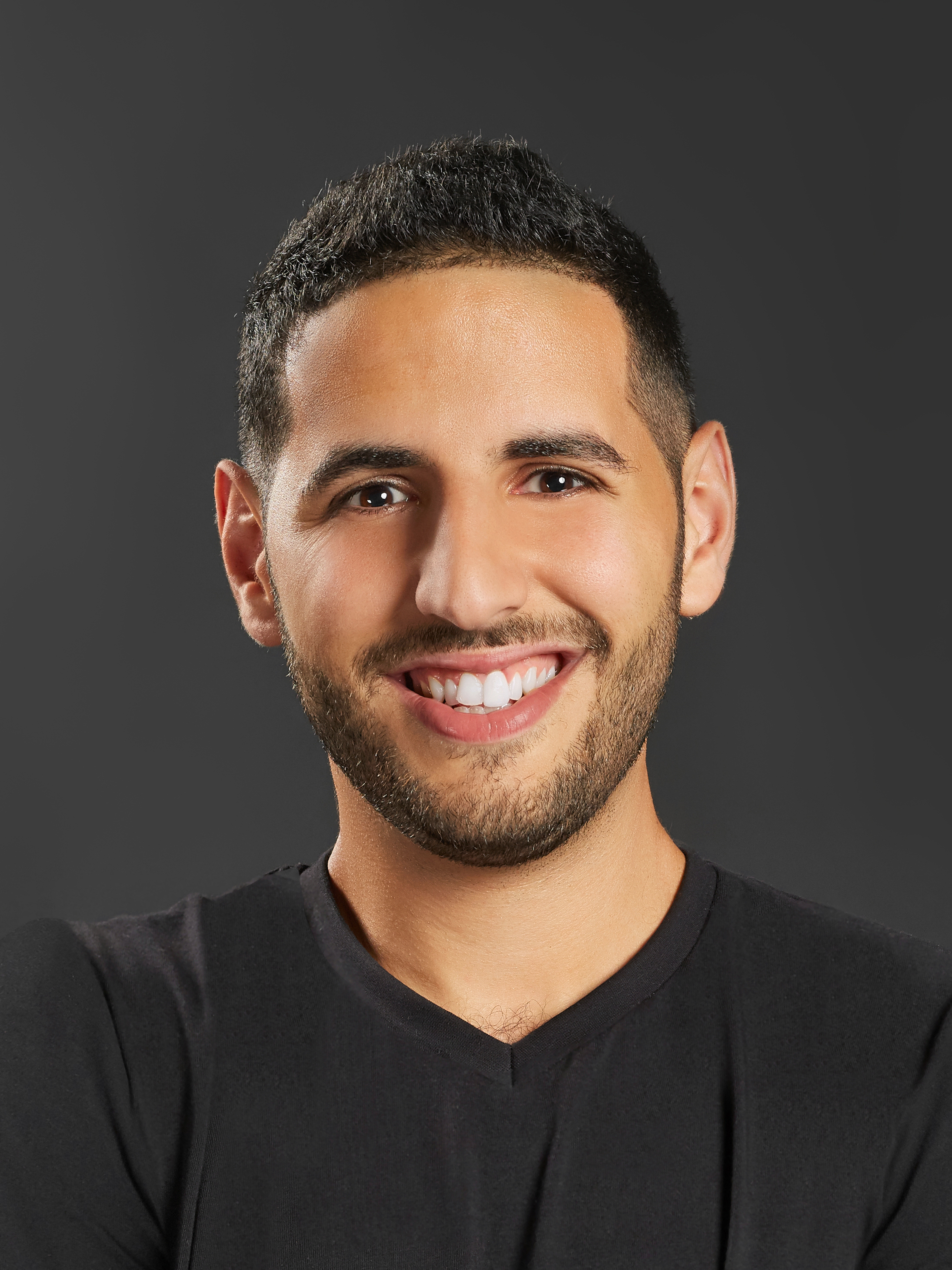
Creator · Founder · Storyteller
Nuseir Yassin
He counts his life in minutes - and gave away a thousand of them, one video at a time, until the world was watching.
He counts his life in minutes - and gave away a thousand of them, one video at a time, until the world was watching.
There is a t-shirt that tells you everything. It is plain and black, and across the chest is a single number: the percentage of his life Nuseir Yassin estimates he has already spent. He calculated it at 24, against a 76-year life expectancy, decided he was a third of the way to gone, and printed the math on his clothing so he could not look away from it. The number climbs every year. It is the closest thing he has to a business plan.
Today the number reads past 40%. In the years it has been ticking, Yassin has done something with the remainder that most people would not attempt in three lifetimes. He posted a one-minute video every single day for 1,000 consecutive days and never broke the streak. He turned that streak into Nas Company, a sprawling operation that now touches more than 300 million people a month through Nas Daily, Nas Studios, the creator school Nas Academy, the community platform Nas.io, and an AI marketing agency he calls 1000 Media.
Strip away the empire and the question underneath is small and almost rude in its simplicity: can you make a stranger care about a place, a person, or an idea in the time it takes to wait for an elevator? Yassin spent a decade proving the answer is yes - and then built companies to teach everyone else how.
My goal in life is not to be famous. It is to be impactful.- Nuseir Yassin
The premise: if the average life runs about 76 years, then a 24-year-old is already roughly a third of the way through. Yassin found that fact unbearable in the best possible way. So he wears the percentage and lets it shame him into doing something worth filming before the next sunrise.
He grew up in Arraba, a town in northern Israel, the second of four children to a teacher and a psychologist, fluent in Arabic, Hebrew, and English before he ever needed a fourth language. He wanted to be an aerospace engineer. Instead a full scholarship took him to Harvard in 2010, where he studied economics, minored in computer science, and co-founded a couple of campus experiments on the side.
After graduating in 2014 he did the sensible thing: he became a software developer at Venmo, the payments app, in New York. The salary was good. The work was fine. And the percentage on his mental t-shirt kept climbing. In 2016 he quit, picked up a camera, and decided to find out whether a single minute could hold a whole story.
The early days were not viral. He nearly quit around Day 217. Then, near Day 271, Facebook's algorithm tilted in his favor and the follower count began to compound. By 2018 he was sitting across from Mark Zuckerberg, and Nas Daily had been promoted to "show" status with millions watching. The habit had become a phenomenon.
The thousand days were also a thousand passport stamps. The format demanded travel, and travel demanded that he keep moving: a daily series cannot live in one city for long. The company itself followed the same restlessness, opening an office in Singapore before relocating its center of gravity to Dubai. He has since taken citizenship in Saint Kitts and Nevis alongside his Israeli passport - the logistics of a person whose job is to be everywhere, all the time, with a camera running.
That's 1 minute. See you tomorrow.- the sign-off that ended every video
When the daily videos stopped in 2019, most people expected Yassin to ride the audience for as long as it lasted. Instead he treated Nas Daily as a prototype and started building the factory around it. Each new venture answered a question the last one raised: who makes the videos, who teaches the makers, who owns the audience, and who automates the work.
The original one-minute video channel and the brand that started it all. A thousand consecutive days became a permanent media voice followed by tens of millions.
The production engine behind the content - a studio built to make short-form storytelling repeatable rather than lucky.
A school that teaches creators the craft Yassin learned the hard way. It raised about $12M in 2021 as the creator economy went mainstream.
A platform letting creators own and monetize their communities directly, instead of renting attention from social platforms that can change the rules overnight.
An AI-driven digital marketing agency - Yassin's bet that the next thousand days of content get made faster, with machines doing the heavy lifting.
The umbrella tying it together, an ecosystem that now reaches north of 300 million people every month from offices that have run from Singapore to Dubai.
The constraint was the whole idea. A minute is long enough to land a single thought and short enough that nobody resents the cost of watching. Yassin treated other people's attention the way an accountant treats other people's money: as a thing he had no right to waste. Every video opened fast, made one point, and ended on the same four words. There was no padding because there was no room for it.
That discipline is harder than it looks. A thousand days means a thousand stories worth telling, found in airports and street markets and the homes of strangers across dozens of countries. It means filming when you are sick, when you are lost, when the footage is bad and the deadline is tonight anyway. The streak was the product. The lesson he kept repeating - to anyone who would listen and, later, to paying students at Nas Academy - was that consistency beats inspiration, and that the discipline of showing up daily compounds in ways a single viral hit never can.
In 2019 he packaged the philosophy into a memoir, "Around the World in 60 Seconds," part travelogue, part manual for anyone who suspects their life is too short to spend it waiting for permission. By then the format had outgrown one person. The natural next move was not to make more videos himself, but to build the institutions that would help millions of other people make theirs.
Life is short. I keep the number on my shirt so I never forget it.- on the t-shirt that became a trademark
Economics degree, computer science minor, then a software developer role in New York.
One minute. Every day. The streak begins.
Nas Daily is upgraded to Facebook "show" status as the audience explodes.
The streak ends on his terms. He publishes "Around the World in 60 Seconds" and launches the YouTube channel.
He stops making videos and starts building the machines that make them.
Nas Academy attracts serious capital; total raised passes $23M.
A platform built so creators can own their audiences outright.
He launches an AI marketing agency and accepts an honorary doctorate from Ben-Gurion University.
A career built on the open internet collects collaborators the way a magnet collects iron filings. Early on, the most consequential meeting was with Mark Zuckerberg in 2018 - the moment Facebook formally embraced Nas Daily as a "show" and the audience leapt into the millions. The platform that hosted the experiment had decided to bet on it.
On screen and off, he worked alongside Alyne Tamir, a fellow video-maker whose own channel grew within the same orbit. Inside the company, operators stepped in to scale what one person had started: a COO joined to run the Nas Daily business, and another came aboard to lead Nas.io and Nas Academy as those products grew into platforms of their own.
Yassin has also leaned into the role of public speaker, taking the stage at conferences to deliver what amounts to a field guide for building fast in the age of short video and, increasingly, AI. In May 2025, Ben-Gurion University awarded him an honorary doctorate, recognizing his advocacy for coexistence between Arab and Jewish citizens of Israel - a public dimension to a career most people know only through a phone screen.
That's 1 minute. See you tomorrow.- four words, tens of millions of times
My goal in life is not to be famous. It is to be impactful.
That's 1 minute. See you tomorrow.
Life is short. I keep the number on my shirt so I never forget it.
Trilingual since childhood - Arabic, Hebrew, and English.
Vegetarian.
Has run his life and his company out of New York, Singapore, and Dubai.
Originally wanted to be an aerospace engineer before economics and the internet intervened.
Nearly quit the daily-video project around Day 217 - weeks before it took off.
His sign-off, "That's 1 minute, see you tomorrow," is recognizable to tens of millions.