João Pedro Resende had written something he thought people might buy. Then came the awkward part: letting them buy it. His ebook concerned digital marketing for gaming communities, a subject he had learned by doing. Getting the file into a customer's hands required a collection of disconnected tools. The author had acquired an unwanted second job as the person holding the machinery together.
There is a pleasing circularity to what followed. Resende and his college friend Mateus Bicalho founded Hotmart in Belo Horizonte in 2011 to make selling digital products easier. In 2025, Resende published another book, this time a fantasy novel. Between those two publications, the frustrated seller became the chief executive of a company built around other people's expertise. Then he put himself back on the customer side of the counter.
He writes fiction as J. P. Resende. At Hotmart, he is usually JP. The initials travel neatly between conference stages and imaginary kingdoms. His career keeps returning to a fairly ordinary predicament: you have made something, you would like someone else to experience it, and there is a surprising amount of administration in the way.
The first world he wanted to build
Before there were customers, there were games. Resende grew up making his own board games, inventing role-playing stories and working out strategies for online competitions. Computer science at PUC Minas offered the prospect of being able to construct things himself. It also supplied a consequential introduction: Bicalho was a fellow student.
Their first business together, MobWorks, developed mobile applications. It began in 2004 and closed roughly two years later. A good partnership had not automatically produced a viable company. The pair went into separate jobs while remaining in contact. Resende worked his way into project management, adding an education in processes to his technical training. He also earned an MBA at Fundação Getulio Vargas.
The gaming communities remained useful classrooms. Resende studied search-engine optimization, marketing and online sales, and shared what he learned. The ebook emerged from that practical experience. Games had brought him toward programming; keeping a community going had pushed him toward finding an audience. His own attempt to sell knowledge exposed the next problem to solve.
It is tempting to tidy this into a sequence of inevitable discoveries. There was considerably more waiting involved. The idea that became Hotmart preceded the company. By 2010, he and Bicalho were returning to it. An abandoned business had left them with enough confidence in each other to try again, and enough experience to know that enthusiasm would need assistance.
A company for the part after “I've made it”
Hotmart joined together people with something to teach, affiliates who could help sell it, and buyers. A teacher could create a course or ebook; an affiliate could introduce it to an audience and receive a commission. Payments and delivery could happen through the platform. The practical appeal was easy to grasp, especially for someone whose alternative was managing the separate pieces alone.
That arrangement also gave Resende a particular view of entrepreneurship. The starting material could be knowledge someone already possessed. A person did not have to invent an entirely new interest before trying to build a business around it. The work was to package that knowledge, find interested people and deliver something they considered worth paying for.
His public advice has consistently returned to these mechanics. In 2018, he was discussing the value of offering more than one product, learning how to attract an audience and meeting other entrepreneurs. Alongside the ambition sat the maintenance: keep improving what customers receive, think beyond the immediate sale, and expect problems that require fixing. A business built from a passion still has to be run.
The unfamiliar country problem
Going abroad presented a different kind of obstacle. Resende and Bicalho wanted to expand, but lacked experience operating outside Brazil. Investor Kees Koolen, the former Booking.com chief executive, asked why Hotmart was not already global. When the founders explained their hesitation, he offered to help. The conversation gave them access to someone who had done the unfamiliar thing before.
Expansion would involve local relationships, different languages and different payment habits. These are modest-sounding details until a buyer cannot pay. They also explain why a digital product can travel instantly while the business behind it takes longer. Resende's company had to build the commercial arrangements around the file, as well as a means of sending the file itself.
On June 29, 2018, both founders joined Endeavor's entrepreneur network. In 2020, Hotmart combined with the New York-based course platform Teachable. The following March, it announced a $130 million Series C led by TCV, with Alkeon Capital also participating. The announcement said Hotmart had already attained unicorn status; it did not disclose a new valuation. The money was intended for product development, international growth and acquisitions.
Hotmart's Series C, announced in March 2021 and led by TCV.
The distance between an ebook seller's inconvenience and an international funding round is substantial. It also changes the chief executive's job. In 2022, Resende was publicly announcing the departure of 227 colleagues, approximately 12 percent of the team. He accepted responsibility for a mismatch between the company's internal expansion and the growth it had expected. That episode belongs in the career alongside the financing. Building a company includes decisions whose consequences cannot be represented by a celebratory milestone.
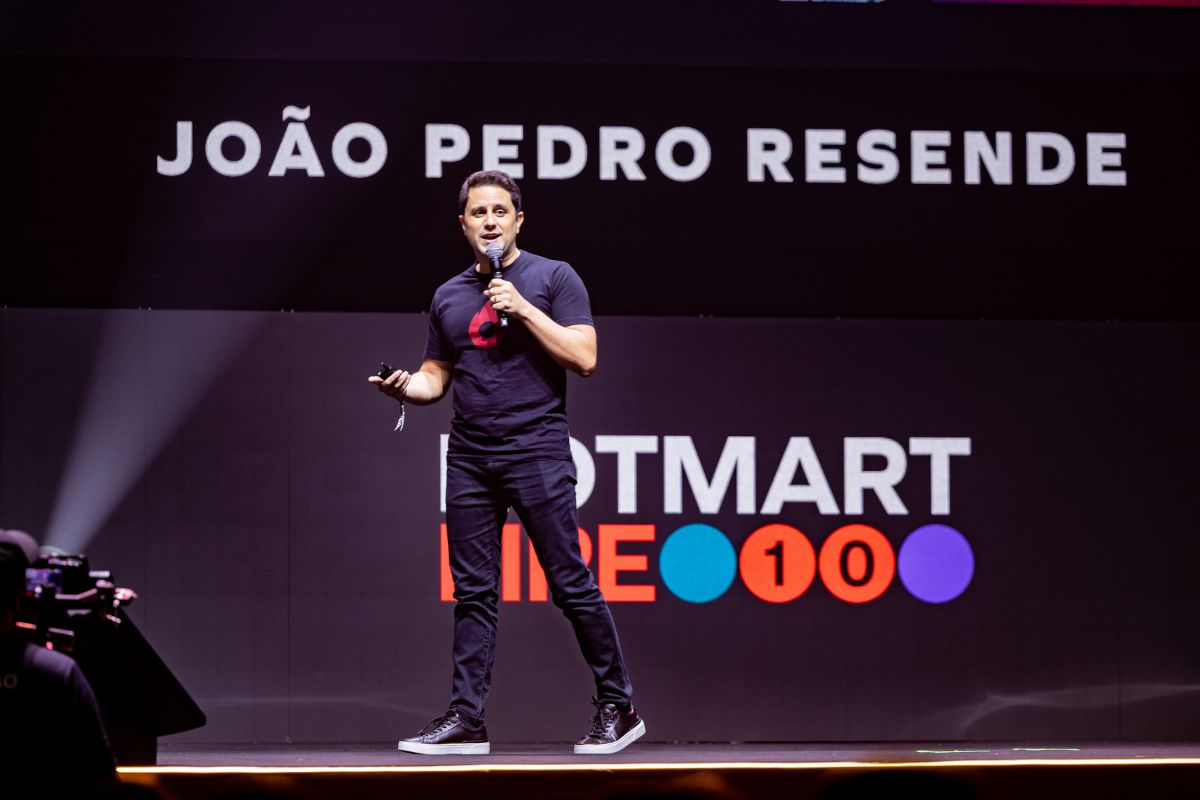
And then the CEO published a kingdom
The book that arrived in 2025 was called Entre Ruínas e Reinos: A Torre Quebrada. Its territory was Tenuria, where established power has vanished and a vacuum awaits its successors. An apprentice alchemist, a royal family in crisis and unlikely heroes occupy the story. The current paperback listing runs to 601 pages. His interest in imaginary worlds had acquired a considerable paper footprint.
Resende published independently. A year later, he described what that had actually involved: beta readers, proofreading, layout, design and illustrations, with friends and professionals contributing along the way. He acknowledged mistakes in the early edition, including proofreading and layout errors. Readers also wanted larger maps and a glossary, particularly when reading on Kindle. He made those available in the book's online community.
The language he used for the experience was recognizably that of a software founder. The first edition was an “MVP,” followed by improvements. Keeping the rights meant he could make changes himself. That is a wonderfully practical approach to a fantasy kingdom: when the geography is difficult to follow, release a better map.
“Como eu tenho controle total dos direitos, posso mexer à vontade, quando eu quiser, como quiser.”
J. P. Resende, on independent publishing, August 2026
The attraction is control over the work. His account of publishing makes room for the messy production details that a finished object conceals. Even someone running a platform for creators can be a beginner in a new medium. The public correction of an imperfect first edition gives the novel a useful place in his story: it shows him doing the iterative work he recommends to others.

The workshop outside the company
His personal workshop, Artifactory, gathers fiction and software in the same place. It includes Journal, the publishing platform that powers his blog and newsletter. It also presents Grimório, a fiction-writing editor developed from his experience of writing a book, and Sumo, an AI-generated personal newspaper assembled from saved reading and videos. Grimório is described as being in private alpha; Sumo is in private beta.
The novel has its own reader community, with discussion, maps, a glossary and places to share fan art. A second volume is being written. These projects make his outside interests unusually visible: the software builder keeps finding reasons to write, and the writer keeps finding reasons to build software. Neither activity appears to have persuaded the other to retire.
The old problem, with a new set of tools
At Hotmart Fire in September 2026, Resende's attention was on letting more people make software. Launchpad, introduced in open beta, allows users to describe applications they want to build. Hotmart's proposition is that the result comes with access to its existing commercial infrastructure, including payments, hosting and authentication. In his September 17 account of the launch, Resende reported thousands of projects in the first week.
There is a familiar concern underneath the new technology. Generating code leaves other jobs to be done before a product can be sold. The customer still needs a way to publish it, charge for it and give the right people access. His original ebook problem has returned wearing a different outfit, and with considerably more computing power.
By October, he was describing social platforms as “networks of interest,” shaped by what algorithms think people want to see. His advice to creators followed from that view: develop products of their own, test what audiences respond to and keep producing consistently. The aspiration is to help someone move from an idea to an operating business with fewer separate technical tasks.
The same career now contains a closed mobile-app company, an international platform, a fantasy kingdom and a workshop full of unfinished possibilities. Resende still has the novelist's second volume ahead of him. Somewhere between publishing a book and improving its maps, he has kept an occupation familiar to anyone who has tried to make something: finding the next thing that needs fixing.
Follow the projects and conversations
Explore Resende's journal, Artifactory, the novel and Hotmart.