At Christmas in 2015, João Pedro Resende received a book containing a story he already knew. His father had told him the tale of a little turtle throughout his early childhood. With help from Resende’s mother, his father had finally put it on paper. The gift came with no business plan, investor presentation or promise of a larger market. It carried something more durable: a family’s way of passing an idea from one generation to the next.
Resende made a promise of his own. When he had children, he would do the same. He later wrote four little books for his three daughters. Meanwhile, another manuscript was growing. Earlier that year he had begun a fantasy adventure inspired by his old role-playing days. Ten years would pass before readers could buy it. A global technology company turns out to be quite an effective distraction from finishing a chapter.
Today, Resende leads Hotmart, the company he cofounded with Mateus Bicalho in Belo Horizonte. He also publishes under the name J. P. Resende. Put those two occupations together and a recurring problem comes into view: how does something imagined become something another person can actually use? His answers have included a checkout, a classroom, a reader community and a kingdom called Tenuria.
Before the marketplace, there was a game
Resende grew up in Ouro Branco, Minas Gerais, drawn to stories and RPGs. He made his own board games, improvised adventures and worked out strategies for online competitions. These were early opportunities to invent rules, then discover what happened when other people entered the system. A game designer can arrange the board; the players retain the privilege of ruining the plan.
He moved to Belo Horizonte to study computer science at PUC Minas. There he met Bicalho, who became a friend and business partner. Resende also earned an MBA at Fundação Getulio Vargas. The two started a mobile-app business in 2004, called MobWorks. It closed after roughly two and a half years. A degree gave them tools. It supplied no exemption from the ordinary difficulties of getting customers and keeping a business alive.
Afterward, both took jobs in technology. Resende became a project manager and studied digital marketing. The partnership survived the company. They remained in contact, and their experiments included importing nerdy T-shirts from China. The imagination was still active; the commercial formula was still being worked out.
A good idea still needs somewhere to go
A turning point came when Resende tried to sell an ebook about internet traffic. Writing the material was only one task. Getting it sold meant dealing with the surrounding tools and processes. He could see gaps in the experience, but initially lacked the resources to fill them. He returned to the idea with Bicalho in 2010. Hotmart was founded in 2011.
The product brought creators, affiliates and buyers together. A creator supplied knowledge in a sellable form. An affiliate could help introduce that product to an audience and earn a commission. Hotmart provided the machinery around the transaction. For a teacher or author, that machinery matters: time spent assembling payment and delivery systems is time unavailable for the thing people came to learn.
Resende’s early failures also left less photogenic memories. In one account of the period after his first company closed, he recalled receiving a cheque that bounced. The amount was small, but he had nothing in the bank. That detail puts useful weight behind the word “entrepreneur.” An unpaid bill can occupy more of a founder’s attention than a distant opportunity.
Twenty-two square metres, two companies
Early Hotmart shared a 22-square-metre office in São Pedro with Rock Content. An imaginary line divided the room. Rent was easier to bear, and the neighbours could compare problems and trade ideas. Resende connects that period with the emergence of San Pedro Valley, Belo Horizonte’s startup community. The name had more available territory than the actual office.
He describes the second attempt as frightening. A job had given him stability; trying again meant risking his savings. Keeping his standard of living modest made starting over feel possible. His approach to risk was grounded in a plain question about what failure would actually cost him. Courage, in this telling, involved arithmetic.
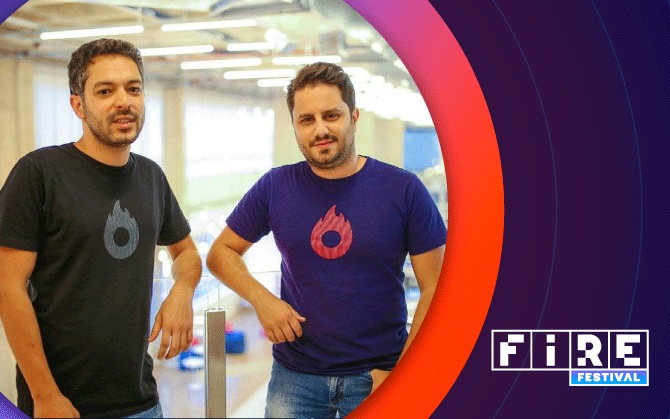
By 2015, the company was convening people beyond the office. Its first FIRE event brought together figures from businesses including Galinha Pintadinha, Uber, Xiaomi and Spotify, alongside digital marketers. It offered a physical gathering place for people whose work happened online. The little room’s exchange of ideas had acquired a programme and an audience.
The distance between Belo Horizonte and the world
International expansion introduced a different constraint: experience. The founders could build the product, but overseas markets were unfamiliar. Kees Koolen, the former Booking.com CEO, became an important connection. He asked why Hotmart was not already global and offered help. On June 29, 2018, Resende and Bicalho joined the Endeavor entrepreneur network, adding another route to advice and relationships beyond their own company.
Hotmart completed its Teachable acquisition in 2020. In March 2021, it announced a $130 million Series C led by TCV, with Alkeon participating. The company said it had already reached unicorn status; the round’s valuation was undisclosed. The money was intended for product development and international expansion. These are company milestones, rather than a measure of Resende’s personal wealth.
For Resende, opening abroad also meant getting closer to users. He described overseas offices as places to build community and understand customer difficulties. That is a more demanding task than changing the language on a checkout. Buyers, teachers and sellers bring local habits with them. The company’s headquarters moved to the Netherlands; Resende’s own base remains Belo Horizonte.
Hotmart’s current press room reports more than 250,000 active digital producers and sales in over 188 countries. Those figures describe the reach of a platform. Behind them sit individual people trying to persuade someone to buy something they made. Resende’s original selling problem has become a daily operating problem at a much larger scale.
Growth has an uncomfortable vocabulary
In October 2022, Resende announced that Hotmart was parting with 227 employees, about 12 percent of its team. His message said expected growth and the expansion of the internal operation had moved at different speeds. Efficiency had fallen. He accepted responsibility and described a restructuring that would discontinue some work and narrow other projects.
The sentence that stands out is brief: “Eu assumo total responsabilidade por isso.” In English: “I take full responsibility for that.” It deserves space in a profile that also includes funding rounds and expansion. The people building a company experience its decisions in ways that a financial milestone cannot convey.
His ideas about education have a similarly practical emphasis. He argues for learning that accommodates different speeds, reduces geographical barriers and lets teachers and students build knowledge together. He also sees value in combining the useful parts of online and in-person teaching. A platform can make a lesson available; the design of the learning experience still needs attention.
In his advice to entrepreneurs, Resende starts with nearby problems and the possibility of solving them. He allows for businesses built to provide extra income as well as those aiming for wider impact. That distinction gives the people using Hotmart some room to define success for themselves. A creator does not need to adopt the ambitions of the company processing the payment.
“Eu assumo total responsabilidade por isso.”
João Pedro Resende, on the 2022 restructuring
“I take full responsibility for that.”
The kingdom took ten years
Resende’s fantasy manuscript began in 2015 and repeatedly stalled. Time was short. Inspiration sometimes followed it out of the room. He wrote during holidays, and occasionally outside them, while the story continued taking shape in his head. The obstacle was familiar to anyone with a project saved in a folder whose name contains the word “final.”
In 2025, he independently published Entre Ruínas e Reinos: A Torre Quebrada. The first volume runs to 601 pages. Its setting, Tenuria, contains political conflict, mysteries and an apprentice alchemist pushed into a consequential journey. Resende wanted an adventure readers would enjoy, with room for reflection. The computer-science graduate had returned to the territory of his childhood games, this time without requiring everyone to find a free evening for a campaign.
Publishing brought another set of operational choices. He used Hotmart with UICLAP for the book’s production and delivery. Independence gave him control, but also the job of arranging and paying for literary services. Friends and professionals helped with beta reading, revision, layout, design and illustration. The acknowledgements record a collaborative effort beneath a single name on the cover.
Readers then asked for larger maps and a glossary, particularly useful on Kindle. He added both to the book’s online community. The request is wonderfully specific. After a decade constructing a fictional world, an author may discover that the next important improvement is simply helping people find their way around it.
Another idea gets a door
Resende’s personal workshop, Artifactory, now holds more than fiction. Its projects include Journal, a publishing platform, and Grimório, a writing editor being tested privately. The book’s community offers discussions, reading groups and fan art. A second volume is underway. His public projects make it possible to follow the work beyond the CEO title.
At FIRE 2026, Hotmart introduced Launchpad, a tool for creating and publishing small software products through natural-language requests. In a September 17 post, Resende described it as an open beta with integrated infrastructure, including authentication, file storage and payments. He also introduced an MCP connection for discussing business data and requesting actions through AI assistants. These were concrete product announcements, with further development still ahead.
The attraction is easy to understand in the context of his own history. He once had an ebook and a collection of obstacles between it and a buyer. He spent ten years finding time for a novel. Now he is working on tools intended to shorten the journey from an idea to something usable. Whether those tools earn a lasting place will depend on what people build with them.

In Belo Horizonte, there is a company to run, a sequel to write and software to tinker with. The little turtle has acquired some improbable companions: affiliates, alchemists and applications. Resende has spent years constructing places where other people’s ideas can take shape. He is still looking for enough room for his own.
Keep the conversation going
Writing, interviews and the worlds still under construction.