A car arrives at a repair shop carrying a problem. Almost immediately, it creates several more. The estimator needs the correct manufacturer procedure. The technician needs the right part. The dealer needs to know whether that part is actually on a shelf. An insurer may need documentation. A supplier needs an accurate order, not a hopeful guess transcribed from a fax. The owner simply wants the keys back. OEC makes software for everything that happens between those sentences.
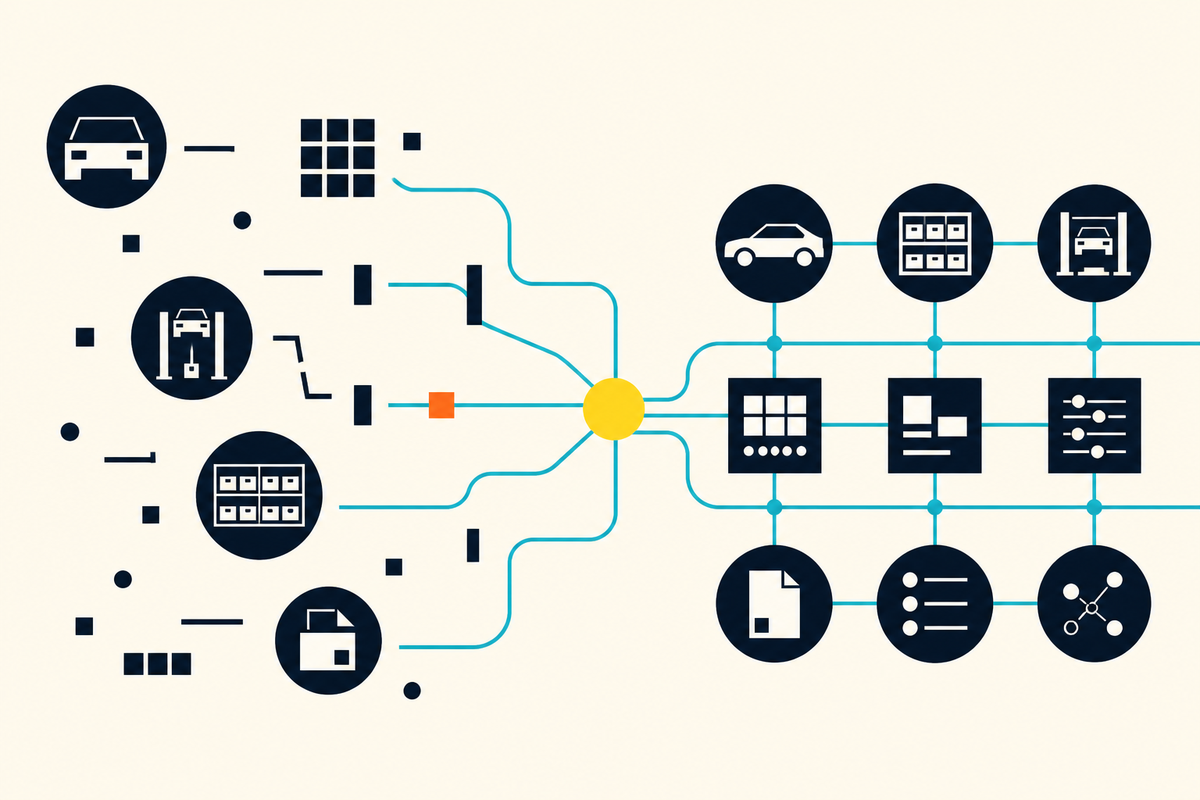
The Fairlawn, Ohio company is easy to mistake for a collection of niche automotive products. CollisionLink handles collision-parts commerce. RepairLink does similar work for mechanical parts. D2DLink lets dealers locate and trade stock. RepairLogic organizes original-equipment repair procedures. EstimateIQ looks for operations that may have fallen out of an estimate. PartsEye and Backorder Fulfillment chase inventory problems. Seen separately, they are tools. Seen together, they form a private operating layer for automotive aftersales.
That distinction matters. OEC is not trying to make the car, sell the insurance policy or turn the wrench. It is trying to make the handoffs among the people who do those things less expensive and less error-prone. Its customers include manufacturers, dealerships, collision and mechanical shops, parts and tire suppliers, distributors, fleets and insurers. The driver is the beneficiary, but rarely the buyer - and almost never aware that OEC touched the repair.
01 · The original bugA fax machine with a parts problem
OEC began in 2000, when General Motors, Ford, Chrysler and Bell & Howell formed a joint venture around an ordinary source of waste. Original-equipment parts orders moved by telephone and fax. A shop might send an estimate to a dealership; someone at the parts counter would decipher it, price the order and send information back. Every retyped line created another chance for a wrong part, a missed program or a return.
CollisionLink arrived in 2001 as an online route between collision shops and dealership suppliers. D2DLink followed, exposing parts inventory across a dealer network. OEC says that connection helped expand its dealership base from roughly 500 to 10,000. The useful lesson is not that the internet beat the fax. It is that digitizing one transaction created a network on which adjacent transactions could be built.
The current scale is substantial. When Francisco Partners announced an agreement to acquire a majority stake in November 2025, it described OEC as a 1,500-person company operating in six countries, serving 45 manufacturers, 30,000 dealers and 135,000 wholesale customers. OEC’s public profile says its network facilitated more than $14 billion in North American ecommerce and more than $30 billion in global trade in a recent year. Those figures describe transaction flow, not OEC revenue, but they reveal why connectivity is valuable.
02 · What it sellsFewer tabs, fewer calls, fewer wrong boxes
The marketplace side of OEC answers a deceptively difficult question: which part should this vehicle receive, and who can supply it? CollisionLink lets dealers process VIN-informed collision orders, apply manufacturer pricing programs and communicate with shops. RepairLink gives mechanical repairers diagrams, customer-specific pricing, availability and order updates. PartsTech, acquired in January 2025, expands the basket beyond original equipment into aftermarket parts and tires, connecting more than 25,000 repair shops with suppliers across more than 30,000 locations.
One repair · five connected decisions
The insights side deals with the information attached to the metal. Modern collision work can involve one-time-use components, scanning, calibrations and model-specific instructions. RepairLogic gathers genuine OEM procedures around a repair plan and makes that plan shareable among estimators, technicians, carriers and customers. EstimateIQ examines an estimate for potentially missed operations. OEC’s certification networks add tooling, training and facility standards for shops seeking manufacturer credentials.
Then comes supply chain. A needed component may be unavailable at the obvious warehouse but idle at another dealership. D2DLink, PartsEye, PartsBroker Direct and Backorder Fulfillment use network visibility to find that stock, optimize orders or move parts where demand exists. DMS Connect ties several OEC products into dealership management systems, pulling in live inventory and selling prices and pushing quotes back without a second round of typing.
03 · The businessA marketplace disguised as workflow software
OEC’s commercial model mixes enterprise SaaS, transaction networks and services. Manufacturers, dealers, suppliers and other business customers pay for subscriptions, programs, integrations, analytics, payments and support. Some procurement products are free to repair shops. That is not generosity so much as marketplace design: make it easy for buyers to participate, and the network becomes more useful to the sellers and program sponsors who fund it.
The company also sells optimization around the transaction. PSXLink turns wholesale activity into reports. OEC eMarketing targets shops based on buying behavior. Performance Coaching puts an adviser beside the dashboard. Payments and reconciliation tools remove financial friction. This is vertical SaaS in its broadest form - software, proprietary data, a buyer-seller network and human expertise packaged around the same recurring job.
Marketplace
Collision, mechanical, OEM, aftermarket and tire purchasing across connected sellers.
Insights
Repair procedures, estimate review, certification, insurance data and business analytics.
Supply chain
Parts location, stock optimization, backorder fulfillment and idle-inventory reduction.
The advantage
Products share participants, data and integrations instead of behaving like isolated tools.
Competitors usually enter through one doorway. CCC Intelligent Solutions, Mitchell, Solera and Repairify are powerful in estimating, claims, diagnostics or repair information. PartsTrader overlaps in collision-parts procurement. Shop-management and distributor platforms cover pieces of the mechanical workflow. OEC’s difference is breadth across the original-equipment channel and the transaction history, inventory relationships and manufacturer programs accumulated over 25 years.
Breadth can also be a burden. Products acquired or developed in different eras have to feel coherent to a user who does not care about the corporate portfolio. OEC’s best product work therefore looks almost invisible: inventory appears without a refresh, a quote moves without re-entry, a procedure opens from the estimate, a document returns to the claim file. In this market, removing a tab can be more valuable than adding a dashboard.
04 · The next connectionRepair planning moves into the estimate
A recent partnership illustrates the strategy. In November 2025, OEC and CCC announced that RepairLogic would integrate with CCC ONE, a widely used collision-estimating platform. The integration became broadly available in June 2026. A repairer can begin planning from the estimate, bring OEM procedures and required operations forward, then synchronize documentation into the CCC Workfile. An industry report said 5 percent of RepairLogic customers activated it within 48 hours.
That is a small adoption snapshot, not a final verdict. But the location of the feature is telling. OEC does not need users to abandon the system in which an estimate already lives. It needs its data and workflow to appear at the point of decision. The same logic explains integrations with dealer systems, parts platforms and calibration tools. The network grows by meeting the work where it is.
- Four automotive players create OEConnection.
- CollisionLink takes OE collision orders online.
- Genstar Capital becomes majority owner.
- OEC acquires PartsTech and widens the parts basket.
- RepairLogic connects repair planning to CCC ONE.
Ownership has changed while the OEM roots have remained visible. Providence Equity Partners became lead investor in 2016. Genstar Capital acquired the majority position in 2019. Francisco Partners agreed to buy control in 2025, with Genstar, Ford and GM expected to retain minority stakes. Financial terms were not disclosed. The continuity matters because an industry network depends on participants trusting the neutral layer between them.
05 · Where it fitsThe company between the companies
OEC belongs to a class of businesses that become important by handling work no single participant wants to own alone. An automaker can publish a procedure but cannot make every shop find it at the correct moment. A dealer knows its own inventory but not every shelf in the network. A repairer knows the damaged vehicle but may not know which pricing program converts an aftermarket line into an OE sale. An insurer wants documentation but does not create the repair plan.
OEC makes those boundaries permeable. Its mission is to “make it easy to do the right thing in the repair and supply workflows.” The line is carefully chosen. Accuracy in this market is not merely administrative. A correct part can reduce returns and cycle time; the correct procedure and documentation can support a safer repair. Commercial efficiency and repair quality often travel through the same data pipe.
The company’s quiet advantage is that it has watched those pipes for a quarter-century. It began with a faxed order and learned that every order touches inventory, pricing, fitment, reimbursement, shipping and proof. The result is not one seamless system - automotive aftersales remains too fragmented for that tidy claim. It is a growing set of bridges across the fragmentation. For a driver waiting on a car, a bridge is enough, provided the right box and the right instructions cross it on time.
Explore OEC
Visit the company, follow its updates or see the connected RepairLogic and CCC ONE workflow in action.