A used car can be polished, inspected, priced and parked under a row of cheerful pennants - yet remain practically invisible. Until photographs reach the dealer's website, the vehicle is an expensive secret. Peter Duffy learned this from the least glamorous angle possible: standing on dealership lots, camera in hand, trying to move through the queue.
He started Dealer Image Pro in 2012 as a photography vendor. The operation grew to nearly 50 dealerships and more than 20 photographers, according to the company's history. That sounds like success. It also exposed the flaw. A visiting photographer works a route. Cars arrive whenever they please. Weather turns. Keys disappear. Staff members get pulled into other jobs. One missed visit can leave inventory waiting for its online debut.
The first thing to fail was not image quality. It was coordination. The service could add photographers, but it could not make an outside schedule behave like an always-on dealership process. Duffy's change of mind came from seeing the same trio of complaints inside store after store: inconsistent pictures, slow time-to-market, and no scalable way for dealers to manage merchandising themselves.
“The greatest benefit is the speed to market. We are in control of the process. We don't have to rely on an outside vendor.”Larry Hamilton, GM, Sonic Cadillac Las Vegas
He turned photographic judgment into a checklist
Dealer Image Pro's central trick is wonderfully literal. Photo Assistant V7 displays a wireframe over the iPad camera view. The employee walks around a sedan, pickup, van, motorcycle or boat, placing the real vehicle inside the outline for each required angle. The frame answers the tiny questions that produce large inconsistencies: Where should the wheel sit? How much hood belongs in the shot? Which image comes next?
That is the difference between this and a filter app. Dealer Image Pro does not merely improve a photograph after it exists. It organizes the entire trip from VIN to vehicle-detail page. A dealer receives an iPad kit, assigns an employee, connects an inventory management system, and receives virtual training. The company says a new operator can become comfortable after shooting roughly four to seven vehicles and that a store can be fully running within two weeks.
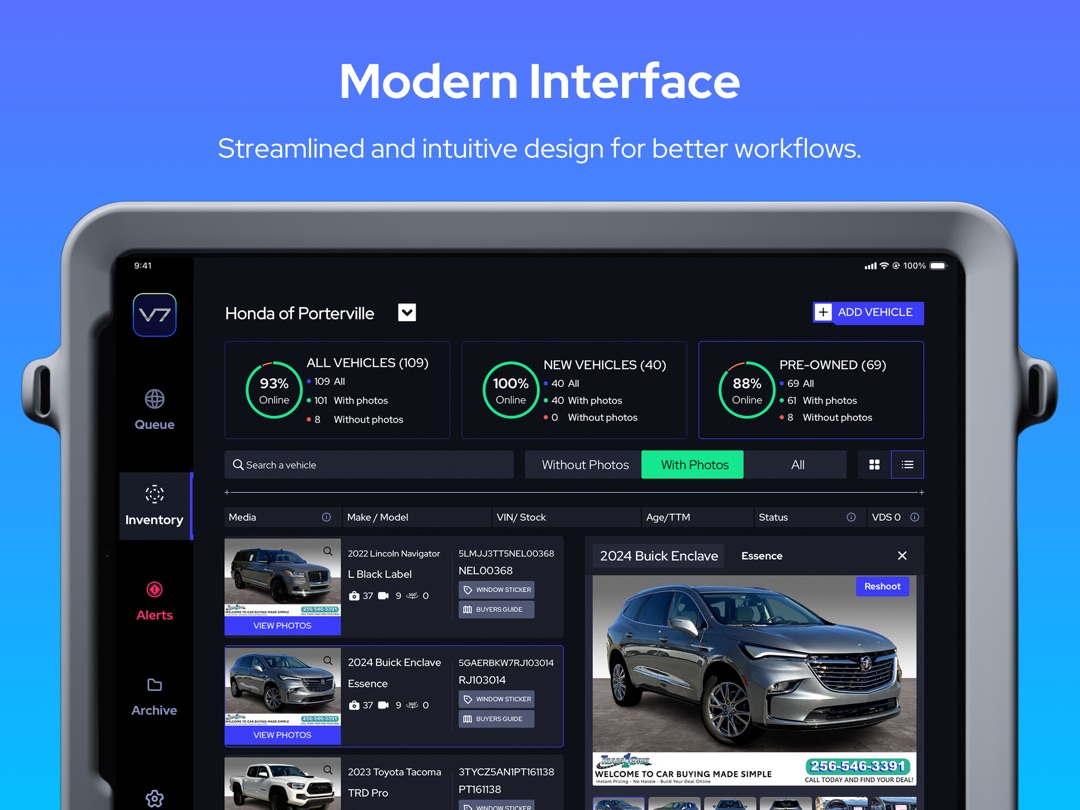
After upload, Autoport handles the backstage traffic. It receives the media, applies AI editing and background work, sequences the photographs, optimizes them, and sends them through dealer feeds. Human reviewers remain in the loop for quality control. Managers get morning, evening, age-bucket and group reports. The same platform can assemble dealer-branded video, host high-resolution imagery, create interactive 360-degree views, print weatherproof window stickers with QR codes, and reuse approved media for matching new vehicles.
The product is operations wearing a camera strap
Customers are franchise dealerships, independent stores and multi-rooftop groups. Their problem is not a shortage of cameras. Every employee already owns one. The problem is dependable throughput across people, locations and systems. A general manager wants Tuesday's vehicles online on Tuesday, not after the photographer's next lap through town. A group marketing director wants twenty stores to look like one brand. A shopper wants enough honest detail to decide whether a drive across town is worth it.
Dealer Image Pro's moat, such as it is, comes from bundling. Other choices include a lot-photography service, a pure imaging app, an AI studio, a physical photo booth, or an employee with a phone and a Dropbox folder. Dealer Image Pro combines dedicated hardware, guided capture, inventory queues, editing, human review, training, publishing, reporting, video, 360s and stickers. Its competitors span Dealer Specialties and Redline on the service side and Impel, SpinCar, AutoVerify, CarCutter and Spyne on the software side.
The company also made training a recurring feature. That matters in a dealership, where the designated photographer may become a salesperson or leave next month. Unlimited refresher sessions and quality feedback are designed to stop staff turnover from resetting the process. The lesson is broader than automotive: if changing the operator can break your software's result, training is part of the product, not a PDF sent after checkout.
published by the company
These are company case-study figures, not a controlled cross-dealer study. They are useful as hypotheses and baselines, not promises.
What it costs - and what remains on the dealer
Dealer Image Pro publishes more pricing detail than many enterprise vendors. Most dealerships, it says, invest between $12 and $22 per vehicle, depending on volume and group structure. The minimum is 50 vehicles a month. Setup, integration and ongoing training cost $999 once. The iPad hardware deposit is $500 and refundable. Agreements run month to month. Window-sticker materials cost extra.
THE PUBLIC PRICE CARD
That is not the whole cost. Someone at the dealership still moves and prepares the cars, finds keys, shoots the media, and responds to reshoot requests. A manager must care enough to read the reports. The software can expose an old vehicle with no pictures; it cannot wash the vehicle or resolve a turf war over who owns the task.
The return depends on holding cost and delay. Dealer Image Pro's own calculator multiplies monthly inventory by twelve months and daily holding cost to value one day saved. Its named examples report three to five days removed from the process, with the Niello Company moving from roughly 10 days to six and Bob Ruth Ford from four days to one. The honest way to buy is to record a store's current median arrival-to-live time, include internal labor, and run a 60- or 90-day comparison.
The acquisition rewarded the boring connection
In April 2026, dealership management software provider PBS Systems acquired Dealer Image Pro. The price was not disclosed. Duffy stayed CEO, the headquarters remained in Sacramento, and the company told customers that existing pricing agreements and broad DMS compatibility would continue. Dealer Image Pro's financial adviser was Dresner Partners.
The fit is plain. PBS says its platform supports more than 3,500 dealerships across accounting, sales, service and parts. Dealer Image Pro manages the shopper-facing media that sits downstream of those operations. One system knows the vehicle exists; the other helps make it look buyable. The deal did not suddenly create that connection, but it placed both ends under one owner.
Before the sale, Dealer Image Pro had widened the visual experience. A 2024 WheelsTV partnership put model-specific road-test videos beside dealership imagery. Insta360 and RICOH support simplified immersive capture. Photo Assistant V7, released in 2025, added a more modern inventory interface; a July 2026 update brought Insta360 X4 Air support and a VIN Tracker that shows media moving through post-production. The evolution is from camera guide to merchandising control panel.
The parts worth stealing
Founders love to say they are productizing a service. Dealer Image Pro offers a more specific recipe: first do the service long enough to see where work waits. Then turn expert judgment into a visible sequence. Include the equipment so the customer's IT improvisation does not become your support burden. Keep humans where taste and exceptions matter. Report the bottleneck to managers. Finally, price against an operating cost, not against the app category.
- Steal 01Convert the expert's eye into an overlay, checklist or template a beginner can follow.
- Steal 02Ship a ready-to-work kit. The strap and marker are part of adoption.
- Steal 03Design for the second employee, not just the person trained on day one.
- Steal 04Pair automation with a human exception loop and direct feedback.
- Steal 05Sell the business metric - days to market - while showing the calculation.
- Steal 06Use month-to-month terms when measurable value should make switching unattractive.
WHEN THE MODEL BREAKS
In-house merchandising is a weak fit below the 50-vehicle monthly minimum, when no employee can own the daily queue, when cars cannot be prepared promptly, or when feeds and website integrations are unavailable. It can also lose to a strong local vendor or an existing studio that already delivers faster at a lower fully loaded cost. Consistency software cannot compensate for zero process discipline.
The amusing thing is that Dealer Image Pro's origin story ends with a photography company teaching clients not to hire a photographer. But that is too neat. Dealers did not stop paying for expertise; the expertise moved into wireframes, training, editing rules, QA and reports. Duffy did not delete the photographer. He spread the photographer's decisions across an operating system.
Go deeper
See the product, follow the company, or watch Duffy explain the dealership problem in his own vocabulary.