An airplane can arrive with an entourage nobody photographs: logbooks, certificates, maintenance histories, and the records that explain what happened to every important part. At Wing Aviation, the paperwork became a problem of its own. Testing several maintenance systems in 2015 made matters worse. The systems did not work well together; people entered the same information again. Buying software had produced another chore.
- Veryon connects maintenance records, manuals, parts, and repair workflows.
- Its roots are in aviation publishing; acquisitions brought tracking and diagnostic expertise.
- The practical prize is less searching, fewer repeated faults, and clearer decisions about aircraft availability.
The second system made more work
Wing’s response was to choose one system and commit to it. As Kari Van Winkle put it, “we needed to pick one system and commit”. In the company-published case study, maintenance director Kari Van Winkle describes a revealing reversal: a 15-minute maintenance task had required 30 minutes of paperwork. With electronic records and signatures, that documentation took three minutes. Those are reported results from one operation, but they identify a wonderfully unglamorous place to look for improvement.

This is the territory Veryon occupies. It sells aviation software and information services to people who maintain, operate, and manufacture aircraft. Its proposition rests on a familiar workplace grievance: the answer exists, but finding it requires visiting several systems and asking three colleagues. In a maintenance operation, that grievance can become an aircraft sitting idle.
A publisher learns to follow the repair
The business began in 1973 as Aircraft Technical Publishers, or ATP. Its early problem was the technical library. Maintenance facilities stored shelves of manuals; updates arrived by mail, and somebody had to replace the right pages. Information had a physical maintenance burden before anyone touched the aircraft.
ATP followed the available technology. Its history includes PC-based Gulfstream publications in 1992 and a cloud publications application in 2010. The continuity matters more than the devices. The business kept selling access to information that a mechanic needed to trust, while changing how that information reached the mechanic.
Acquisitions widened the job. CaseBank brought diagnostic and troubleshooting capabilities in 2016. Flightdocs joined in 2020, adding maintenance tracking, inventory, and flight operations to the combination. Rusada followed in 2023. By June that year, ATP had adopted the Veryon name. A publisher’s initials were becoming a cramped description of the business.
Veryon Publications still makes that original expertise visible. It collects technical and regulatory material in an application, including maintenance manuals, parts catalogs, airworthiness directives, and service bulletins. Mobile users can download documents for offline access. The useful detail is the download: a cloud service needs a plan for the hangar where the connection is uncooperative.
The fault that comes back wearing a new name
Finding a manual is one information problem. Recognizing that an aircraft has had the same fault before is another. Maintenance entries are written by people, and people describe similar symptoms differently. A recurring issue can hide behind changing language or different ATA classifications, the aviation coding system used to organize technical information.
Veryon Diagnostics addresses that second problem through Defect Analysis, Reliability, and Guided Troubleshooting. The tools group recurring issues, examine component performance, and help technicians investigate fixes. Reliability features include monitoring short-life parts and supporting compliance reporting. Here, the software’s purpose is to give an engineering team a usable account of what keeps happening.
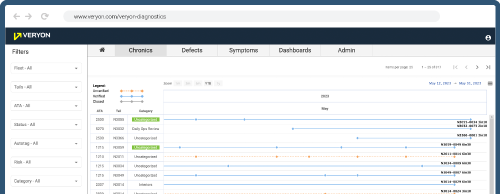
AIRE is Veryon’s AI technology across the portfolio. The company describes applications ranging from retrieving publication information to assisting tracking workflows and identifying defect patterns. These are distinct jobs, even when they share a brand. A useful answer from a manual and a useful grouping of fleet defects should be judged against different evidence.
The September 2026 Defect Analysis update makes the human role unusually explicit. Engineers can approve, split, or merge suggested chronic-defect groups, and their choices inform the system’s adaptive clustering. Veryon also describes an expert-reviewed benchmark dataset. The interesting feature is the correction mechanism: maintenance specialists can tell the model that its tidy grouping is wrong.
A recurring fault needs a history that survives a change of wording.Why defect analysis matters
On September 16, Veryon announced that Qatar Airways had selected Defect Analysis for its widebody operation. The stated aim includes earlier recognition of recurring defects and fewer unnecessary parts replacements. The announcement describes integration with the airline’s existing maintenance technology. A selection is a vote of confidence; operating results will be a separate test.
One portfolio, several kinds of buyer
Veryon Tracking combines maintenance tracking, inventory, work orders, and flight operations for business and general aviation, including routine helicopter operations. A maintenance manager can monitor upcoming work; technicians can update records; operations staff can work with scheduling and flight logs. Those people need connected information, although their screens and responsibilities differ.
Tracking+ addresses broader fleet, maintenance, repair, and overhaul workflows. Chrono Aviation’s case study shows why that scope matters. As the Canadian charter and cargo group grew, departments used an assortment of systems and larger aircraft added complexity. Tracking+ connected with its in-house planning system and brought inventory transactions and fleet status into a more coherent operation. Growth had exposed the seams between departments.
- IdentifyRecord the defect
- InvestigateFind history and manuals
- ExecutePlan work and parts
- RecordComplete the sign-off
A conceptual workflow across the portfolio; available connections depend on the products and implementation.
Repair shops also have Work Center, while the November 2025 EBIS acquisition extended the portfolio into ground support equipment management. A tool used beside an aircraft can need its own maintenance history. The portfolio’s expansion follows the work outward from the airplane.
Veryon competes in a market with several buying decisions. CAMP is an alternative for business-aviation tracking; AMOS, TRAX, and Ramco serve airline and MRO requirements; CORRIDOR and Quantum Control address repair operations. Veryon’s case is the breadth of its publications, maintenance workflows, and diagnostics under one provider. Buyers still need to inspect the connections they will actually use.
The invoice includes the changeover
Veryon’s commercial model reflects that variety. Publications are sold as annual subscriptions, with prices depending on the libraries required. Diagnostics uses a fixed cost per aircraft and permits unlimited users controlled by customer administrators. Tracking+ pricing can depend on users or aircraft and selected modules; project size can also bring a one-time implementation fee.
That structure makes the buying exercise operational. Count the aircraft and users, then examine the work involved in moving records, configuring workflows, and training staff. Veryon says Diagnostics onboarding typically takes four to six weeks. That estimate belongs to that product, rather than every possible deployment across the company.
Ownership has changed too. ParkerGale acquired ATP in 2015; Accel-KKR lists an equity and credit investment beginning in 2020. The succession of acquisitions helps explain the portfolio’s range. It also makes a finished workflow a better evaluation tool than a long list of product names.
September brings safety into the conversation
On September 3, 2026, Veryon acquired Polaris Aero, whose products include VOCUS SMS, FlightRisk, and GroundRisk. The deal added more than 200 customers, according to the announcement. Safety reports and maintenance events can describe related operational problems, so connecting them is a plausible next step.
The integration is still a task ahead. Veryon said Polaris would initially remain its own business unit while the companies planned their longer-term connection. That distinction matters: common ownership arrives on a closing date; a shared working process takes longer.
Make the demo finish the job
The lesson a reader can copy is simple enough to use outside aviation. Bring a real job to the software demonstration. Ask who enters the information, where it travels, how someone checks it, and what record remains when the work is finished. A polished screen offers little consolation if the next department must type everything again.
Results depend on accurate records, clear responsibility, trained users, and integrations that suit the operation. AI suggestions still need maintenance judgment. Veryon’s strongest idea is a practical one: give the people doing the work a better memory of the work already done. An airplane has plenty of complicated machinery. Finding yesterday’s answer should not require more of it.