An airplane can be extraordinarily modern and still carry a very old-fashioned bottleneck. The crew notices something. Someone writes it down. The people who can fix it need that record. Between observation and action sits a logbook, an object whose modest appearance conceals an impressive talent for making everybody wait.
Ultramain’s business lives in that interval. Its electronic logbook lets crews record defects and share them with maintenance; its broader software manages the work, materials and records that follow. The appealing part is how little of this requires glamour. A mechanic getting useful information earlier is a perfectly respectable ambition.
- The job: connect aircraft records, maintenance work and materials.
- The buyers: airlines and maintenance providers, with deployments spanning the cockpit and hangar.
- The wrinkle: the record must remain usable offline and fit an approved operating process.
A notebook with an enormous social circle
ULTRAMAIN ELB covers technical, cabin and flight logs. Crews can enter an issue on mobile or installed devices. A ground repository holds an auditable record, and interfaces connect that record to maintenance and engineering systems. When communications are available, the information can travel before the aircraft arrives. When they are unavailable, the software supports offline operation.
Consider the advantage without pretending every defect has a miraculous resolution. Earlier notice gives maintenance a chance to investigate, identify a part and prepare. The repair still requires qualified people, available materials and an appropriate decision. Software changes when those people learn about the problem. That is a smaller claim than abolishing delays, and a much more useful one.
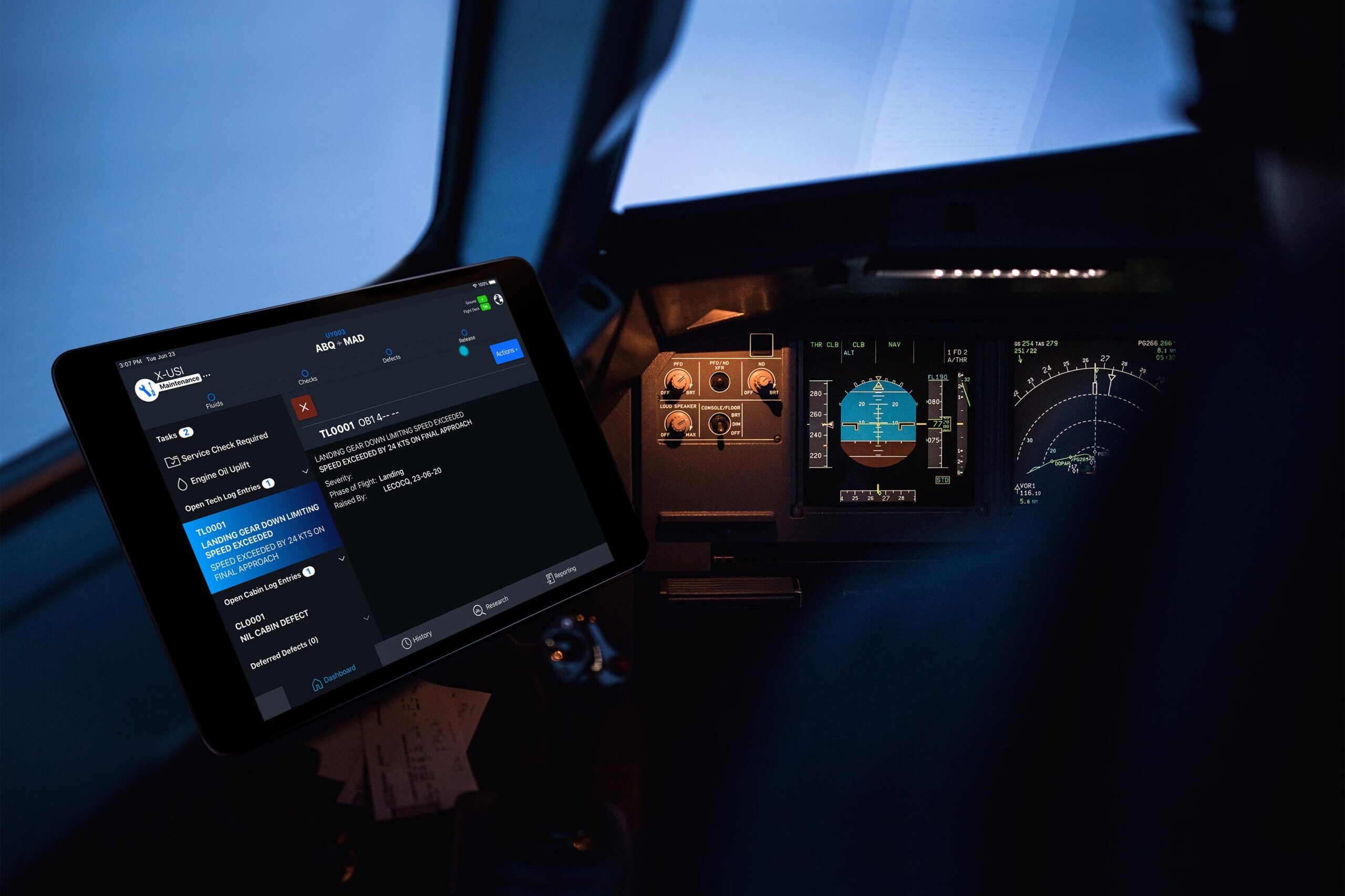
The cabin has its own version of this problem. eCabin lets crew record discrepancies and see previous reports and their status. It can operate alone or alongside ELB, where the captain can determine which cabin entries belong in the technical log. The distinction matters: useful reporting also requires deciding which record an observation belongs in.
- 01NoticeCrew captures a defect
- 02ShareELB synchronizes when connected
- 03PrepareMaintenance reviews the record
- 04RecordWork and sign-offs follow
The first digital answer had a hardware problem
Boeing and Ultramain developed the electronic logbook that received UK Civil Aviation Authority operational approval for British Airways’ 787 fleet in February 2015. Crew observations could appear beside aircraft-generated fault information from Boeing’s Airplane Health Management software. The ground team could assemble parts and documentation before landing.
“Electronic Logbook will allow faster and more detailed communication between our crews and ground teams”
Steve Frewin, British Airways Engineering 787 Fleet Chief, 2015
The next chapter exposes the practical difficulty. British Airways’ logbook manager, Scott Falkiner, described connectivity loss as the old installed system’s most common failure. Printing and signing records supplied a fallback, until hardware changes could also remove printing. Software updates required aircraft loads. The airline wanted a standalone solution usable across fleets.
It selected Ultramain’s iPad product, trialled it on four A380s in 2018 and introduced it with the A350 in 2019. Approval followed in early 2020. Later, dedicated teams prepared records and migrated 218 previously paper-based aircraft over 15 months without operational downtime, according to Falkiner’s account.
That sequence offers a useful correction to the usual app-launch story. The product had to survive broken connections, fit familiar work and earn approval. Preparation mattered as much as installation. Anyone replacing a record system should pay attention to that unexciting middle.
The mechanic should not commute to the computer
Ultramain’s maintenance business extends well beyond the aircraft log. Its web-based v9 suite covers maintenance, labor and assets; supply-chain and warehouse functions; financial oversight; and quality and reliability analysis. The mobile portfolio includes Mobile Mechanic, Mobile Inventory, Mobile Executive and GATe, the Ground Activity Tracker. Applications can be licensed separately and connected to an existing maintenance system.
This gives the buyer a choice about scope. An airline can address a particular mobile workflow, or a maintenance organization can implement a broader suite. The attraction is the relationship between tasks and resources: maintenance does not happen independently of labor, parts, documentation or cost. A useful record has to meet those neighboring systems.
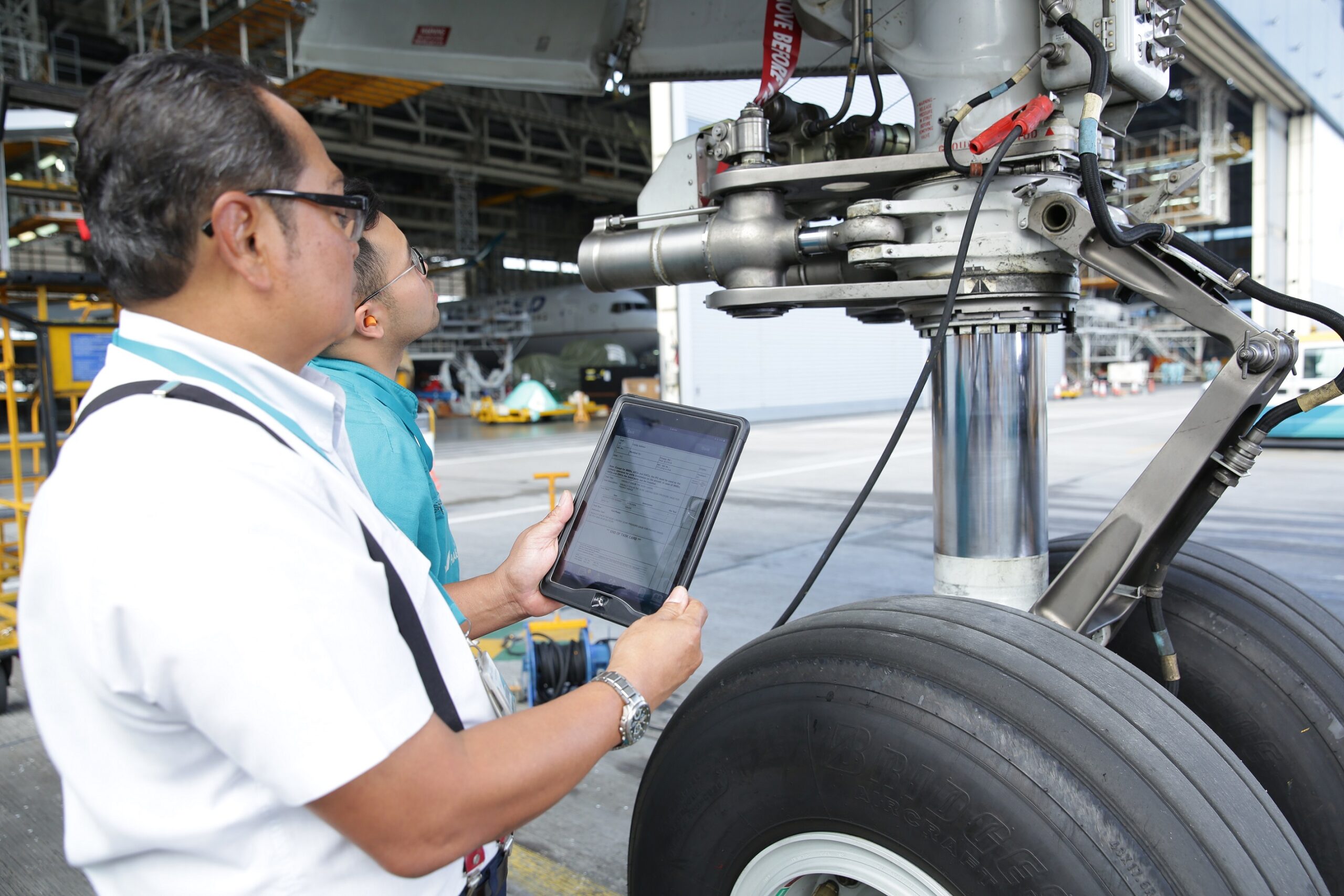
HAECO Hong Kong supplied a concrete demonstration in 2017. Working with Ultramain, and with Cathay Pacific supporting the project, it introduced Mobile Mechanic into light maintenance. Technicians could receive assignments, open electronic task cards, create non-routine cards and sign off work on mobile devices. Cathay could monitor job status in real time.
HAECO’s announcement described more than 1,000 annual light-maintenance checks for Cathay and projected a saving of 640,000 paper sheets a year. Those are useful dimensions of the project, with a necessary distinction: the paper figure was an expectation at launch. The operational change was already specific. The assignment and its record could accompany the technician.
Two paper piles, two different promises
easyJet’s June 2024 announcement offered another scale: a planned rollout across the 346-aircraft fleet described at the time, with more than 300,000 sheets no longer printed and stored annually. Operational iPads would give ground and flight personnel access to the electronic logs. An interactive cabin map would help engineers locate reported problems.
Paper is easy to count. Avoided waiting is harder. The sensible commercial question is which particular handoff improves, who receives the information and whether they can act on it. Removing sheets while leaving duplicate entry and disconnected systems intact would be a rather expensive stationery policy.
The invoice includes the surrounding work
Ultramain sells business software and the services needed to put it into use. Its implementation offering includes process review, gap analysis, modifications, integration, data migration, training and onsite go-live support. Its published approach involves customers in modification design and approvals. This is a relationship with an operating organization, rather than an isolated download.
A buyer should therefore cost the surrounding work: interfaces, records to move, roles to train and the deployment itself. Module choice and hosting also shape the purchase. Treating the visible app as the entire project is an excellent way to discover the rest of the project late.
The company’s expertise has a recognizable origin. Mark McCausland’s official biography describes flight instruction at his father’s flying business in Carlsbad, New Mexico, where he began designing maintenance software. He also flew A7D and F-16CG aircraft during a 25-year Air National Guard career. The connection between software and aviation here is unusually literal.
Its range has occasionally reached beyond airline service: Virgin Galactic announced a go-live with the v9 suite and mobile applications in 2013. More recently, LS Technics announced a Unity MRO implementation partnership in March 2025. These are different operations buying related capabilities for organizing maintenance work.
Paper has friends. Change needs them too.
Ultramain operates in a specialist market with credible alternatives. Conduce’s eTechLog8 also offers offline electronic logs and maintenance-system integration. Broader maintenance platforms include AMOS and TRAX. Offline capability alone cannot decide the contest. Ultramain’s proposition combines a logbook, mobile execution and a wider maintenance suite, while allowing existing systems to remain part of the arrangement.
In a company-authored 2025 magazine article, business-development director Rob Saunders described early adoption barriers including hardware cost and uncertain regulatory expectations. More affordable mobile devices helped. Human adoption remained a central obstacle, with pilots, mechanics, cabin crew and ground handlers all affected. A screen can be ready before an organization is.
The conditions for success follow from that account. The software needs usable workflows, an appropriate approval path and dependable interfaces. A project that cannot supply those conditions will struggle to deliver earlier, trustworthy information. Copy the attention to handoffs: find the person waiting, move the record closer to the work and plan for the connection to disappear.
In August 2026, Icelandair selected ULTRAMAIN ELB for a planned fleetwide replacement of paper technical logs. That announcement starts another implementation story. The interesting test will take place in the ordinary moments afterward, when a crew records a problem and someone on the ground can do something useful before the airplane gets there.