Consider the aircraft owner’s monthly statement. It is an unlikely place to look for drama. There are no champagne flutes, no runway lights, no photograph of a person who has somehow packed for a week in one exquisite leather bag. There are expenses. And, according to Portside, before using its integrated billing product, many customers took seven to twenty days to close their books and issue those statements. An aircraft can move remarkably quickly. The explanation of what it cost can require rather more patience.
- Portside connects the office behind aviation: schedules, owner information, billing and safety.
- Acquisitions have widened its product range; integration is the next test.
- Its September 2026 roadmap puts four scheduling products at the center, with migrations ahead for FOS and PFM customers.
That gap between physical speed and administrative speed is a useful way into Portside. The company sells cloud software to the people who make aircraft operations possible: flight departments, charter businesses, aircraft managers and other aviation organizations. Its proposition starts with a modest observation. A flight is one event, but it leaves information scattered across a surprising number of desks.
The dispatcher needs the schedule. Finance needs the costs. The owner needs an intelligible account of both. Maintenance and crew records have their own demands. If the information travels by repeated copying, the aircraft’s arrival does little to settle the office’s work. Portside wants those handoffs to become ordinary, repeatable software operations. This is enterprise technology with the glamour carefully removed.
The bill is also a relationship
In business aviation, ownership and operation are often separate jobs. An aircraft manager must run the asset and explain its performance to the person paying for it. The Owner Portal addresses that second task, giving operators a branded place to share aircraft information. It makes schedules, financial reporting and other records available without making every question an email expedition.
There is a commercial consequence to this seemingly clerical improvement. On Portside’s customer page, Mayo Aviation describes its reporting experience as an advantage in winning a management services contract. That is a customer testimonial, rather than a controlled experiment, but the mechanism is easy to understand. An owner choosing a manager is also choosing how difficult it will be to obtain an answer.
“Providing on-demand access and transparency is critical”
Jet Aviation, in its Portside customer testimonial
Portside has even packaged the sales demonstration. Its Acquisition Portal lets a prospective customer explore a white-labeled Owner Portal before signing a management agreement. A manager can show the future relationship instead of describing it in a slide deck. The small joke here is that “acquisition” refers to winning an aircraft-management customer, not buying another software company. Portside does both.
Time some customers previously needed to close books and issue owner statements, according to Portside’s billing product page. This describes the starting problem, not a measured saving.
Integrated Owner Billing tackles the records underneath the presentation. The product supports multiple accounting and scheduling systems, aircraft-specific account categories and multi-currency statements. Publishing controls let the operator decide when a statement reaches an owner. In this setting, a good interface is useful because it sits on top of a reconciled account. A handsome invoice with the wrong charges would merely make a mistake more legible.
Buying the pieces of the office
Co-founders Alek Vernitsky and Alek Strygin established Portside in 2017. The business expanded from reporting and information sharing into a wider collection of aviation workflows. Its financing provided room to pursue that expansion: a $17 million Series A announced in June 2021, led by Tiger Global and Dragoneer, followed by a $50 million Series B led by Insight Partners in February 2023.
The 2023 funding announcement explicitly included acquisition opportunities among the uses of the money. This matters because Portside’s portfolio is partly a record of purchases. PFM brought corporate-flight scheduling and dispatch. SeaGil brought BART. Portside obtained licensing and development rights for Avianis from Wheels Up, a distinction worth preserving: acquiring rights to a product is a more specific transaction than buying its former owner.
Scheduling & dispatch
Flight operations & safety
Passenger & cargo operations
Baldwin Safety & Compliance added safety-management software and associated support. Takeflite, acquired in July 2024, broadened the picture again. Its customers include scheduled passenger, cargo and humanitarian operators; its functions extend from bookings and pricing to dispatch and financial management. Portside’s market therefore reaches beyond the private jet that makes the most attractive photograph.

Other tools cover fleet and crew allocation, recruiting and trip planning. The expertise lies in understanding how these tasks fit together in aviation, rather than assuming that a generic calendar and accounting package will settle everything. The business model is B2B software-as-a-service. Portside offers individual applications or a broader platform, with a sales process built around demonstrations and discussions of the operator’s requirements.
A competitor can also be a connection
A company assembling an aviation suite still has to live in a world full of other aviation suites. FL3XX, for example, markets connected charter sales, dispatch, crew scheduling and reporting. Those functions overlap with Portside’s operations products. Yet FL3XX also lists an integration with Portside for dashboards and operational data. Portside’s own integration directory includes FL3XX and Leon.
This is a more interesting market position than a simple contest between two logos. An operator may want new owner reporting while keeping its existing scheduling system. Portside can be a layer joining tools together, or it can supply more of the underlying operation. The differentiating bet is the combination of owner-facing information, financial workflows and a portfolio of aviation-specific products. It is a strategic claim, not proof that every competing product is weaker.
Operations→Records
Finance & crew→Report
Owner
An editorial map of the information handoff Portside’s applications address.
Large customers provide a better test than feature lists. In October 2023, Solairus announced a ten-year agreement centered on Avianis. At the time, its fleet numbered more than 320 aircraft. The relationship also included work on quoting, interoperability, security and resiliency. Clay Lacy Aviation adopted Avianis in October 2025, describing a unified system for its flight operations. Neither announcement supplies a universal return-on-investment figure. Both show the kinds of operational commitments these buyers are making.
The portfolio acquires a problem of its own
There is a pleasing irony in Portside’s internal history. A business selling connected systems found that buying companies gave it disconnected equipment. A JumpCloud case study describes Portside starting as a Mac-only organization, then accumulating Windows devices through acquisitions. Its device mix became roughly 65 percent Mac and 35 percent Windows.
Portside hired its first chief information security officer, Paschall Freeman, in August 2023. He needed common management across those devices and a security approach covering the acquired businesses. After evaluating alternatives, he chose JumpCloud. This was a documented constraint on the old setup, not a tale of corporate collapse: tooling suited to the original company no longer covered the company it had become.
The lesson travels well. A product portfolio can grow faster than the routines required to govern it. Buying capabilities also buys differences in systems, working habits and support obligations. Portside’s own experience makes its integration promise more demanding. It must solve internally the sort of coordination problem it sells externally.
Four schedules, one difficult transition
Horizon, launched in February 2025, targets larger, more complex flight departments, fractional programs and jet-card operators. It brings operational, financial and compliance information into a configurable cloud platform, with Microsoft Power BI reporting and APIs for other systems. The attraction is the ability to fit an operation’s complexity without sending people on a daily tour of unrelated screens.
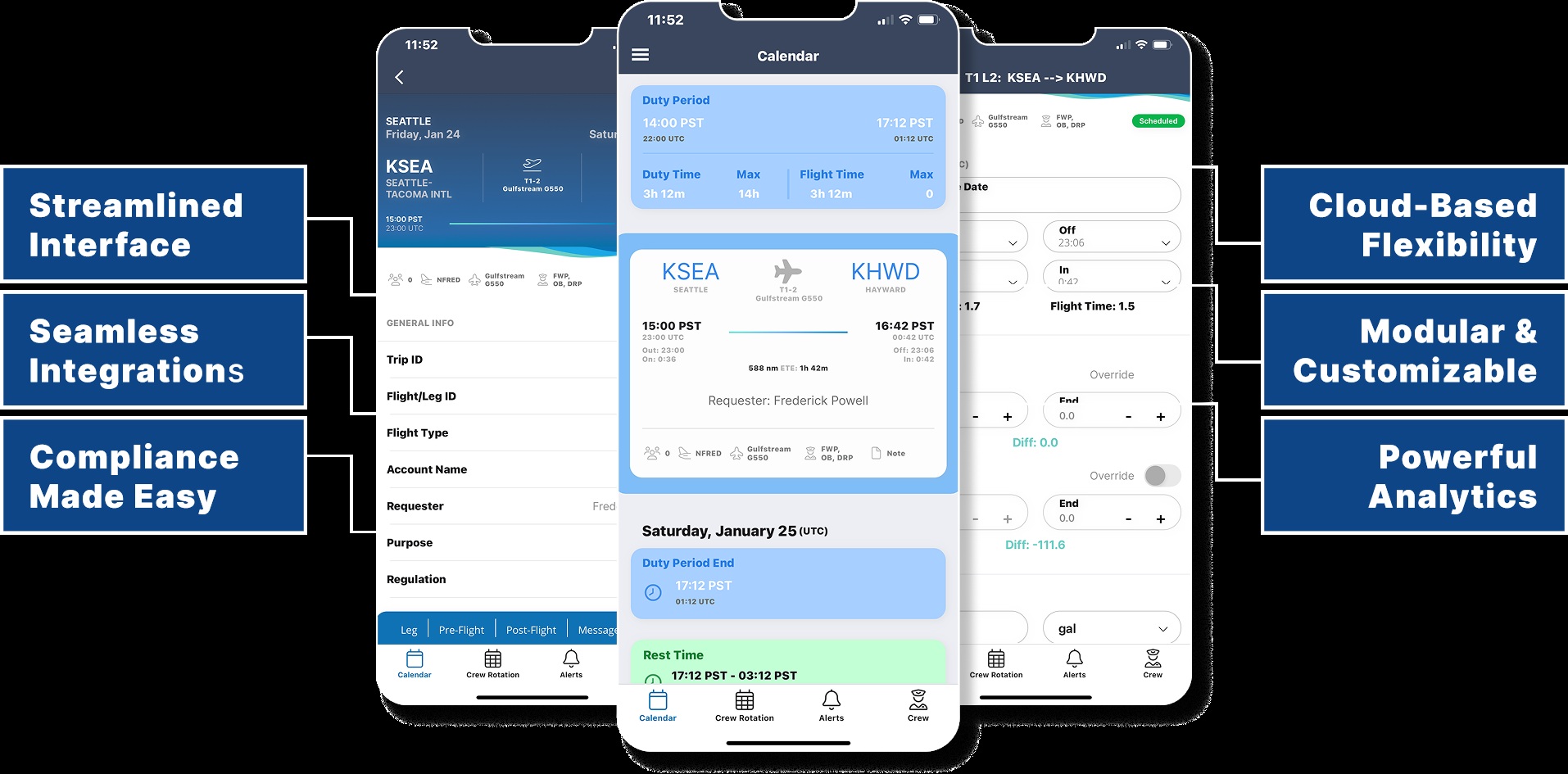
Vista Equity Partners invested in 2024 and again in March 2026, when Portside named Brandon Holden as its next CEO. Vernitsky remained an advisor and director. The stated priorities included integration and an AI-enabled roadmap. The company had assembled considerable breadth; the next leadership brief emphasized connecting it.
On September 29, 2026, Portside focused scheduling investment on Avianis, BART, Horizon and Takeflite, with supported migrations before FOS and PFM retirement. It promised no immediate forced operational changes. Available AI features include safety-report classification and manuals search; Roger AI scheduling assistance is in beta, with further capabilities planned for Q4. Those release labels matter. A roadmap and a working feature make different promises.
For a buyer, the practical exercise is to trace one flight through scheduling, records, reconciliation and owner reporting. Ask which integrations carry the information, who checks it and where an exception lands. For a founder outside aviation, the copyable idea is to study the handoff everyone repairs by email. Portside’s approach depends on reliable inputs, workable integrations and people using the tools consistently. The owner may enjoy the view from the aircraft. Someone still has to make the numbers land.
Website · Horizon · Integrations · Newsroom · LinkedIn · Twitter / X · Facebook · Owner Portal video