Airplanes spend their public lives in motion and their private lives on calendars. Behind every departure board is another schedule, measured not in gates and seat numbers but in inspections, hangar slots, labor, components and the stubborn biography of each airframe. Elliot Margul found his business in that second calendar. It was less glamorous than flight, more consequential than a spreadsheet and, in the middle of the last decade, badly in need of modern software.
Margul began his career as a reporting analyst, then moved into financial planning and analysis at Alaska Airlines. From 2013 to early 2016, his work reached across airframes, engines, materials, components, wages, outside line maintenance and lease returns. The vocabulary alone suggests a room where every answer creates three new questions. A forecast had to capture cost, timing and risk, then remain useful as the underlying aircraft refused to behave like a generic row in a model.
He built new methods for forecasting power-plant maintenance, a more detailed component budget and a dynamic lease-return calculator using Tableau. These were practical inventions inside a large airline, designed to make a difficult job less foggy. They also revealed the limit of the available toolkit. Long-range maintenance planning needed to account for the fact that two nominally similar inspections could require very different amounts of time. One aircraft might need 20 days. Another might need 27. Corrosion, past repairs and lower-level tasks had their own votes.
The schedule beneath the schedule
Heavy maintenance planning is a puzzle with expensive edges. An airline has to decide when an aircraft leaves service, what work belongs in the visit, which facility has room, whether the necessary skills are available and how the choice affects future inspections. The decision horizon can stretch across years. The aircraft, meanwhile, remains a revenue-producing machine that is conspicuously unproductive while parked.
One maintenance decision, five linked constraints
history
scope
capacity
labor
service
This is where Margul's training made an unusual founder profile. He studied accounting, finance and information systems at the University of Washington's Foster School of Business. He was close enough to the money to see the cost of a weak plan, and close enough to the systems to imagine a better one. He did not need to invent aircraft maintenance. He needed to give experienced planners a clearer view of its consequences.
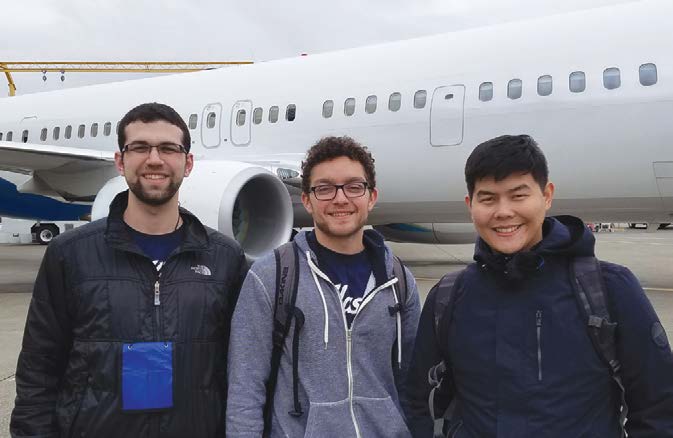
In December 2015, Margul founded Aerostrat with Cody Morris and Frankie Angai, combining airline knowledge with product and engineering experience. The company set out to build modern planning tools for aerospace and defense. Its first product, Aerros, focused on long-range heavy maintenance for airlines and maintenance, repair and overhaul organizations. It could model constraints, test scenarios, manage aircraft allocation and help planners publish a schedule that colleagues and vendors could actually use.
Eight airlines and a public promise
A year after the company formed, the three founders brought their concept to a Starburst Accelerator event at Seattle's Museum of Flight. Twelve aerospace startups pitched to investors and industry executives in a friendly version of a shark tank. Margul offered a conservative estimate of a $250 million annual market and described a company still living in the useful, awkward stage between experiment and contract.
Aerostrat had been testing with eight airlines. Contracts had gone to two. Margul hoped to close them in early 2017 and said the company had other products it wanted to build. The remarks read differently after a decade because they preserve the scale of the beginning. Eight design partners are not 5,000 aircraft. They are eight chances to learn where a polished assumption collides with an airline's working day.
Aerostrat's operating language settled around customer attention rather than theatrical disruption. The company described candid feature discussions, direct communication with developers and round-the-clock support. Its ambition for the product was almost domestic: maintenance planning should feel as seamless as a consumer application. In aviation software, that aspiration carries weight. A pleasant interface still has to respect airworthiness directives, engineering changes, labor skills, production capacity and the unpleasant surprise hiding in an individual tail number.
The narrower the domain, the more revealing the edge cases become. Aerros was designed to sit alongside an airline's existing information systems rather than demand that everything else move out of the way. It offered API integration and planning across different enterprise resource planning environments. The product's value rested on joining information that already existed, then making the future legible enough for teams to argue about it before the hangar door opened.
The long integration
FedEx Express offers a clean example of the patient work. The cargo carrier and Aerostrat began meeting as FedEx sought to modernize maintenance planning that still depended on old mainframe systems. Their goals aligned around automation and integration. The resulting effort was not a weekend installation. It became a multi-year API program that embedded Aerros into existing information systems in stages.
Margul co-authored the later case study with Roger Hutchinson II of FedEx Express. The collaboration showed his role expanding beyond chief executive shorthand. He managed Aerostrat's business operations while shaping product and corporate strategy, and he could speak in the detailed grammar of maintenance planning. Software founders often claim to live close to the customer. Co-writing the account of a multi-year enterprise integration is a particularly literal version of the phrase.
There was community work around the edges, too. Margul coordinated Aviation Day at Alaska Airlines from 2014 to 2018 and lists years of packing food with Northwest Harvest. In 2024, he advised an Illinois Mathematics and Science Academy student investigation into airline heavy-maintenance product development. IMSA was his own high school. The project involved months of training, product work, data analysis and exposure to customer sessions, a tidy loop between a technical education and an unusually technical business career.
A ten-year overnight result
By 2025, Aerros supported more than 5,000 aircraft across airlines, cargo operators and maintenance organizations. Publicly disclosed users included Azul Brazilian Airlines, FedEx Express and JetBlue Airways. The number is impressive because aircraft are not seats in a productivity app. Each one represents a stream of maintenance events, operational constraints and decisions whose costs can persist for years.
On August 11, AAR acquired Aerostrat's outstanding shares. The announced structure was $15 million at closing plus contingent consideration of up to $5 million. Aerostrat joined a portfolio that already included Trax, AAR's maintenance software subsidiary. Aerros would continue to work across ERP platforms while also becoming available within the Trax suite, connecting long-range heavy-maintenance planning to a wider set of digital maintenance tools.
The fit was architectural as much as financial. Trax already covered broad maintenance operations, including enterprise planning and mobile workflows. Aerros specialized in the long horizon, where planners decide how fleets, facilities and major visits should fit together before work reaches the line. AAR could offer the products together without closing Aerros off from airlines using other ERP systems. For Margul, the arrangement preserved the product's agnostic approach while putting it beside a larger aviation technology business. The startup had spent a decade making one planning layer more precise. The buyer did not ask it to become something less specific.
The 2025 transaction
AAR paid a $15 million base price, with up to $5 million tied to product and revenue conditions. Aerostrat became part of AAR's Integrated Solutions segment.
+ up to $5M
Margul framed the fit around values. Aerostrat had tried to be customer-centric and to build reliable, quality software. He saw the same priorities at AAR and called the chance to work beside Trax an honor. It was corporate language, certainly, but consistent corporate language. The company had spent years describing itself through customers, direct conversation and dependable tools. The buyer was being welcomed through the same door.
An acquisition can tempt a neat ending onto a stubbornly continuous job. Aircraft will still arrive with different histories. Capacity will still tighten. A schedule will still be asked to make peace among engineering, finance, operations and time. Margul's achievement is not that he made those constraints disappear. Aerros gave planners a place to see them together, move them around and understand the bill before reality presented it.
There is a useful founder lesson in the route from Alaska Airlines to AAR. Margul followed a problem across departmental borders instead of sanding it down into a universal pitch. Finance showed him the cost. Maintenance supplied the constraints. Information systems offered the lever. His co-founders supplied product and engineering depth. Ten years of customer conversations supplied the rest.
The public romance of aviation belongs to the sky. Margul built in the interval when an aircraft cannot fly, when planning earns its keep and precision is more charming than spectacle. Somewhere behind the tail numbers, the second calendar continues. Quiet software is busy keeping it honest.