Mark Michael has spent most of his adult life working on a category of software whose success is measured by how little anybody thinks about it. A franchise location page loads. The right phone number appears. A customer in Tacoma sees Tacoma, not Tampa. An appointment gets booked. Hundreds of local operators stay inside the brand lines without becoming identical. The machinery behaves, and everyone moves on.
Michael would prefer that leaders stop moving on quite so quickly. His current argument is blunt: the website is infrastructure. For a franchise or multi-location company, it is the owned source of truth connecting the corporate brand to every local market, search result, form, booking tool, CRM and future software layer. Treat it like a campaign and it ages like one. Treat it like infrastructure and it can keep changing without being replaced.
That conviction took 18 years to earn. It arrived through an early product built for a different internet, a venture round spent too fast, a Google algorithm change, years behind other companies' logos, an acquisition in New York, and a late decision to meet the end customer directly. The tidy version would call this focus. The honest version is closer to very persistent editing.
The partnership before the product
Michael and Daniel Rust began working together when they were 17. The partnership survived high school, college, the first startup experiments and every version of DevHub. Their responsibilities developed around temperament. Michael handled business, marketing and outward vision. Rust set the technical roadmap. Michael has called Rust the closer, the person who enters at the right moment and seals a deal. He has also joked that Rust “lets me be CEO.” In a 2024 note celebrating his co-founder's birthday, he offered the less polished truth: there was nobody else he would rather have beside him on the trip.
Shared history can become a trap, but theirs became an operating asset. Each remembers what the other believed before the evidence changed. Neither needs the simplified version of a hard year. They can disagree inside a language built over decades. In startup folklore, the idea usually receives top billing. At DevHub, the enduring advantage may be two people willing to revise the idea without revising their commitment to one another.
The expensive first draft
DevHub started in 2007, initially as EvoLanding, when automatically generated sites could win search traffic and domain owners needed alternatives to parked pages. The company raised a little more than $2 million in 2009. Michael later recounted what happened with the disarming speed of somebody who has already paid for the lesson: the money was gone in roughly six months. The office expanded. A team of about three became roughly 35. Rent reached around $20,000 a month. Everyone was spending toward a destination that seemed sensible at the time.
Then the internet changed its mind. Google's algorithm updates weakened the original model. DevHub had built for a set of rules it did not control. The company shifted toward a website builder and found more durable business by licensing that technology under other companies' brands. Yellow Pages businesses, agencies and marketing platforms could sell websites without building the machinery themselves.
Three DevHubs, one underlying problem
White-label work is an odd kind of success. The technology can power millions of experiences while its maker remains unknown. Michael sometimes described DevHub as a secret in the agency world. The obscurity suited the business model but complicated the founder's natural desire to point at the work. Even source code could conceal the company doing the heavy lifting.
Still, those years supplied an education no keynote could compress. DevHub learned how listings, reviews, paid search, analytics, co-op marketing, CRMs and location data collide in actual organizations. It learned that one page is a design task while 5,000 pages are a systems problem. “If you're doing it as a one-off, then you don't need us,” Michael said in 2021. Scale was not a large version of the same job. It was a different job entirely.
The deal that shortened the distance
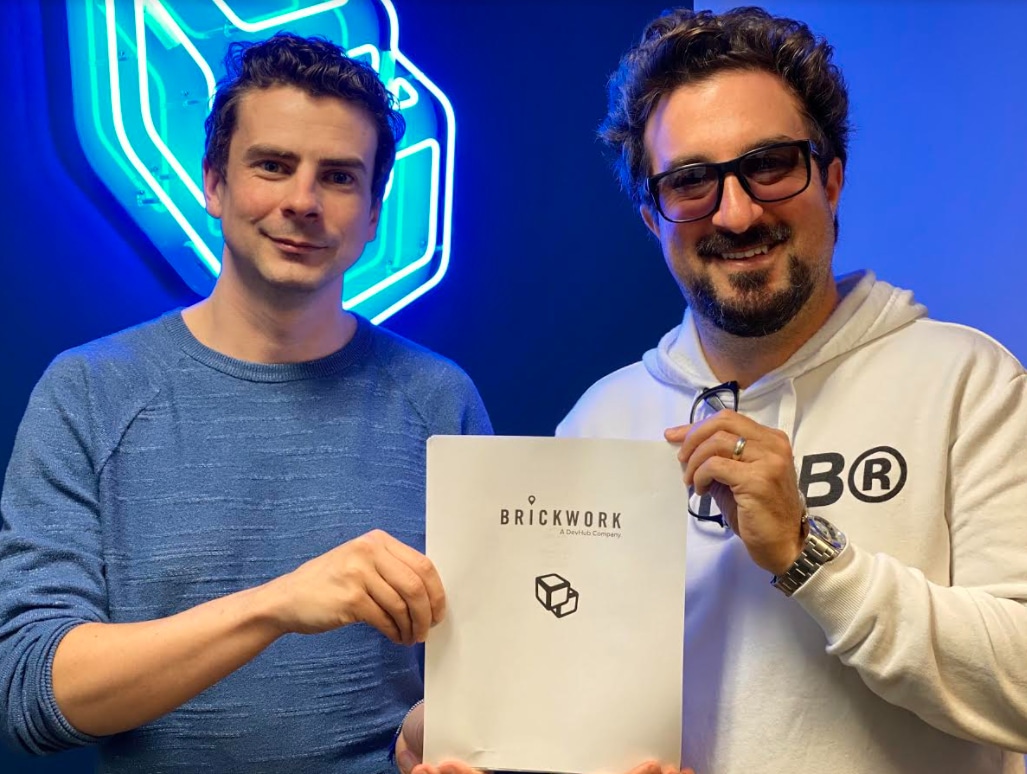
In May 2021, DevHub acquired Brickwork Software from retail-as-a-service company b8ta. Brickwork helped physical retailers turn local discovery into action through store pages, appointment booking, event RSVPs and promotions. Its customer history included brands such as Nike, Chanel and Saks Fifth Avenue. DevHub gained product capability, a New York presence and something more strategic: direct relationships with brands.
Michael had first proposed a joint venture. The seller preferred an outright deal. He saw useful software where the previous owner saw a mismatch, and he was characteristically plain about the diligence: DevHub had spent five months inside the product, he said. It had not been sold a fantasy.
His behavior during the transaction revealed what he wanted the combined company to feel like. Michael texted Brickwork team members every month as the purchase moved toward completion. An earlier acquisition approach had gone badly in part because the prospective buyer's CEO never contacted him. Silence from the person at the top had made the process feel mechanical. When his turn came, Michael chose presence.
That instinct appears in DevHub's internal values now: be obvious, cultivate feedback, choose momentum over indecision, show up, take ownership. Corporate value lists tend to become decorative nouns. These read more like instructions somebody might actually use during an uncomfortable Tuesday.
Leaving the middlemen
By late 2023, DevHub made another edit. The company began cutting ties with white-label middlemen and working directly with franchise brands. Years of serving agencies and marketing platforms had shown the founders a gap: the end customer often did not control the website well enough. Agencies changed. Software tools changed. Franchise locations multiplied. The supposed marketing asset became a recurring rebuild project.
Michael reframed the website as the stable layer beneath all that motion. A useful franchise system needs corporate pages, location microsites, store locators, service-area rules, permissions, integrations, data synchronization and local search structure. It needs franchisees to move quickly without improvising the brand into confetti. Generic content management can handle pages. The opportunity DevHub chose was handling the organization.
the company
by Dec. 2025
by Dec. 2025
There is a stealable strategy here. Find the complexity everyone else dismisses as implementation detail. Stay close enough to see its pattern. Then make the pattern the product. DevHub's value is not that it can publish a page. Plenty of tools can. Its pitch is that it can preserve control while hundreds or thousands of pages, people and integrations keep changing.
The founder has more than one room
Michael's public life would be easier to classify if it stopped at software. It does not. Under the name gliderCEO, he has recorded more than 200 podcast episodes, often as a spoken journal about leadership, ambition and doubt. He writes short fiction; his first named work, Travelers Rush, uses Seattle as the atmosphere for an urban-fantasy story. He paints in acrylic, oil pastel and collage, annotating the backs of works with the place, music and thoughts present when they were made. His catalog counted more than 100 works by 2023.
In 2026 he added Mark Michael's Living Room, a talk-show project based across Seattle, Arizona and New York. None of this feels like an executive assembling tasteful hobbies for a biography. The output is too restless. It resembles the same impulse that shaped DevHub: make an experience, put it somewhere people can encounter it, observe what happens, revise.
The discipline is equally unromantic. In a 2019 interview, Michael said he woke at 4:30 a.m. to work out and saw his parents four or five times a week. Colleagues describe energy, directness and loyalty. His own accounts are less flattering and more useful. He talks openly about the early money, the false starts and the pressure founders manufacture in their own heads. Creativity, he has said, can balance ambition.
A company built in revisions
- Michael and Rust launch the company that becomes DevHub.
- An early venture round funds a rapid, costly expansion.
- DevHub develops into white-label website infrastructure.
- The Brickwork acquisition adds retail actions and direct brand ties.
- DevHub turns directly toward franchise and multi-location brands.
- Michael discusses AI agents while insisting the owned website remains the source of truth.
The next version is already arriving
Artificial intelligence has given Michael a new vocabulary for the old question of scale. In a 2026 interview, he described internal knowledge agents, developer copilots and systems capable of coordinating updates across hundreds or thousands of websites. His interest is practical rather than ceremonial. Where can a small company remove meetings, handoffs and repetitive production without removing judgment or culture?
He has long connected company ambition to low headcount. In 2021, when DevHub had roughly 45 employees, Michael said he believed it could become a billion-dollar company with fewer than 200. The number is an aspiration, not an outcome. The operating idea beneath it is consistent: scale the system before scaling the org chart.
AI also sharpens his argument for owning the website. Discovery may begin in ChatGPT, Claude, Grok or whatever interface arrives next, but the brand still needs a reliable place where structured information, local facts and conversion paths live. In Michael's formulation, the interface can change while the source of truth remains under the brand's control.
The charming irony is that a founder preoccupied with future interfaces has built his case around an artifact as old-fashioned as the website. Yet longevity is precisely the point. A durable system does not freeze the present. It gives the future somewhere to connect.
Michael's story offers no clean recipe for avoiding wrong turns. He did not avoid them. He stayed with the same partner, the same broad problem and enough candor to make the wrong turns useful. Eighteen years later, the company is still making websites. Only now the humble page has become a network of local truth, organizational permissions and customer action. The product grew up because the founders kept looking at what it had become.