A bottle of foundation is a surprisingly awkward thing to sell on the internet. The customer needs to know how a color will look on her face. The seller has a photograph, a screen and a considerable incentive to say yes. Somewhere between those two positions sits the beauty counter: a person, a tester, a little reassurance. ODDITY’s wager was that much of this reassurance could be rebuilt in software.
- IL MAKIAGE sells makeup with product matching and home trials.
- SpoiledChild extends the approach into hair, skin and wellness.
- METHODIQ adds online dermatology with clinician oversight.
- Record 2025 sales met an expensive advertising problem in 2026.
The interesting question is what happens after the quiz. Does the bottle stay? Does the customer return? Can the next brand use what the first one learned? Those questions explain ODDITY more clearly than the word “AI” on its own.
The purchase before the prediction
ODDITY’s corporate history begins in 2013. Its co-founders are siblings: Oran Holtzman, the chief executive, and Shiran Holtzman-Erel, the chief product officer. That date matters because 2018, frequently attached to its story, marks IL MAKIAGE’s US digital launch. The cosmetics brand itself is older still. This was a reinvention with a past attached.
There was trouble in that past. Globes reported that Holtzman acquired the Israeli IL MAKIAGE business after its 2013 liquidation for NIS 12 million. The later online operation therefore followed an actual business failure, rather than a founder’s imaginary frustration in a department store. The record supports the sequence; it offers less access to the private moment when anyone changed their mind.
For shoppers, the resulting proposition is concrete. Answer questions, receive a recommendation, try the product. IL MAKIAGE’s Woke Up Like This foundation comes in 50 shades; its US storefront currently lists it at $45. PowerMatch narrows the choice. Selected Try Before You Buy offers add a 14-day home trial, with shipping paid upfront and charges governed by the offer’s terms.
Consider the division of labor. The matching system makes a prediction. The trial lets the customer judge it in her own bathroom. A return option absorbs some of the anxiety that a photograph cannot remove. Calling the whole arrangement an algorithm misses the part that makes trusting the algorithm easier.
One engine. Different bathroom shelves.
ODDITY sells physical products through brands it owns. Its expertise spans data science, computer vision, digital merchandising and formulation research. Consumers buy makeup, skincare, haircare and supplements; they do not need to buy software. The platform is chiefly the machinery behind the transaction.
SpoiledChild, launched in February 2022, tested whether that machinery could serve another identity. Its matching engine, SpoiledBrain, recommends products around individual profiles. Reusable dispensers and refill capsules gave the launch a distinctive physical format. The consumer problem was familiar: too many products, too little confidence about which ones belonged in a routine.
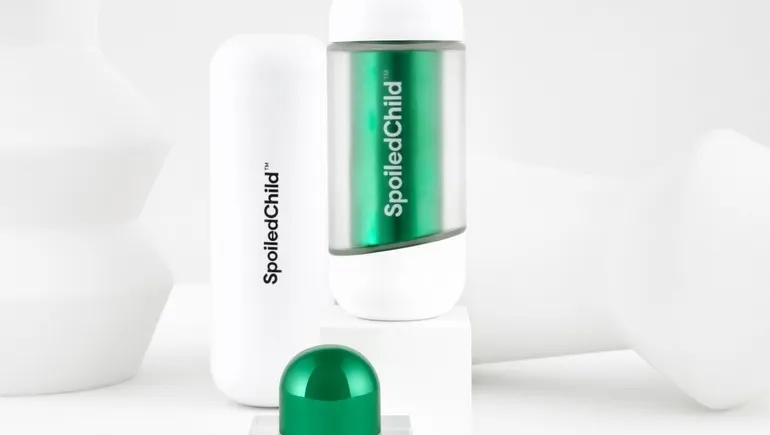
Think of ODDITY as a house of brands with shared technical plumbing. Its prospectus describes centralized technology and data science alongside separate brand leadership. That places it among consumer businesses, competing for both attention and repeat purchases. MAC and Clinique are alternatives for makeup shoppers; Sephora and Ulta offer another route to discovery. Owning the whole online journey gives ODDITY different information to work with.
The scale needs careful language. By September 2026, ODDITY said its platform served more than 70 million users. A user is not necessarily a paying customer. Still, the audience helps explain the appeal of launching adjacent products: the company can investigate needs among people already interacting with its brands.
Then the quiz company bought a laboratory
In April 2023, ODDITY announced a $76 million acquisition of Boston biotechnology startup Revela, plus $25 million for a laboratory. The ambition moved upstream. Better matching helps select among available products. Ingredient discovery aims to improve what is available in the first place.
ODDITY described a process of biological screening, machine-learning analysis, laboratory validation, safety testing and human testing. The distinction matters. A promising computational result is an input to development, not a finished bottle or proof that every consumer will benefit. ODDITY Labs brought molecular discovery into the same organization that could eventually sell the resulting formulation.
METHODIQ brought those ambitions into sharper focus in November 2025. Its launch covered acne, hyperpigmentation and eczema, combining prescription and non-prescription products with online care. Weekly app check-ins send progress information to an assigned clinician. Here, personalization includes a medical relationship, with responsibilities beyond choosing a flattering shade.
The company said METHODIQ took four years of investment and testing and launched with 28 core products and more than 100 treatment plans. Those are company-reported development figures. They show how far the business had traveled from a simple shopping quiz.
The algorithm outside the building
By 2025, the approach produced $809.8 million in annual net revenue and $110.7 million in net income. Capital followed through several distinct doors: a $130 million secondary share sale in 2022, an IPO in 2023, and $600 million of exchangeable notes in 2025. The secondary sale paid existing holders; it was not fresh operating cash.
Then acquiring customers became abnormally expensive. Management attributed the problem to algorithm changes at its largest advertising partner. In September 2026 it reported second-quarter revenue down 25%, with remediation continuing. Its full-year forecast called for revenue to fall about 19%; that was guidance, not a completed annual result.
“We made progress during the quarter”Oran Holtzman · September 2026
The portable lesson is practical: identify a narrow uncertainty, ask useful questions and make the purchase easier to reverse. But the economics require affordable acquisition, repeat demand and products worth keeping. A company can own the quiz, the brand and even the laboratory while remaining exposed to the auction that brings the next person through the door.