The first thing NVIDIA built was a chip with an identity problem. Released in 1995, NV1 could handle 3D graphics, video, audio and a game port. Jensen Huang later called it an octopus. The customer, meanwhile, wanted a fast graphics chip at a price that made sense. The elaborate newcomer was clever enough to impress an engineer and awkward enough to alarm a buyer. In Huang's telling, Diamond Multimedia took 250,000 units and returned almost all of them.
- NVIDIA began with PC games, then turned its GPU into a programmable computing platform.
- Its early rescue involved abandoning NV1's graphics approach and a Sega console project.
- It now sells chips, networking, complete systems and software to AI builders, while serving gamers and creators.
- The useful lesson: follow the standard customers adopt, then build the tools that make your hardware worth using.
The wrong shape of an image
Huang founded NVIDIA in 1993 with Chris Malachowsky and Curtis Priem. The three had talked through the idea over bottomless coffee at a San Jose Denny's. They expected home PCs to become places for games and multimedia. That was a sensible wager on a market that barely existed. The first implementation was less sensible. NV1 drew 3D scenes with quadrangles, while the wider PC graphics world gathered around triangles and Microsoft's Direct3D.
NVIDIA was also developing NV2 for Sega's next console. Completing that contract would have tied the company to the same graphics approach for years. Huang went to Sega executive Shoichiro Irimajiri, explained that the architecture was headed in the wrong direction, and asked to be released from the work while still receiving the remaining payment. According to Huang's account, Sega agreed. The sum was roughly $5 million - enough, he said, to keep the company alive for another attempt.
“It was a great technology achievement. It was a terrible product.”Jensen Huang on NV1
There is an appealing little cruelty in this story: NVIDIA's future depended on admitting that its own impressive invention was unsuitable. RIVA 128, the replacement, aimed squarely at the graphics market that existed. With cash tight, the team bought a refrigerator-sized emulator from a failed company, tested the design in software before production and committed to one chip fabrication attempt. It worked. RIVA 128 sold a million units in its first four months in 1997.
A graphics card learns another trade
The rescue did not predestine AI. NVIDIA still had to win in graphics. Its 1999 GeForce 256 helped establish the GPU as a distinct processor. Later GeForce cards made games and creative applications faster and more detailed; RTX added real-time ray tracing in 2018. A gamer could buy an NVIDIA card for frame rates and image quality without caring what an AI lab would eventually do with the architecture.
But researchers saw a different opportunity. Graphics chips perform many similar calculations at once. Scientists began using them for work that had nothing to do with pixels. NVIDIA's 2006 CUDA platform gave programmers a more direct way to write such jobs for GPUs. That cost engineering time, people and attention while the company's established business was still gaming. The bet was that better tools would make the chip useful to more people. By 2012, NVIDIA GPUs helped power AlexNet, a landmark neural-network result. CUDA's developers, libraries and framework support became as important to NVIDIA's position as the silicon itself.

The rack is the product
Today NVIDIA designs GPUs, CPUs, high-speed networking, complete computing systems and software. The customers are cloud providers, AI labs, large enterprises, researchers, carmakers, robot builders, designers and gamers. The problem varies. A model developer needs to train and serve AI without leaving processors waiting for data. A scientist needs to run simulations faster. A game studio wants detailed scenes at playable speed. NVIDIA's answer increasingly arrives as a coordinated system rather than a lone component.
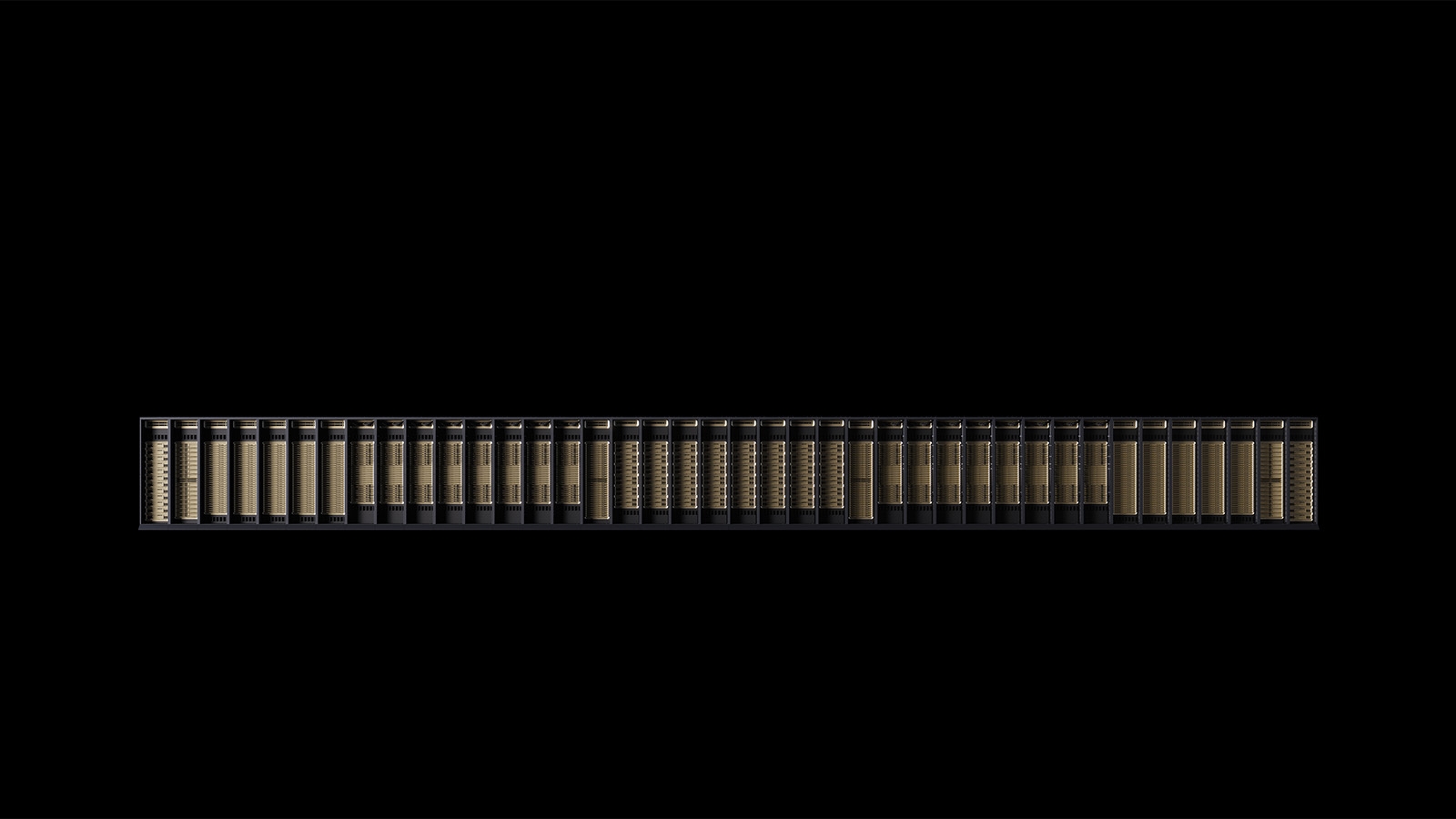
Vera Rubin makes that approach visible. NVIDIA introduced the 2026 platform as a combination of Rubin GPUs, Vera CPUs, NVLink switches, network adapters, storage processors and software. Its claim is not simply that one chip is quick. The parts are designed to work together across a rack, where power, heat and communication become limiting factors. A cloud company can buy or deploy such infrastructure, while an enterprise can use NVIDIA AI Enterprise and NIM microservices to put models into production. The latter carries a published starting license price of $4,500 per GPU per year. Cost, here, is not an afterthought; it is part of the architecture.
Those reported figures, for the quarter ended July 26, 2026, explain where NVIDIA now sits in the market. It remains a graphics-card maker, but its largest business is supplying AI data centers. It sells through computer makers and infrastructure partners, and it licenses enterprise software. TSMC helps manufacture its chips. AWS, Google Cloud, Microsoft Azure, Oracle and CoreWeave are among the companies deploying its platforms. Industrial software makers such as Siemens and Cadence build on NVIDIA tools for engineering and simulation.
A moat made of habits
AMD, Intel and the custom chips built by large cloud providers offer alternatives. That competition keeps the comparison grounded: NVIDIA does not own parallel computing, and a buyer should judge the full workload, including power, software portability and operating cost. Its distinction is the accumulated bundle - hardware, interconnects, CUDA, libraries, developer knowledge and distribution. NVIDIA says more than four million developers use its accelerated-computing ecosystem and more than 40,000 companies use its AI technology. Each new tool gives existing hardware another use; each new use gives developers a reason to learn the tools.
What a builder can borrow
Start with the customer's narrow job, not the cleverness of the prototype. When a standard wins, change course while there is still time. If the product requires a new way of working, invest in the tools that make it usable. NVIDIA could afford the long CUDA bet because GPUs already had a real graphics business; the same strategy would be much harder without cash, patient customers and a growing base of developers.
That may be the least glamorous conclusion of a glamorous business story. NVIDIA's early chip failed because it did too many things the market did not ask for. The company survived by making one thing work, then patiently built the surrounding software that let the thing do much more. The octopus had to go before the ecosystem could grow.