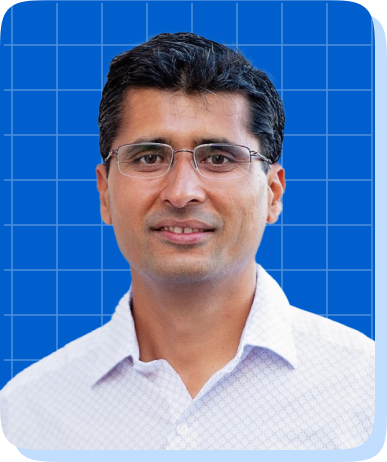
Mid-stride, building something that shouldn't exist yet
The average CISO lasts 18 months before burning out or being replaced. Ambuj Kumar knows this. He's spent the last three years building the reason that might finally change.
Simbian's AI agents - not copilots, not dashboards, actual autonomous agents - now handle the kind of security workload that used to require entire analyst teams cycling through overnight shifts. Threat advisory analysis that previously took hours completes in seconds. Kumar watched a customer's face during a live demo when that clicked. He didn't need a slide deck to explain the value proposition after that.
The thing about Kumar is that he is not a security person who learned AI. He is an engineer who built the infrastructure that makes both possible. Eight years at NVIDIA, as one of the company's first ~500 employees, designing GPU memory controllers under Jen-Hsun Huang. The hardware that now trains the large language models that everyone is scrambling to deploy in their products. Kumar built some of that foundation, then left to figure out what to actually do with secure data at scale.
"Creating a new category is like inventing a new language and evangelizing it one person at a time."- Ambuj Kumar
He has done this twice. The first time, with Fortanix: Confidential Computing, the first commercially successful technology for encrypting data in use - not just at rest or in transit. IBM adopted it. Intel adopted it. Goldman Sachs adopted it. Kumar raised $135 million before stepping back in 2022. The second time, with Simbian: autonomous AI security agents that eliminate 90% or more of routine SOC tasks. He co-founded it with Alankrit Chona, a former Twitter software engineer, and had the seed round oversubscribed before they finished asking.
He grew up in Bihar, India. Earned a Gold Medal at IIT Kanpur. Built an M.S. at Stanford while working full-time at NVIDIA. Holds over 100 patents across cryptography, cloud computing, and computer science. That's a resume that could support a comfortable career as a deep technical executive somewhere. He keeps choosing harder paths.
"There is no rational reason to be an entrepreneur because it's so difficult." He says this, and then does it again.
His philosophy on hiring sounds counterintuitive until you hear the reasoning: "We value hustle, hunger, and the ability to learn over experience. Too much experience can hold you back." When you're building categories that don't yet exist, you need people who don't know what's impossible.
Kumar maintains a strict weekday/weekend split - work entirely on weekdays, family entirely on weekends. For someone running a venture-backed security startup in a market moving at adversarial speed, that kind of discipline reads less like life-balance advice and more like an engineering constraint: the system performs best with defined boundaries and predictable cycles.