There is a particular kind of tech gadget that promises to change your life and looks like a garage door opener while doing it. The clip-on recorder. The lanyard puck. The badge that blinks. Nirva, a San Francisco startup, started from the opposite end of the problem. Before it settled on what the AI would say, it decided what the device would have to look like: something you would clasp around your neck on purpose, and forget you were wearing by noon.
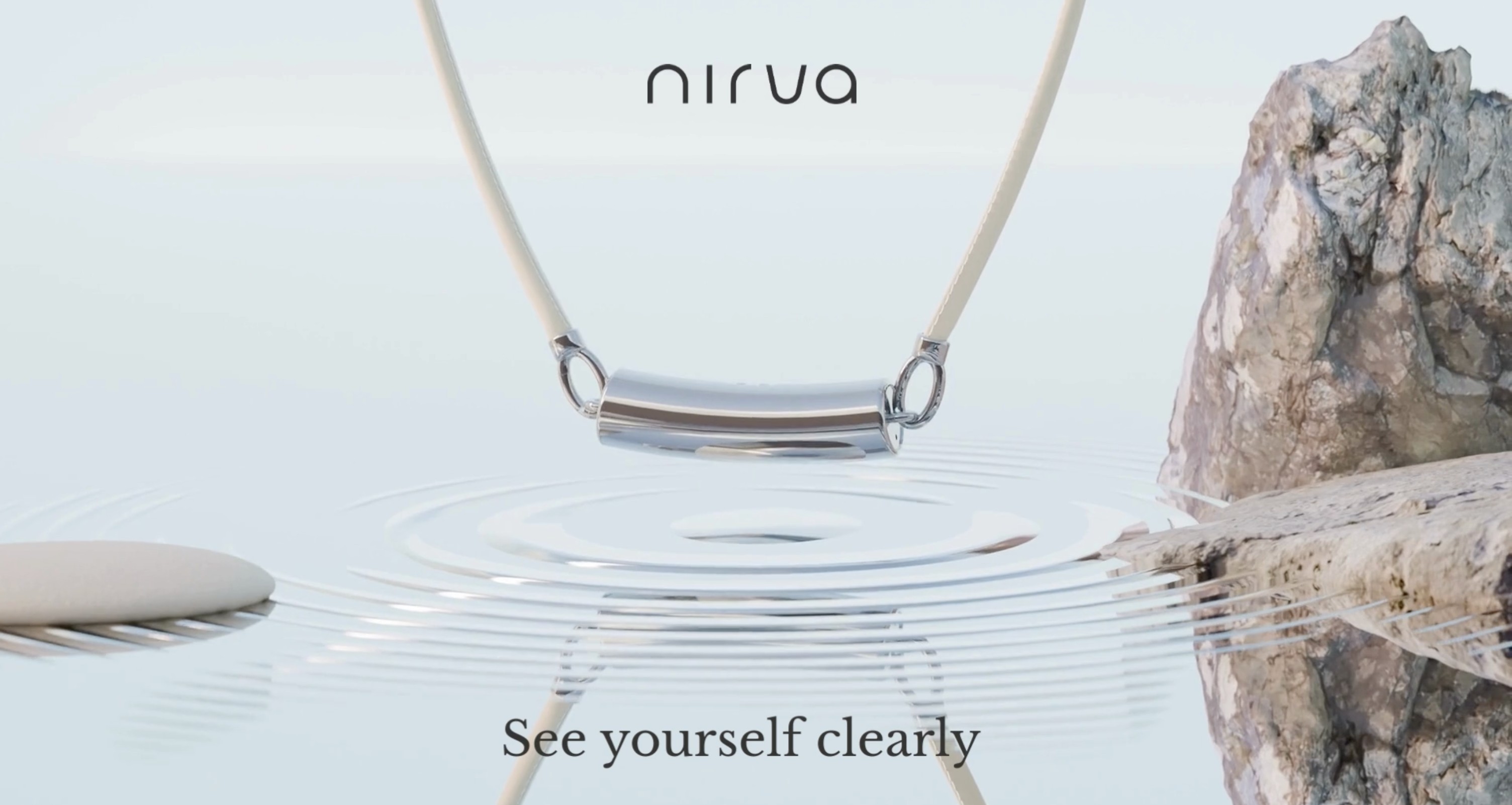
That decision explains most of what is interesting about the company. Nirva is building an AI wearable - a titanium necklace, with a bracelet version too - that listens through your day, writes the diary you never keep, tracks your moods and the people you spend time with, and hands the patterns back to you. You can text it or call it for guidance on work, relationships, and wellbeing. The tagline printed over its launch imagery, a still pool rippling beneath the pendant, is plain: "See yourself clearly."
01 / What It Actually DoesA diary that writes itself
The pitch is easy to describe and harder to sit with. Worn through the day, Nirva captures the context of your life and turns it into an automatic journal - a running summary of what happened, who was there, and how you seemed to feel about it. Over time it maps your relationships and reads your energy, then surfaces what it calls Insight: interpretations of your mood patterns and the triggers behind them. When you want advice, you message it the way you would a friend who has been paying close attention.
The company frames the gap it is chasing in one line about the recorders that came before it: "Because they couldn't be worn throughout the day, they had an incomplete picture of the wearer." That is the whole thesis in a sentence. Nirva is betting that the value is not in any single conversation it captures, but in the accumulation - the longitudinal record that only exists if the thing stays on.
The business model follows from that logic. Nirva sells the hardware direct to consumers and positions the necklace and bracelet as premium objects rather than gadgets, with seasonal collections and limited editions on the roadmap - the language of a jewelry house, not a spec sheet. The recurring value lives in the software: the journaling, the Insight readouts, the on-demand guidance. Pricing has not been made public, which is its own signal at this stage; a company that leads with the pond and the tagline is still deciding how much of the story is the device and how much is the service behind it.
02 / The TeamTwo who built the glasses, one who dressed the stars
The founding story is unusually legible. Chief executive Wei Lyu led product for AR glasses and devices at Meta Reality Labs and, before that, took XREAL's glasses from prototype to a global launch. Chief technology officer Jason Chen - Qianyuan Chen - was an engineering manager at Meta Reality Labs who had earlier worked on Reels and scaled Facebook Lite. Between them sits the hardware-and-software half of the company: people who have shipped consumer devices at scale and know how a zero-to-one product goes from a rendering to a thing on a shelf.
The third seat is the tell. Co-founder Hanying Hu ran her own jewelry brand and has designed pieces worn by Lady Gaga and BLACKPINK. In most AI hardware companies, design is a late hire. Here it is a founder. Lightspeed, which led the seed, described the trio as a rare combination of "three kinds of genius" - hardware, software with product instinct, and design - and argued that most entrants in the category are missing at least one. You do not have to buy the venture-capital framing to see the point: a device meant to be worn all day lives or dies on whether people want to wear it.
Inside the pendant - the sensing stack
03 / Where It FitsNot your body, not your calm - your inner life
The wearable shelf is crowded, but Nirva is aiming at a corner of it that is mostly empty. Oura and Whoop own the body: sleep, recovery, strain, heart-rate variability. Calm and Headspace own the ten quiet minutes before bed. A newer wave of AI companions - Friend, the Limitless pendant, Bee, Plaud - overlaps more directly, capturing conversations and turning them into notes and recall. Nirva's stated target sits between the biometric and the meditative: your thoughts, your patterns, the arc of a day rather than a metric from it.
Rough positioning - what each device is really measuring
The other axis on that map matters just as much. Nirva wants to be all-day, not on-demand - and that is exactly where the jewelry decision earns its keep. A clip you attach for a meeting captures a slice. A pendant you never remove captures the connective tissue between the slices. The company's longer-term language points at an "intention engine" that anticipates what you need before you say it. Whether that is a promise or a mood board, it only becomes possible on a foundation of continuous, personal context.
04 / The Hard PartThe moat and the risk are the same sentence
Here is the tension worth naming. Nirva's value compounds the longer you wear it - which means its value also depends entirely on you not taking it off. That is the moat: a rival cannot clone months of your context. It is also the risk. Every reason a person removes a necklace - the shower, the gym, the charger, the dinner where they would rather not be recorded, the simple day they forget - is a hole in the record the whole product is built on. The two-day battery and a case that holds three more charges are answers to part of that. The rest is behavior, and behavior is the thing hardware cannot spec.
Then there is the question any always-listening device has to answer before it earns a spot on your collarbone: what happens to everything it hears. Nirva has led its public story with design and capability rather than a detailed account of consent, storage, and control. For a product whose pitch is intimacy, that is the conversation that will decide how many people say yes - and it is the one most worth watching as pre-orders turn into shipped units.
The team is small - roughly five people - which cuts both ways. A five-person company can hold a single, coherent point of view about how the thing should look and feel, and it shows in the restraint of the product. It also means Nirva is attempting one of the harder combinations in consumer tech, custom hardware plus a personal-AI service plus a brand people wear, with the headcount of a seed-stage startup. The $8 million from Lightspeed and South Park Commons buys runway to prove the first units, not to win the category. What it has to show, quickly, is that the daily wear-time it is banking on is real rather than aspirational.
Where the always-on bet leaks - a rough read
05 / What You Can Take From ItThe lesson isn't the AI
If you are building anything meant to live on a person's body, Nirva's move is worth copying: solve for adoption before you solve for the feature. The founders did not start with a smarter model and then hunt for a shape. They started with the shape people would tolerate - jewelry, ten grams, titanium, water-resistant, comfortable enough to disappear - and let the intelligence live behind it. In a field where most AI hardware still looks like a prototype that escaped the lab, the least technical decision may turn out to be the most strategic one.
It debuted publicly at CES 2026 in January, opened pre-orders, and targets shipping in the first half of the year. Whether Nirva becomes a category or a curiosity will come down to two things it cannot fully control - whether people keep it on, and whether they trust it with what it hears. But the bet underneath it is clear-eyed: the next thing worth quantifying is not your resting heart rate. It is the story you tell yourself about your own day, written down for once by something that was actually there.