Company Profile • Wellness-Tech • Los Angeles
The Company That Sells You Peace of Mind, One Filter at a Time
AirDoctor and AquaTru turned invisible anxieties - what's in your air, what's in your tap - into a nine-figure consumer business. Here's how a direct-response veteran built it.
There is a particular kind of dread that shows up quietly in the middle of an ordinary day. You fill a glass at the kitchen tap and wonder, for half a second, what's actually in it. You open a window during fire season and think twice. Ideal Living, a Los Angeles company most people have never heard of by name, has spent more than two decades building a business out of that half-second of doubt - and then answering it with hardware you can put on your counter.
The company sells air and water purifiers under three brands: AirDoctor for air, AquaTru for water, and AromaTru, a waterless aromatherapy diffuser. You have very likely seen the ads - on television, in your social feed, tucked into an affiliate's newsletter, or on an Amazon results page - even if the parent company's name never registered. That is not an accident. Ideal Living is built to be everywhere its customer already is, and to keep the brand you remember (AirDoctor, AquaTru) out front.
01 / The OriginA marketer who decided to only sell useful things
Ideal Living was founded in 1999 by Peter Spiegel and co-founder Kathleen Williams. Spiegel's background is the tell. He describes himself as a pioneer of direct-to-consumer marketing and is credited with selling more than $3 billion of products over his career - the kind of resume built in the trenches of direct-response television, where every second of airtime has to earn its keep. His interest in wellness is older than the company: as an undergraduate studying Human Development at the State University of New York, he worked on an organic farm in the foothills of the Smoky Mountains and later studied traditional Chinese medicine in London.
In 2007, Spiegel narrowed the company's focus to something closer to a rule: only manufacture and sell products that measurably improve a customer's health. That constraint - marketer's reach, but pointed exclusively at wellness - is the seed of everything Ideal Living has become.

02 / The ProductWhy AirDoctor keeps winning the spec sheet
AirDoctor's entire argument fits in one number. Its UltraHEPA filter is rated to capture 99.99% of airborne particles down to 0.003 microns - roughly one hundred times smaller than the particle size the standard HEPA rating promises. Around that filter sits a sealed three-stage system: a pre-filter for the big stuff (dust, pet hair), a carbon and VOC filter for gases and odors that ordinary purifiers wave through, and the UltraHEPA layer for the microscopic remainder. Because the housing is sealed, dirty air can't sneak back out the seams. The fans, which the company calls Whisper-Jet, run about 30% quieter than a typical purifier.
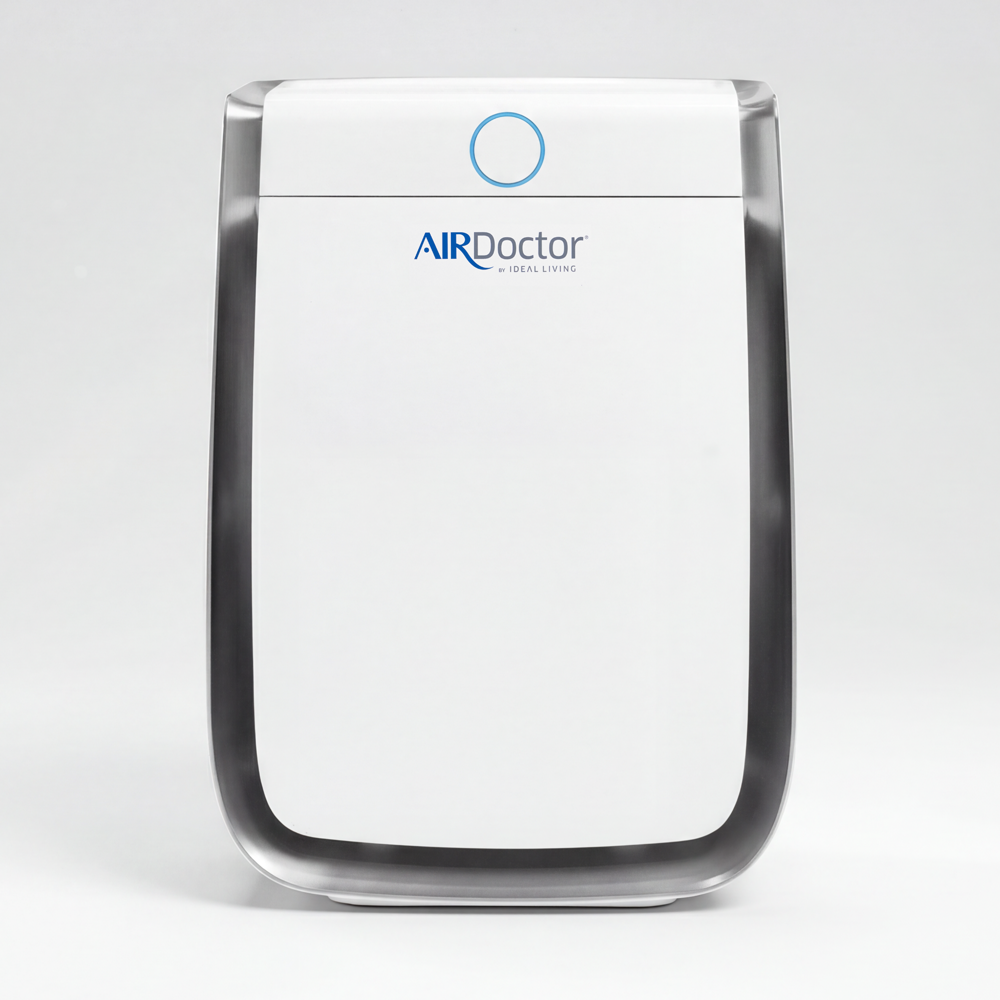
The point of that spec sheet is not to win a physics debate. It is to give a nervous parent, a skeptical retailer, and an affiliate all the same thing: a claim that can be handed to an independent lab and come back verified. In a category thick with vague promises, testable numbers are the product.
"Everyone has a right to pure water, clean air, and a solid foundation for wellness." - Ideal Living
03 / The Other HalfAquaTru put reverse osmosis on the counter
If AirDoctor is the company's answer to the air question, AquaTru is its answer to the water one - and arguably the more clever piece of engineering-as-marketing. Reverse osmosis is the gold standard for stripping contaminants out of drinking water, but historically it meant calling a plumber, giving up a cabinet to a tangle of tubing, and drilling into the counter. AquaTru's insight was to shrink the whole system into a countertop appliance you unbox and fill like a coffee maker. No installation, no plumber.
The claims, again, are certified rather than asserted. AquaTru's four-stage systems are independently NSF-tested to remove 83 contaminants - lead, PFAS, and, as of December 2024, microplastics across the entire lineup. The company frames the payoff in bottles: AquaTru customers, collectively, are estimated to have avoided around two billion single-use plastic water bottles. The line now spans the classic countertop unit, a Carafe, and a Carafe Smart that picked up a Good Housekeeping 2026 Kitchen Award and Esquire's Best Water Purifier nod.
Ideal Living's stated policy is to only market claims it can hand to an independent lab. For a physical-product company, certification isn't just compliance - it's distribution. Every NSF stamp is a reason a retailer stocks you, an affiliate recommends you, and a wary buyer clicks add-to-cart.
04 / The MachineHow it actually reaches you
The reason Ideal Living can compete against far better-known names - Dyson and Blueair in air, Berkey and Aquasana in water - is not that its hardware is unbeatable. It is that the company owns the entire path from the first ad to the replacement filter. It designs the products, writes the direct-response television spots, runs the internet and social campaigns, operates a network of affiliates and influencers it calls Health Experts, sells through its own branded storefronts and Amazon, and stocks shelves at Walmart, Target and Costco. Filters are consumable, so the first sale opens a subscription-shaped relationship that keeps paying.
That vertical integration also explains the company's move into commercial territory. In 2024 it launched an enterprise line of air and water systems for offices, gyms and hospitality, and in 2026 brought AquaTru Pro to the HFA Show. When a countertop brand starts selling to boardrooms, it usually means the consumer flywheel is spinning fast enough to fund a second act.
A portfolio - air, water, scent - lets Ideal Living sell the whole idea of a clean home, not a single gadget. That is the entire lifetime-value strategy in one sentence.
05 / The StandingWhere it fits, and where it doesn't
Ideal Living sits in the premium-but-accessible tier of home wellness: pricier than a grocery-store pitcher filter or a bargain purifier, cheaper than a whole-home installation. Its customers are health-conscious households across the US and Canada, with distributors reaching the EU, UK and India, and a growing slice of commercial buyers. Third-party data pegs annual revenue in the neighborhood of $70 million and headcount somewhere between 150 and 230, though as a privately held company the exact figures vary by source and should be read as estimates.
The strategy has limits worth naming. It leans on paid acquisition and affiliate reach, which get more expensive as a category matures; competitors can copy a spec sheet; and a business built on certified claims lives or dies by staying ahead of the testing curve. What Ideal Living has that is genuinely hard to copy is the combination - a marketer's distribution engine bolted to a discipline of only saying what a lab will confirm. In a wellness industry where the opposite is common, that restraint is the moat.
The clearest illustration wasn't an ad at all. When wildfires hit Los Angeles in early 2025, the company shipped more than $325,000 worth of air purifiers into the recovery. You cannot buy that kind of credibility with media spend - you can only earn it by showing up in the exact moment your product is the answer to the question everyone is suddenly asking.