An insurance sales team can move very quickly until somebody asks a slow question: was this person allowed to sell this policy, in this state, on this date? Niji Sabharwal had to work through questions like that at Zenefits. He had joined the machinery of growth. He found himself helping repair the machinery of permission.
The experience supplied a business idea with remarkably little glamour and considerable staying power. Insurance companies needed to know whether their producers had the right credentials. Their sales systems needed that information while work was happening. A spreadsheet could record an answer. Keeping the answer current across a growing business was another matter.
Sabharwal and his wife, Jenn Knight, founded AgentSync in 2018 to tackle that problem. Seven years later, after leading the company through several funding rounds, he made another operating decision: he would hand the CEO job to David Samuels and become executive chair. There is a thread connecting the licensing work and the leadership handoff. Both required him to ask whether the system still suited the job.
A spreadsheet gets a bigger job
At Zenefits, Sabharwal worked in sales strategy and operations before leading the producer licensing and broker compliance response team. The company’s regulatory problems made the limits of manual administration painfully concrete. Adding salespeople meant adding credentials to verify, requirements to track, and opportunities for a mismatch between a person’s permissions and their work.
One response was Licensing+, a Salesforce application developed inside Zenefits. It checked state requirements against an agent’s licensing status. The company made it available free through Salesforce AppExchange. Sabharwal served as its product manager; his LinkedIn record dates the project to September 2016.
The practical trigger was simple: opportunities were being assigned to representatives who lacked the appropriate state license. The fix connected licensing controls to the system employees were already using, with information from the National Insurance Producer Registry. Put the check where the work occurs, and it becomes harder for the two to drift apart.
That is a modest-sounding design choice. Anyone who has had to move information between two systems will appreciate its appeal. The extra tab, the separate list, the reminder to check later: each leaves a small opening for ordinary human forgetfulness.
Before insurance, there was SimCity
Sabharwal’s earlier interests were more colorful than a licensing checklist. Born in San Francisco to a father from India and a mother from France, he grew up speaking English and French. He attended École Bilingue in Berkeley. In a 2019 conversation, he remembered sometimes reaching a French word before finding its English equivalent.
There were Lego bricks, SimCity 2000, and Lemmings. Green Day was his favorite band; Dookie was his choice of album. The child interested in building a city would eventually make a career inside the less photogenic systems that help organizations function.
He studied business economics at the University of California, Santa Barbara, graduating in 2009. His professional route ran through LinkedIn, where he worked in global sales strategy and operations, and then Zenefits. These were jobs concerned with how a sales organization actually runs: the tools, information, compensation, and processes supporting the conversation with a customer.
He also met Knight at LinkedIn. That connection would become both a marriage and a founding partnership.
The kitchen becomes an office
AgentSync’s first office was their kitchen in San Francisco. The decision to found it was made over dinner there. Sabharwal brought experience with the operational problem. Knight, the company’s cofounder and CTO, brought the technical experience to build around it. They had an unusually direct way to compare the proposed product with the mess it was supposed to address.
“When we started AgentSync, it was just Niji and me in the kitchen in San Francisco,” Knight recalled. It is a familiar startup setting, though a kitchen table offers very little protection against a business becoming the subject of every meal.
Sabharwal has said they established product-market fit before building out the team. The distinction mattered to him. A product someone would use gave them firmer ground for expanding than a plan for a product someone might eventually want.
They later moved the business to Denver. By then, the question was growing beyond a single company’s licensing checks. Insurers, agencies, and managing general agents all had producers to onboard and credentials to manage. The same administrative difficulty appeared on several sides of an insurance sale.
Automation meets its supervisor
The founders have been candid about an early product mistake. They initially put too much emphasis on automation they found exciting, overlooking some of the practical considerations customers brought to onboarding. They had to reconsider how to remove manual touches while preserving appropriate oversight.
It is an instructive admission from a company selling software to make work easier. A customer’s existing process may be awkward and still contain checks that matter. Removing the awkwardness requires understanding what those checks are doing. Otherwise, the new system simply helps the wrong thing happen faster.
Asked what advice he would give himself on the day the company started, Sabharwal offered three words: “Hire more engineers.” The answer is funny because it is so specific. No grand speech about courage. A staffing request, sent backward in time.
- 01Check credentialsBring licensing data into the workflow.
- 02Connect the stepsCoordinate onboarding and appointments.
- 03Keep oversightMake status visible as work progresses.
Illustrative workflow, not a measured performance comparison.
Money changes the pace
AgentSync’s first phase imposed its own discipline. Sabharwal has described an initial 18 months of bootstrapping and said the business was cash-flow positive when the founders chose to raise capital. Investment offered a way to accelerate research and development. It also gave them room to work on the parts of software that enterprise customers expect to hold up under pressure.
The financing soon became substantial. A $25 million Series A in March 2021 was followed by a $75 million Series B that December, at a reported $1.2 billion valuation. AgentSync said the new funding would support demand and product development. Valor Equity Partners led the Series B, with investors including Craft Ventures and Tiger Global participating.
Individual announced rounds. The December 2021 valuation was $1.2 billion.
By October 2023, the company announced another $50 million in financing and put cumulative funding at $161 million. It also reported working with more than 200 insurance companies. Those are dated milestones in the company’s development, figures attached to particular announcements rather than a live scoreboard.
Sabharwal’s public comments on growth have carried a second concern alongside opportunity: responsibility for the people hired to pursue it. Discussing plans for 2023, he described a more restrained approach intended to balance growth, customers, and employees’ careers in an uncertain economy. The memory of operational systems failing to keep pace gave that concern a practical context.
Leave room for the human
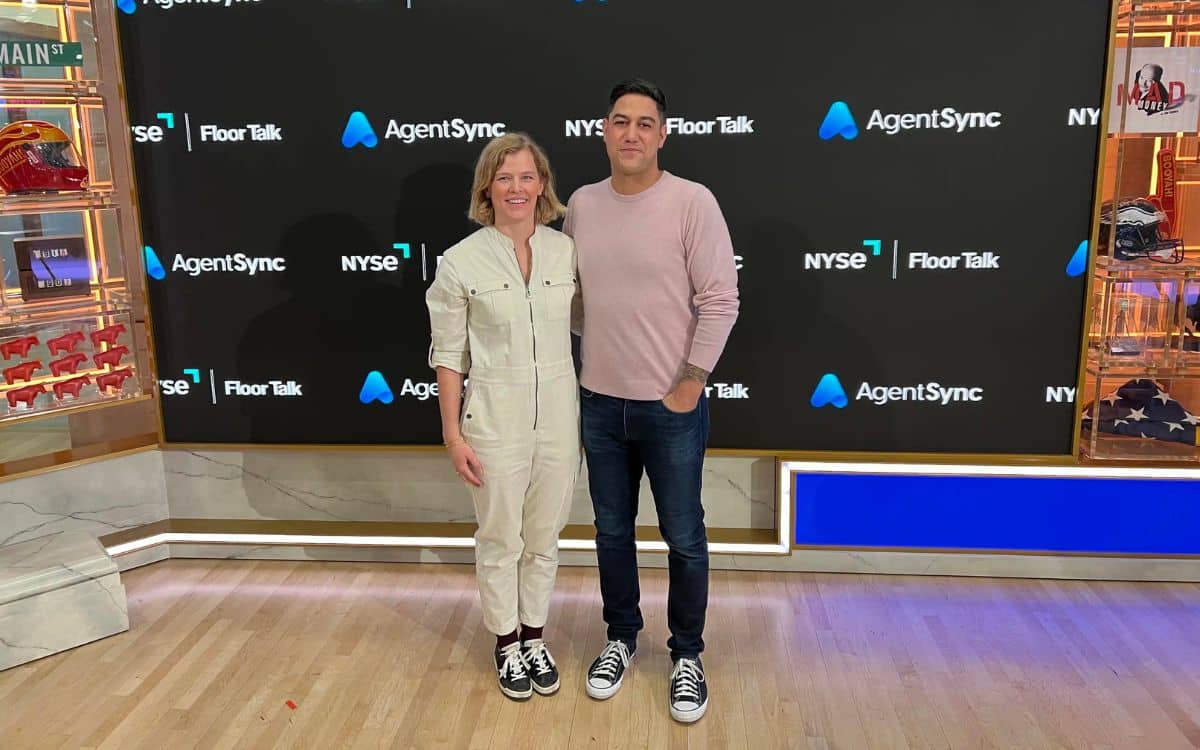
The business had also developed a clear view of whom its software was supposed to help. In their NYSE Floor Talk conversation, Sabharwal and Knight described insurance agents as continuing to play a necessary role. Customers still wanted expertise and advice. Digital tools did not make the purchasing decision simple for everyone.
That view gives the licensing project a human destination. A producer who spends less time entering the same details into disconnected systems has more time available for a customer. An agency with a clearer onboarding process can get someone working with fewer administrative detours.
The distinction also explains why AgentSync’s customer relationships mattered to the founders. Knight has described customers as partners in understanding the work. An insurer’s requirements supply more than a list of features; they show where a general idea about efficiency meets the actual sequence of approvals and responsibilities.
Sabharwal’s career had taken him from supporting salespeople to helping companies manage the conditions under which salespeople could sell. The resulting software sits behind the visible transaction. Its usefulness becomes apparent when people can proceed without having to stop and reconstruct the paperwork.
The founder takes a different chair
On October 14, 2025, AgentSync announced Samuels as CEO. Sabharwal moved to executive chair of the board. The company described the decision as one he and Knight had made together, with its next phase of growth in mind.
Samuels had been AgentSync’s chief commercial officer. Sabharwal’s explanation of the handoff emphasized the operating experience needed for a company at a different scale. He would remain close to strategy and culture while someone else took responsibility for the CEO assignment.
“It’s incredibly rare for a founder to be wired for every stage of a company’s evolution.”
Niji Sabharwal · on the CEO transition
The admission fits the operating habits visible elsewhere in his story. A tool built for one stage can become a constraint at the next. A process that worked for a small team may need rebuilding. Eventually, the founder’s own job belongs in that examination.
There is no requirement that the person who first understands a problem perform every role needed to solve it forever. Sabharwal stayed involved, with a different remit. Knight continued as the technical cofounder. The business they had started over dinner would carry on with another person running it.
The kitchen-table origin is charming. The work that followed was full of particulars: a credential, a state, a customer’s approval, an engineering hire. Sabharwal’s story gains its shape from paying attention to those particulars, then recognizing when a new set of hands should take over. Even the founder, it turns out, can be part of the workflow.