Before Niji Sabharwal built software for insurance compliance, he learned what compliance failure feels like from the inside. Zenefits had grown from roughly 100 employees to 1,700 in a rush. Desks were shared. Screens touched. The company sold benefits software through an insurance brokerage model, but the operational controls did not keep pace with the sales engine. Producers needed the right licenses and carrier appointments in every state where they worked. The details multiplied faster than the company’s systems could hold them.
Sabharwal had joined to build sales operations. When licensing violations surfaced, he was pulled into the response. The assignment lasted 22 months. His team had to reconstruct whether agents were properly authorized when thousands of transactions were quoted, bound, and paid. Regulators pressed. Records had to be reconciled. The experience was slow, bruising, and specific.
Years later, he described the mistake with unusual directness: the company had treated itself as a technology business and not seriously enough as a regulated insurance brokerage. It had also underestimated the continuing value of human brokers. The lesson did not turn him against technology. It made him more exacting about where technology belonged.
A crisis leaves behind a product brief
During the remediation, Sabharwal helped develop Licensing+, a free Salesforce application that checked state requirements against an agent’s status. He initially regarded the public release as a useful gesture. Then hundreds of downloads arrived, many from insurance carriers. That was the signal. A tool created inside one troubled brokerage was touching a problem shared across the industry.
Zenefits eventually assigned him the relevant intellectual property. Sabharwal left with a narrow idea: verify licenses in real time as transactions arrive. He also left with a rare combination of knowledge. He understood high-velocity sales operations, the limits of manual compliance, and the cost of discovering gaps after the fact.
“I consider myself probably more of a problem solver.”Niji Sabharwal
Problem solvers are often attracted to visible breakage. Insurance licensing is quieter. Every state sets its own requirements for licenses, appointments, affiliations, continuing education, and renewals. A five-person agency in one state can survive with a spreadsheet. A carrier or fast-growing brokerage operating nationwide cannot. The mundane work becomes a thicket of conditional logic.
The company began at the kitchen-table boundary
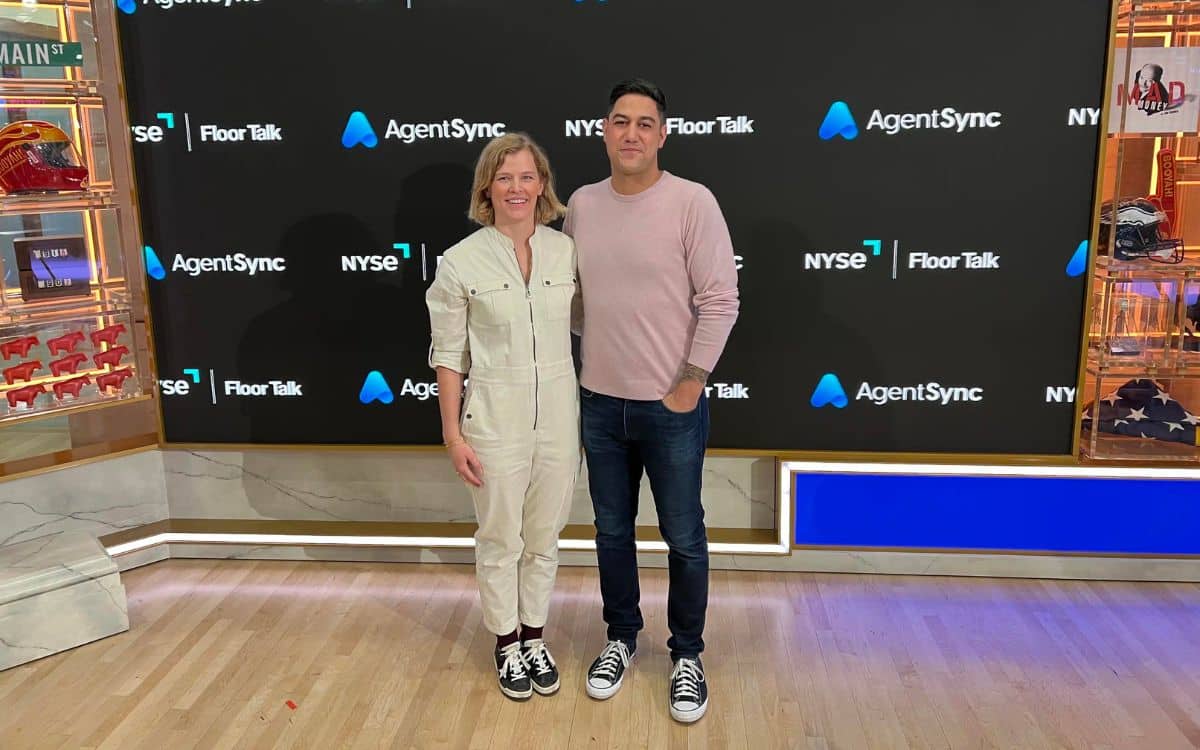
AgentSync was founded in San Francisco in 2018 by Sabharwal and Jenn Knight, his wife. They had met while working at LinkedIn. Knight went on to build business systems at Dropbox and Stripe; Sabharwal spent about five years at Zenefits. He brought the painful workflow. She brought the architecture to turn it into durable software.
Their division of labor was clean enough to describe in a sentence. Knight ran research and development. Sabharwal focused on the rest of the company. They met on product strategy. The home boundary was messier. In the early days, an idea at bedtime could become an hour-long product conversation. Knight worked on AgentSync during nights and weekends while still leading a large team at Stripe. Sabharwal would promise something to a customer, then ask if she could build it by Monday.
They lived on savings and initially paid themselves nothing. One contracted engineering mistake repeatedly submitted license transactions and cost about $70,000 before anyone caught it. There was a limit to how much they were prepared to lose. Product-market fit arrived before the limit did.
The first ten customers looked much like Zenefits: technology-forward companies selling insurance, often in group health. Then the category expanded. Carriers had the same pain. So did managing general agents, agencies, aggregators, and distributors across property, casualty, life, annuity, Medicare, and commercial lines. The license checker was becoming distribution infrastructure.
From paperwork to a distribution system
Bootstrapped discipline meets a hot market
Sabharwal was initially against fundraising. He and Knight had bootstrapped for roughly two years and reached customers with a small team. The restraint gave them leverage and kept decisions concrete. But demand was running ahead of their ability to hire engineers, salespeople, and customer teams. Parker Conrad, the Zenefits founder, wrote an early check and coached Sabharwal through raising capital.
The timing mattered. AgentSync moved its headquarters from San Francisco to Denver in March 2020, just as the pandemic reset where software companies could be built. Its first announced seed round came that summer. A second seed financing followed. In 2021 came a $25 million Series A and then a $75 million Series B at a reported $1.2 billion valuation.
The money made speed possible, but it changed the emotional ledger. Hiring meant becoming responsible for other people’s livelihoods. Sabharwal has called that pressure crushing. His account of growth is less victory lap than balance sheet: the chance to capture demand on one side, accountability to employees and investors on the other.
The product also widened beyond compliance. Sabharwal’s north star became making a producer ready to sell in something closer to real time. That meant normalizing the rules, connecting distributors with products, and moving repetitive steps into APIs. Compliance remained the backbone, but distribution was the larger body.
The problem solver confronts scale
Sabharwal’s first professional instinct was never grand leadership theater. He started at LinkedIn as the fifth sales development representative, making about 100 cold calls a day. When he saw the need for a systems role, he pitched it to his boss and moved into sales operations. By his account, the SDR organization grew from five people to more than 200 across nine offices. He spent a year in Dublin working through the linguistic and cultural mechanics of European sales.
That path explains his bias for diving into machinery. At an early startup, the person who sees a blockage can remove it personally. At 200 people, the same impulse can become interference. Sabharwal described the transition in plain terms: department leaders should be better at their jobs than the CEO, and the CEO needs enough context not to rip into a problem with a quick answer.
“The better you can remove roadblocks and let people run, the better the company and the business is going to do.”Niji Sabharwal
His definition of success carries the same tension. He talks about “leaning into the hurt,” solving something hard, and still feeling good about the time spent doing it. The phrase fits a founder who built from a regulatory wound. It also hints at a limit: loving a problem does not require occupying every role around it forever.
Seven years in, a deliberate handoff
On October 14, 2025, AgentSync announced that David Samuels would become CEO. Sabharwal moved to executive chair of the board, remaining focused on strategy and culture. He wrote that business growth is not linear and neither are leadership journeys. AgentSync’s scale, opportunities, and ambitions called for a different kind of operator.
Founder transitions are often narrated as endings, even when they are designed as continuations. Sabharwal’s move is more legible as the next expression of his leadership theory. Set the direction. Remove roadblocks. Let a strong operator run. Stay close enough to protect the reason the company exists.
The personal pattern has always contained both motion and boundaries. As a child in the Bay Area, he sold candy from his backpack, raced BMX bikes, listened to punk rock, and wanted to design buildings. After graduating from UC Santa Barbara into the 2009 recession, he struggled to land even a coffee-shop job and worked at a Berkeley stamp-and-engraving store. A conversation with a LinkedIn recruiter at his parents’ Halloween party opened the technology door.
In Denver, the boundaries are now more tangible. After their daughter was born, Sabharwal and Knight developed a simple signal for ending work talk at home. He spends spare time cooking, traveling, mountain biking, snowboarding, and riding dirt bikes. If given unlimited time, he says he would open a brunch restaurant designed to lose money gently - a place allowed to stay closed when its owner does not feel like waking up.
It is a funny aspiration for someone who spent years designing systems to remove delay. It also makes sense. AgentSync came from a world where nothing could be casual: every license, appointment, state, and date mattered. The imagined restaurant has no investors, no scaling plan, and no uptime promise. The cappuccino can arrive when it arrives.
For now, Sabharwal remains attached to the harder system. The work is to make insurance distribution feel less like a scavenger hunt and more like infrastructure: producers connected to products, regulators respected, customers served, and growth permitted to move without leaving control behind. The lesson he carried out of Zenefits was expensive. AgentSync is what he built so others would not have to buy it the same way.