The most important object in AgentSync's origin story is not an algorithm. It is a spreadsheet - the sort with too many tabs, too many owners and consequences wildly out of proportion to its charm. In 2014, Niji Sabharwal joined Zenefits in sales strategy and operations. The benefits startup grew faster than its appreciation for insurance regulation. Producer-licensing violations followed. Sabharwal was reassigned to work with legal and government-relations teams on the cleanup, a 22-month education that ended after Zenefits settled violations and paid millions of dollars in penalties.
That was the first thing to fail: a manual system asked to carry a regulated hypergrowth company. The mess exposed a more general flaw. An insurance producer is responsible for holding the right license, but the carrier, agency or managing general agent that lets that producer sell can still carry the institutional risk. Someone must know who is authorized, for which line, in which jurisdiction, under which appointment, right now. A spreadsheet can record yesterday. It cannot calmly answer today.
Sabharwal left in late 2018 and started AgentSync with Jenn Knight, his wife and a business-systems builder whose resume included LinkedIn, Dropbox and Stripe. They began at their kitchen table in San Francisco's Soma neighborhood. Their early discipline is worth stealing: prove that the product fits and that a buyer will pay before raising institutional money. In other words, do not confuse applause for regulated-industry software with a purchase order.

The product is the handoff
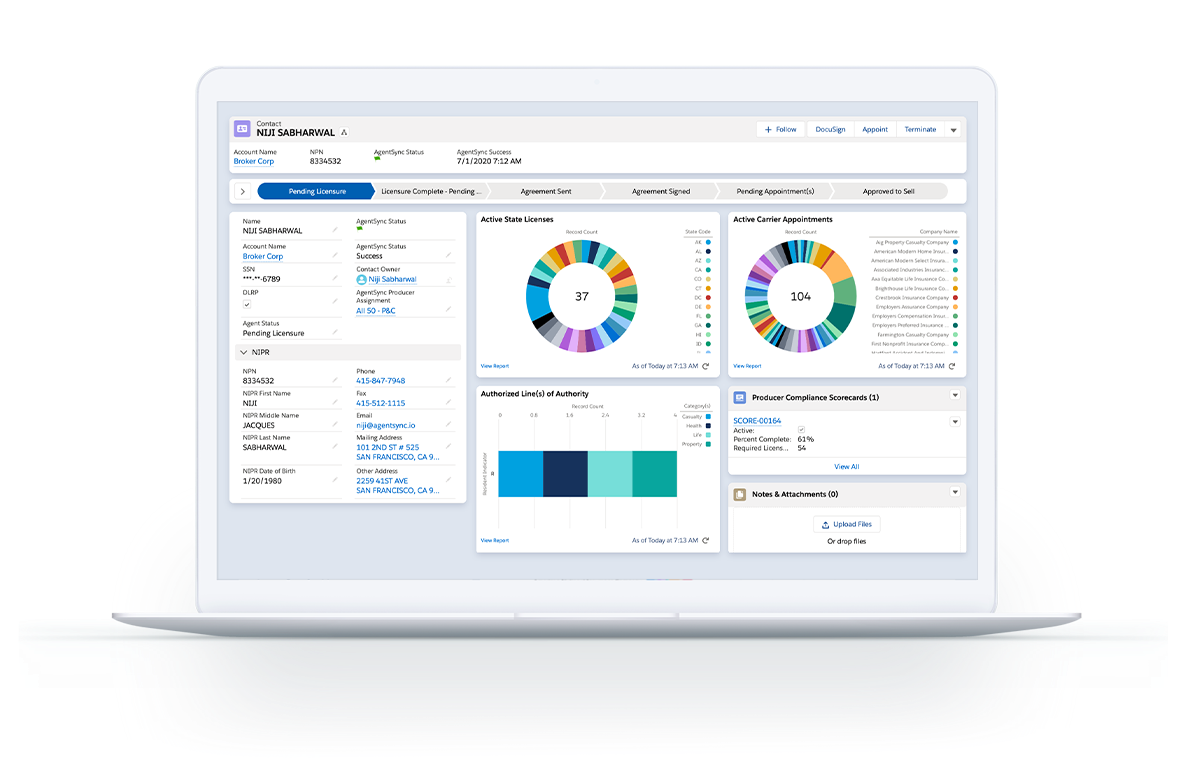
AgentSync does not issue licenses and it does not replace state regulators. It connects the industry's data source to the systems where work happens. Its flagship Manage product is built on Salesforce and ties directly to the National Insurance Producer Registry, or NIPR. It collects producer records, checks licenses and appointments, surfaces regulatory actions, and triggers workflows for onboarding, renewals, appointments and terminations. ProducerSync exposes normalized data through APIs. AutoPilot adds managed compliance work for teams that want software plus operators.
How a producer becomes ready to sell
The handoff is where AgentSync earns its keep. Old data in a nicer screen is still old data. A live license status connected to a rule - notify this producer, file that renewal, stop this appointment, expose the result to another system - becomes operational infrastructure. Compliance teams can manage exceptions instead of checking every row. Producers get a self-service view rather than another email asking whether their paperwork disappeared.
The company has followed that same record farther through the producer lifecycle. Contracting standardizes the bundles, forms, carrier requirements and signatures that sit between an agency and an underwriter. In April 2026, AgentSync said the product had passed 15,000 carrier submissions, tracked more than 55,000 contracts across 150 carriers and served more than 18,000 individual and firm producers. Hierarchies, introduced that month, maps who sits above whom, which commission level applies and how the structure looked on a past date. It includes approvals, audit logs, APIs and webhooks. The product road map resembles a paper trail learning to walk.
The customer buys fewer dead minutes
AgentSync sells to insurance carriers, agencies, brokerages and MGAs, from compact teams to distribution organizations managing tens of thousands of producers. The users are compliance specialists, licensing administrators, operations leaders, technologists and the agents themselves. Named customers over time have included Hippo, Lemonade, HUB International, Embroker, Steadily, Veterans United Insurance and Rate Insurance. Transamerica announced in 2025 that an AgentSync integration would deliver daily NIPR updates to reduce licensing holds in life and annuity applications.
Rate Insurance supplies the cleanest before-and-after. In 2022, it managed roughly 90 agents with a third-party service, a spreadsheet, SharePoint, e-signatures and a heroic quantity of follow-up. New agents spent two days completing contracts. Clerical errors could sit with carriers for weeks before rejection. After adding Manage and then Contracting, the agency says administrative onboarding fell to one hour, not-in-good-order applications dropped by more than 90 percent, it doubled its carrier roster and more than doubled agent headcount in three years.
“There was no visibility for the leadership team other than posting a spreadsheet to Sharepoint.”Jess Blair, Director of Operations, Rate Insurance
Steadily offers the more amusing conversion story. The landlord-insurance MGA initially chose incumbent Sircon after an RFP, yet staff still maintained spreadsheets to track application and renewal dates. When the employee handling licensing left, co-founder Datha Santomieri temporarily took over. Doing the work changed his mind. Duplicate applications, repeated fees and the lack of configurable rules stopped looking like tolerable overhead. Steadily returned to AgentSync, automated reminders and grew its force to 110 agents while making licensing a subject people largely stopped discussing. Quiet, in back-office software, is an excellent review.
A business built on expensive boredom
AgentSync is a demo-led enterprise SaaS company. It sells subscriptions, API access, additional modules, professional services and managed compliance support. It does not publish a standard price list. That matters: the buyer is not comparing a $19 app with a $29 app, but the full cost of licenses, implementation, data migration, Salesforce fit, integrations and ongoing administration against the salaries, delays, duplicate fees and regulatory exposure of the existing process.
The company raised $4.4 million in August 2020, another $6.7 million that November, and $25 million at a $220 million valuation in March 2021. Nine months later came a $75 million Series B at a $1.2 billion valuation. TechCrunch reported that AgentSync still had about $28 million in the bank, but chose to shrink its projected runway from five years to two by hiring faster. The round was raised from a detailed investor update, not a pitch deck; the first term sheet arrived within two days. It was venture-market exuberance with unusually good receipts: zero churn, 169 percent net dollar retention and rapid recurring-revenue growth were reported at the time.
The cost of that speed became visible in 2023, when the company conducted layoffs. Three months later it raised a $50 million Series B extension led by existing investors Craft Ventures and Valor Equity Partners. AgentSync said total funding reached $161 million, annual recurring revenue had tripled and customer count had more than doubled since the prior round. By October 2024 it described more than 250 enterprise insurance clients. The lesson is less cinematic than the unicorn headline: capital can accelerate a valid wedge, but it does not repeal the need to size a company for the market in front of it.

Where the wedge stops working
The obvious competitor is Vertafore's Sircon, an entrenched producer-management suite with long-standing carrier and regulator relationships. RegEd offers broader financial-services compliance. Producerflow, SureLC, ReSource Pro, direct NIPR services, custom Salesforce builds and internal operations teams cover overlapping territory. AgentSync's difference is the combination of Salesforce-native workflows, normalized NIPR data, a modern API surface and an expanding lifecycle that links licensing to contracts and hierarchy changes. It is a connected layer, not merely a renewal calendar.
Good conditions
- Many producers or jurisdictions
- Frequent onboarding and change
- Revenue waits on authorization
- Systems need live compliance data
Bad conditions
- Tiny, stable producer roster
- Single-state simplicity
- No owner for implementation
- Savings cannot clear enterprise cost
It will not work by magic. Registry data has coverage and timing constraints. Historical hierarchy gaps remain historical gaps. Some carriers still require processes that resist seamless third-party support. A company with five stable producers in one state may be better served by a disciplined operator and a smaller tool. A company that buys automation without assigning implementation owners can simply manufacture a newer spreadsheet beside it. The economics improve when volume, state complexity, change frequency and the cost of being wrong all rise together.
What an operator can copy
Copy the sequence, not the vocabulary. First, find the manual file attached to a regulated right to earn revenue. Second, identify the authoritative data source. Third, connect that source to a decision and an owner, rather than displaying it passively. Fourth, prove the workflow with a narrow product before expanding along the same record. Manage led naturally to ProducerSync, Contracting and Hierarchies because every step asks a new question about the same producer.
Also copy the moment Steadily changed its mind: put a senior decision-maker inside the existing workflow. Demo-room objections become concrete when an executive has to chase a renewal, pay twice or explain why an agent cannot sell. The best enterprise software does not merely save clicks. It removes a recurring uncertainty that had trained the organization to accept delay.
Founded from a San Francisco apartment after the Zenefits licensing cleanup.
Raised $11.1 million across seed and extension rounds; built a Denver team.
Raised Series A and B rounds; valuation reached $1.2 billion.
Cut staff, then raised $50 million while reporting stronger ARR and customer scale.
Expanded from licensing into Contracting and dynamic distribution Hierarchies.
AgentSync sits in a useful corner of the market: less glamorous than selling insurance, closer to revenue than generic compliance software, and more specialized than a horizontal CRM. Its wager is that every carrier, agency and MGA will eventually need a current, portable answer to who may sell what. The company began because the wrong answer cost millions. Its future depends on making the right answer cheaper than asking people to check.