The average homeowner encounters mortgage servicing as a monthly withdrawal and, once a year, an escrow statement capable of making a calm person stare suspiciously at a tax bill. Behind that bland encounter sits an industrial operation: cash application, investor accounting, insurance, tax, statements, lien documents, regulatory notices, call centers, bankruptcies, foreclosures, and a long parade of exceptions. Sagent makes the software that keeps that operation moving.
Its customer is the servicer. Its user is also the homeowner. Its real product is getting the two through a 30-year financial relationship without losing the data, the deadline, or each other.
The company reports more than 16 million active loans, over $2.5 trillion in unpaid principal balance, 40-plus lending clients, and 1.7 million self-service logins in a typical month. Those figures put Sagent far from the cheerful land of freemium SaaS. This is enterprise infrastructure sold to banks, credit unions, independent mortgage companies, and nonbank servicers on negotiated, often multi-year contracts.
01 / The unglamorous frontierThe closing is a moment. Servicing is a lifetime.
Mortgage technology modernized the front door first. Applications moved to phones; documents became electronic; approvals got quicker. Then the borrower closed and entered a servicing world built around mature systems, overnight files, separate portals, and staff who knew which screen contained the truth. That order made commercial sense. Origination drives an immediate sale. Servicing earns its value a few dollars, one compliant transaction, and one avoided mistake at a time.
Sagent began in its current form in 2018, when Warburg Pincus bought a 55 percent controlling interest in Fiserv's Lending Solutions businesses. Fiserv kept 45 percent. The package included LoanServ, a deeply established system of record for mortgage and consumer loans. There was no garage founder and no dramatic napkin sketch. Sagent was a carve-out with an installed base, decades of product history, and the useful burden of software that already mattered.
That lineage explains the company better than a founding myth would. LoanServ handles the ledger-grade chores: payments, escrow administration, collateral, investor management, reporting, and compliance. CARE gives borrowers a servicer-branded self-service experience. TEMPO manages loss mitigation and default. DataScape handles reporting and analytics. LoanBoard moves new loans into the system. Each is useful; together, they expose the original problem. A stack of connected products is still a stack.
02 / The betOne root system, not a nicer pile of tabs
Dara is Sagent's answer: one cloud-native platform with shared real-time data across Core, Consumer, Default, Analytics, Migration, and AI. The distinction is architectural, not cosmetic. When the borrower changes something, the service agent should see it. When a regulation changes, the relevant workflow should inherit the rule. When a loan enters hardship, documents, decisioning, messages, attorneys, and audit history should not scatter into separate systems.
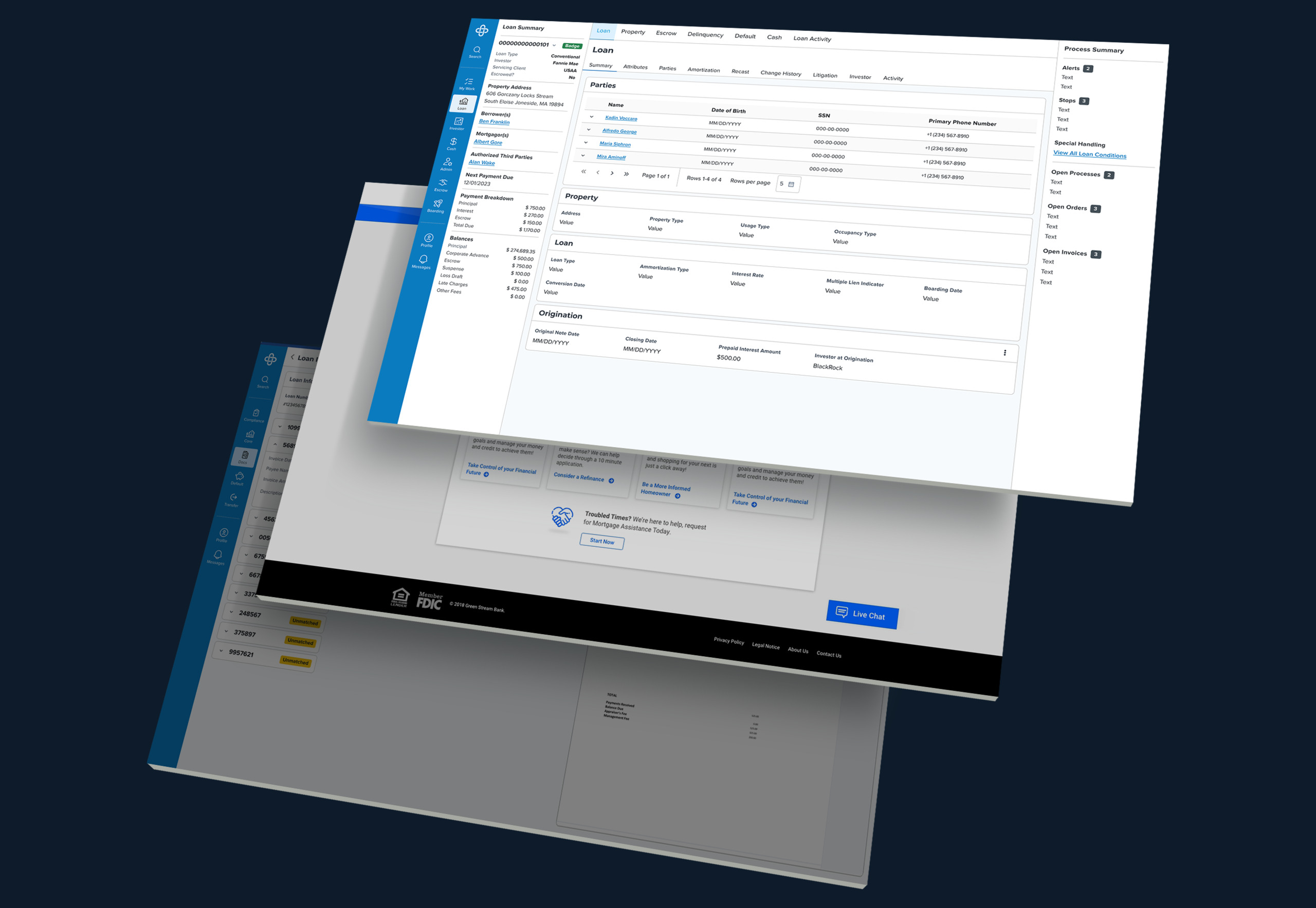
The platform is built around APIs that Sagent itself uses. The company says every manual action can be exposed for automation, while event-driven architecture replaces the ritual of waiting for a nightly batch. Dara's model carries roughly 3,300 fields, compared with about 2,200 baseline fields that Sagent's product chief describes as common in the industry. The extra structure lets the system retire peripheral tools and gives its AI something more useful than a chat box: context.
“Yesterday, you sent an email or waited on a report. Today, you just ask Dara.”Shane Leonard, Sagent chief product officer
Ask Dara lets an employee question a portfolio in ordinary language, pull the supporting documents, and propose a next action. RegIQ watches regulatory changes. AI Docs classifies and extracts information from more than 300 mortgage document types; Sagent claims throughput above 3,000 pages a minute and more than 3.3 billion pages processed. The interesting piece is the guardrail: actions can require human approval, and the trail stays logged. In a regulated system, a clever answer without evidence is merely a new kind of liability.
03 / What it costsThe price card is a contract. The savings number is a model.
Sagent does not publish subscription tiers. Public announcements reveal the shape of the sale instead: Freedom Mortgage renewed for five years; Bank of England Mortgage signed for ten; other deals bundle core software, consumer tools, analytics, default management, migration, integrations, and services. Buyers should expect a negotiated enterprise program, not a per-seat checkout page. Terms of the Warburg Pincus carve-out and the later Mr. Cooper technology transaction were also not publicly disclosed.
An executive discussing Dara in 2025 cited roughly $250 as the average annual cost to service a loan at a typical Mortgage Bankers Association member. Combine that reference point with Sagent's modeled 40 percent reduction and the theoretical prize is about $100 per loan per year. That is arithmetic, not a customer result. Delinquency mix, call-center volume, old integrations, conversion work, and contract price can move the answer sharply.
04 / The difficult middleThe first deadline was not the finish line
The rebuild became tangible in 2022. Mr. Cooper sold selected intellectual property from its proprietary cloud servicing platform to Sagent, received a minority equity stake and board seats, and became a multi-year customer. Sagent paired the technology of a huge servicer with its own product depth. It previewed Dara in February 2024, but the rollout was deliberately uneven.
Consumer, Default, and AI components reached production before the core. In February 2025, Dara Core was still under construction and approaching a demonstration and testing phase with Mr. Cooper; Movement and Data were described as roadmap work. The company had discussed completing the broader platform by June 2025. What arrived was not a single cinematic switch-over, but modules, tests, and later customer commitments. That is the first assumption the project corrected: a servicing core cannot be launched like a consumer app.
| Year | What changed | Why it mattered |
|---|---|---|
| 2018 | Warburg Pincus and Fiserv form the lending joint venture. | Sagent inherits LoanServ and a live enterprise base. |
| 2022 | Mr. Cooper contributes cloud servicing IP for equity. | The rewrite gains technology and a scale test partner. |
| 2024 | Dara is previewed; early modules run in production. | The vision turns into a phased platform rollout. |
| 2026 | New customers select Dara; leadership shifts to deployment. | The question moves from “can it be built?” to “can it convert?” |
That change in phase is visible at the top. Chris Marshall, previously Mr. Cooper's vice chairman and president and a Sagent board leader, became chairman and CEO in January 2026. Former CEO Geno Paluso moved into a vice-chairman and advisory role. The stated brief changed from building Dara to deploying it at scale.
05 / Proof, then scaleA claim in 60 days is not a core conversion
Sagent's cleanest early proof point is intentionally narrow. Idaho Housing and Finance Association implemented Dara Claims, powered by VAT-MS Cloud Claims, in under 60 days. The agency wanted to automate claims across multiple investors and recover more servicing expenses for affordable-housing programs. That project demonstrates the advantage of a modular entry: pick a painful workflow, connect it to the existing system, measure the effect, and expand from there.
The larger tests are now queued. Click n' Close committed to Core, Consumer, and Default. Land Home Financial selected Dara. Evergreen Home Loans chose the platform while switching from its former servicing system and expanding into new markets. Meanwhile, Sagent still operates LoanServ at scale. At the end of June 2026, the company said the LoanServ portfolio carried $1.080 trillion in unpaid principal balance. The old engine is not in a museum; it is hauling freight while its successor pulls alongside.
“Servicing, by nature, is a low margin, difficult business to do.”Shane Leonard, Sagent chief product officer
06 / The copyable partStart at the seam where humans retype the truth
Most companies cannot copy Sagent's mortgage expertise, its Fiserv lineage, or a partnership with the country's largest servicer. They can copy the sequence. First, map the full lifecycle instead of polishing the most visible screen. Second, establish one operational data model before layering on AI. Third, expose internal actions through the same APIs customers use. Fourth, migrate in modules where value can be proven without putting the core ledger at immediate risk.
The test is wonderfully mundane: find the places where an employee downloads a report, sends an email, checks another screen, or retypes a value. Those seams are where delay, cost, and compliance risk collect. Dara Invoice attacks emailed PDFs and spreadsheets between servicers and default vendors. Dara Consumer lets an agent see the same account view as a borrower. Dara Default connects attorneys directly to workflow and documents. None makes for a dazzling billboard. Each removes a handoff.
The approach is less attractive for a tiny portfolio whose existing system is cheap and adequate, or for an organization unwilling to standardize years of bespoke workflows. API-native does not mean migration-free. A core conversion still has to reconcile escrow balances, investor pools, payment history, legal cases, and partner interfaces. Buyers should ask for a five-year cost per loan, conversion fees, named implementation owners, parallel-run plans, support commitments for LoanServ, and exam-ready artifacts from live Dara deployments.
Sagent's nearest heavyweight alternative is ICE Mortgage Technology's MSP, the Black Knight platform with long production history and a broad integration network. Smaller servicers can also consider FICS, Finastra, Shaw, Nortridge, LoanPro, or internal systems. The choice is not simply old versus new. It is gradual modernization on a mature platform versus a migration toward a unified rewrite. A servicer buying certainty today may value installed-base depth. One buying lower unit cost and real-time flexibility may accept the conversion work.
07 / The actual productA mortgage that behaves like one relationship
For a bank, Sagent promises fewer systems to maintain, faster rule changes, visible workflows, and a better chance of retaining a borrower when rates move. For an operations team, it offers automation without surrendering the audit trail. For a homeowner, the result should be almost boring: a correct balance, an understandable escrow, a payment that posts now, a hardship option that appears before panic, and a human who already knows what happened in the app.
That last user never chose Sagent and may never see the name. Yet the homeowner is where the software's claims are finally tested. The company can process billions of documents and trillions in balances, but its sharpest measure is smaller: when life goes sideways, does the system help the servicer answer correctly on the first try?
Company scale and performance figures in this profile are reported by Sagent. Cost reduction is a vendor benchmark model, not a guaranteed customer result.