Somewhere behind a monthly mortgage payment, a person is reconciling a custodial account. Another is checking whether a borrower received the right letter before a regulatory deadline. A third is pulling a report, comparing it with another report and asking why two systems disagree. The homeowner never sees this machinery. The mortgage investor may notice only when it leaks money. Yet this is the territory Livegage has chosen: the long, fussy life of a loan after the celebratory closing photo.
The Holmdel, New Jersey company sells software for mortgage servicers and investors. Its products watch compliance deadlines, match cash and ledger entries, map scattered data, surface operating exceptions, assist distressed borrowers, run customer portals and monitor portfolio performance. The fashionable label is mortgage-native AI. The plainer description is more revealing: Livegage is trying to remove expensive human scavenger hunts from a business built around rules, money and mismatched records.
That makes its clearest competitor less cinematic than a frontier model. It is Microsoft Excel, surrounded by an aging system of record, a queue of exceptions and a team that knows exactly which report breaks on the third business day. Livegage does not ask that team to replace the core. Its modules sit around it, and the company says they can be integrated in 30 to 45 days.
The founder quit trying to fix it from the inside
Founder and CEO Anupam Sarwaikar spent 25 years in mortgage technology, including more than a decade as an enterprise-wide CIO across mortgage investment, asset management, servicing and origination. By his account, passion and frustration accumulated together. Origination gets attention because it wins the customer. Servicing owns the relationship that can last for the life of the loan, but it inherited the less photogenic technology.

“If I wanted to completely reinvent mortgage servicing, I couldn’t do it inside a mortgage company.”Anupam Sarwaikar, founder and CEO
What failed first, then, was not a startup product. It was the incremental playbook. Sarwaikar had watched teams automate workflows and modernize systems without escaping the constraints of the underlying stack. In 2021, he decided the work needed a separate fintech. Crucially, he did not conclude that every incumbent platform should be torn out. Servicers already pay heavily for their core systems. The new suite, he wrote later, had to wrap around those systems and pay for itself by lowering the cost of servicing.
That is the strategic move worth stealing. Enterprise founders often attack the central database because it owns the account. Livegage attacks the costly work orbiting it. A wraparound product faces integration headaches, but it avoids asking a risk-conscious financial institution to transplant its operational heart.
Begin with the spreadsheet that hurts
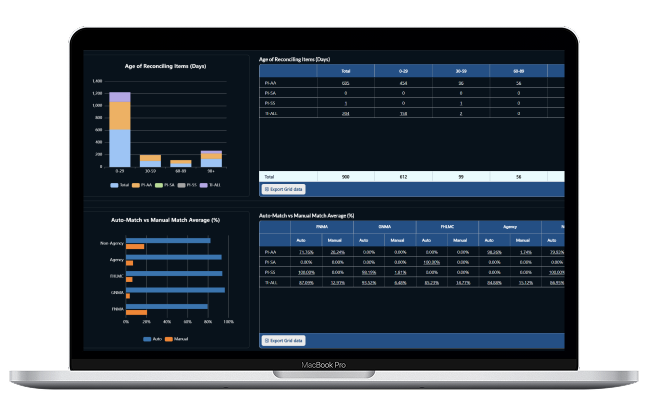
RECONCAIL is the easiest Livegage product to understand because the before-and-after can be counted. Mortgage investor-accounting teams reconcile servicing transactions, cash movements and bank accounts. The product performs that three-way match daily, then handles remittance reporting and servicing-fee calculations. Exceptions still exist; the point is to make people investigate exceptions instead of manually proving every ordinary line item.
Livegage publishes a “typical client experience” that is unusually concrete for an enterprise AI page. After 30 days, the auto-match rate ranged from 70.39 percent for principal-and-interest custodial accounts to 87.28 percent for tax-and-insurance custodial accounts. At 90 days, all three displayed account types were above 90 percent. Those are company-reported figures, not a controlled independent study. They are still more useful than a cloud of adjectives.
One engine, several unlovely jobs
The rest of the suite follows the same logic. VAIDA, developed over two years, is the proprietary engine underneath it. Livegage introduced it as a way to read servicing guidelines in PDF, Word or image form; extract the relevant conditions and actions; create process flows; and test those rules against a loan portfolio. COMPLAI extends the idea into continuous compliance: every loan against every maintained rule, with countdowns to potential breaches and work routed before a missed step becomes a finding.
INSAITS watches a different class of leakage. For servicers, it pulls daily metrics across 11 operational departments and exposes breaks at portfolio and loan level. For investors, it adds servicer surveillance, reps-and-warranties tracking and modeled-versus-actual yield views. ENLAIT tackles the prerequisite nobody wants to put on the keynote slide: mapping scattered source data into a warehouse and making it usable without code.
On the borrower side, ENGAIGE is a brandable web and mobile portal. Its landing page adapts to behavior and recent loan activity; borrowers can make payments, request payoff quotes, monitor escrow and share documents. HOMEAID focuses on self-service workout options for people in financial distress. In 2026, Livegage also began promoting KLAIMS for default-claims work and a suite of servicing agents with human review at approval gates.
The names are a small act of corporate mischief: COMPLAI, RECONCAIL, ENGAIGE, INSAITS. Each smuggles “AI” into a mortgage verb. The products themselves are less playful. A wrong compliance interpretation or an unreviewed borrower action has consequences. Livegage’s own terms tell users to verify AI output and recommend human review. That caveat is not legal wallpaper; it is the operating model.
The scale claim needs the right denominator
Livegage says its products are in production with clients managing more than $1 trillion in combined unpaid principal balance. This is a useful signal, but it is not $1 trillion of transactions processed by Livegage, and it says nothing by itself about revenue or customer count. It describes the mortgage portfolios managed by client firms. In enterprise finance, that still matters: production software is being exposed to institutions with serious operational scale.
The named users are roles rather than logos: servicing operations, compliance, investor accounting, capital markets, MSR investors and portfolio managers. The company has not published list prices. Its model is familiar B2B enterprise software, sold through demos and implementation conversations, with data-mapping expertise available alongside modular products.
Its market position sits between core servicing platforms and narrow point solutions. Incumbents such as ICE Mortgage Technology, Sagent, Fiserv and the ecosystem descended from Black Knight own deep systems and long relationships. Internal teams can also build reports and workflows. Livegage’s differentiation is the shared mortgage-trained layer across multiple jobs, deployed without demanding a core conversion. That advantage disappears if integration becomes as slow or costly as replacement.
Where the wager breaks
AI on top of bad data produces faster confusion. The approach is a poor fit when source records are incomplete, processes change without control, rules are not maintained, integration access is blocked or managers expect model output to replace accountable human judgment. A company also needs enough repetitive volume for the saved labor and prevented errors to cover implementation.
The copyable playbook is pleasingly boring
There is a temptation to copy Livegage at the level of vocabulary: train a vertical model, add agents, announce transformation. The more useful lesson is operational. Start where a specialist team spends expensive hours proving that normal things are normal. Keep the system of record. Automate the routine cases, route the exceptions and publish a metric that a buyer can verify after 30 and 90 days.
Livegage has assembled the kind of team this thesis requires. Its leadership combines mortgage operations, capital markets and technology, while a 2025 advisory board added veterans from servicing, investment, fraud prevention and startup scaling. Chief operating officer Mike Blair joined after running servicing organizations and said the tools addressed problems he had wrestled with for years. The culture is remote-first across the United States and India, with periodic gatherings, a flat structure and, according to its careers page, office snacks and a nap room.
The company still has the hard part ahead. Mortgage buyers move carefully, integration promises meet real data, and every automation creates a new exception class. But Livegage has chosen the right kind of proof. A compliance countdown should prevent a miss. A reconciliation engine should shorten the close. A surveillance view should catch leakage. If those numbers hold across customers, the spreadsheet tax becomes visible - and once a tax is visible, someone eventually demands a rebate.