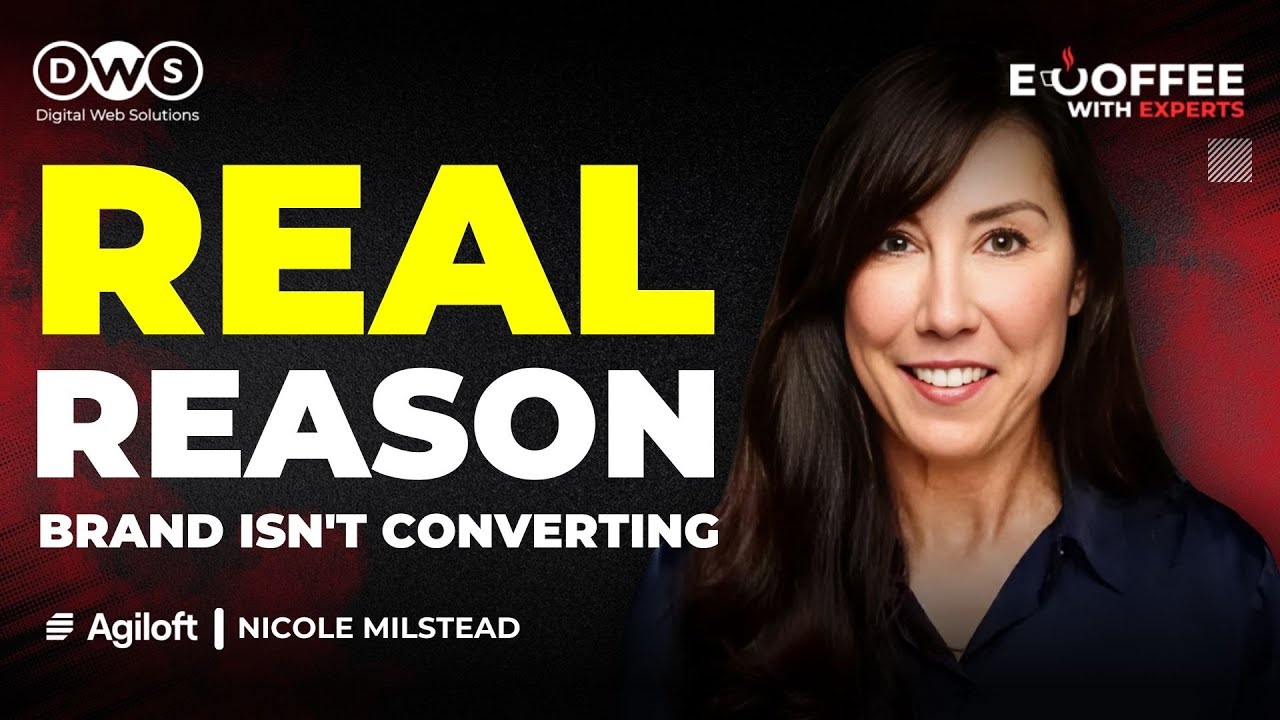
Nicole Milstead’s career begins with a useful misdirection. Before the dashboards, pipeline reviews and executive meetings, there was social work. She earned a master’s degree at the University of Pennsylvania after completing her undergraduate education at Lafayette College. Then the plot turned toward enterprise technology: a sales role at Gartner, analyst relations at SAP, 14 years at Oracle, senior leadership and the chief marketing job at FinancialForce, and finally Agiloft, where she became chief marketing officer in May 2023.
It is tempting to tidy this into a story about an accidental marketer. The more interesting reading is that Milstead kept using the same instrument in different rooms: attention. A social worker pays attention to the person inside a system. An analyst-relations leader notices how a market makes judgments. A business-development executive watches the distance between a campaign and a sale. A CMO must somehow do all three before lunch.
Milstead’s version of marketing is therefore less about clever decoration and more about connected machinery. She talks about empathy, emotional connection and being a good human. She also talks about funnel conversion, marketing operations and controlling the metrics a team can actually control. Warmth and rigor sit at the same table. Neither is asked to wait outside.
The degree that refused to become irrelevant
At first glance, social work and software marketing occupy opposite ends of a university prospectus. One studies people and institutions; the other sells systems to institutions full of people. In practice, the overlap is almost impolite. Enterprise purchases are complicated social acts. Buyers carry professional risk. Salespeople interpret hesitation. Product teams defend detail. Marketers translate all of it into a reason to care now.
Milstead has described her path as nonlinear, and the phrase fits without turning it into mythology. Her early Gartner sales experience put her close to the commercial conversation. At SAP, she led analyst relations, learning how outside experts test a company’s claims against a noisy market. She was running that function by age 28. Then came Oracle, where 14 years supplied the scale: field engagement, business development, segmented sales plays, campaigns and demand programs.
Sales at Gartner, close to the questions enterprise buyers ask.
Two years directing analyst relations at SAP.
Leadership posts at Oracle spanning field engagement and business development.
FinancialForce: senior vice president of marketing, then CMO.
Chief marketing officer at Agiloft.
The career progression makes more sense when seen as accumulating translations. Gartner taught the buyer’s language. SAP added the analyst’s. Oracle taught scale. FinancialForce offered the chance to build a team and a demand engine. Agiloft added a category - contract lifecycle management - whose value must be explained across legal, procurement, finance, sales and operations. Every new room required the old skill of listening before speaking.
“Get comfortable with being uncomfortable in your role.”Nicole Milstead
Make the engine visible
Milstead calls marketing operations a secret weapon. This is not glamorous language, which may be why it is helpful. Operations is where ambition receives a calendar, an owner and a measurement plan. It reveals whether a brand idea can travel through a campaign, whether a lead can travel toward sales, and whether anyone can explain what happened without opening seven incompatible spreadsheets.
Her recurring subject is the gap between sales and marketing. Alignment is easy to announce and hard to operate. The practical work begins by locating where context disappears: which accounts matter, how demand is defined, when a lead is useful, what feedback returns, and which outcome both teams recognize. Milstead’s advice is to understand those gaps rather than decorate them with a slogan.
The same duality appears in her view of events. An event has a brand job and a demand job. The first creates recognition, memory and trust. The second helps create and advance commercial conversations. Forcing either purpose to impersonate the other produces bad measurement. A dinner may deepen a relationship without generating a neat pile of form fills; a product session may produce intent without becoming the thing anyone remembers six months later. Good operators name the job before demanding the number.
Her line about controlling what you can control is equally unsentimental. Marketing cannot command a market, a budget cycle or a buyer’s internal politics. It can improve the quality of its choices, the clarity of handoffs and the speed of learning. This is not a retreat from accountability. It is a sharper definition of it.
A team award, with a dashboard attached
When FinancialForce promoted Milstead from senior vice president of marketing to CMO in 2022, she framed the honor through her experience as a former athlete. It was, she wrote, “a team award.” The phrase could have dissolved into ceremonial modesty. Her colleagues’ descriptions make it more concrete. They credited her with clearing roadblocks, trusting experts, collaborating on analysis and building a culture in which people could do stronger work together.
That history gives substance to another piece of her shorthand: EX = CX. Employee experience becomes customer experience because the internal conditions of work eventually leak into every external interaction. A confused team creates confused handoffs. A team trusted with context can make better choices at the edge. Culture is not the beanbag chair in the corner; it is the quality of the decision made when the executive is absent.
“As an ex-athlete, it is easiest for me to frame this up as a team award!”Nicole Milstead, on becoming FinancialForce CMO
The athlete metaphor also explains why her people-first language does not excuse low standards. Teams practice, review and keep score. Accountability is a form of respect when the goal is clear and the system is fair. Milstead’s public playbook asks leaders to hire good people, give them room to contribute expertise, and use data to improve the work rather than to stage a weekly inquisition.
Five notes worth stealing
- Find the real gap between sales and marketing before prescribing alignment.
- Give brand and demand separate jobs, then let them reinforce each other.
- Treat marketing operations as strategy made executable.
- Measure the variables the team can influence.
- Build employee experience with the customer consequence in mind.
Brand is a room full of honest answers
At Agiloft, Milstead participated in a brand-development process that began with an admirably analog move: put executives from different functions in a room and determine who the company is, where it is going and what it wants to mean in the market. She called that work the crux of building a North Star. The meeting matters because companies rarely suffer from a shortage of adjectives. They suffer from incompatible private definitions.
Agiloft’s product sits inside contracts, documents famous for making interesting work look beige. The marketing challenge is to connect technical capabilities - data, workflows, integrations and AI - to progress a business can recognize. That demands coherence across audiences who approach contracts from different angles. Legal sees obligation and risk. Procurement sees suppliers and terms. Finance sees exposure. Sales sees time. The brand must give those perspectives one useful center without flattening them.
Milstead’s attraction to Agiloft included its flexible no-code platform, its customers, its people and its culture. Her remit was direct: advance marketing strategy, create demand and strengthen the company’s position in contract lifecycle management. The job joins her career’s two persistent interests. Make a complicated system legible. Make the humans around it feel included in the explanation.
The human stays in the loop
No modern enterprise-software conversation avoids artificial intelligence for long. Milstead’s position is concise: AI should enhance human effort, not replace it. In marketing, that boundary is useful. Machines can accelerate research, variation, analysis and routine production. They cannot be held accountable for taste, trust or the consequences of a claim. Efficiency is welcome; abdication is not.
The principle fits the rest of her operating system. Technology expands what a team can see and do. Empathy helps decide what is worth doing. Operations turns the decision into repeatable behavior. Evidence shows whether it worked. Then the circuit begins again, ideally with fewer meetings and better questions.
Milstead’s scenic route never really left its first subject. Her career has remained about people inside systems: buyers inside markets, marketers inside revenue organizations, employees inside cultures, and now contract professionals inside a flood of business data. The titles changed. The scale grew. The ability to read both the room and the dashboard kept compounding.
There is a career lesson here, though not the tidy kind. A nonlinear path becomes valuable when its traveler notices what transfers. Milstead carried human understanding into enterprise software and added operational discipline without sanding off the empathy. The result is not a contradiction. It is a CMO who can ask what people need, what the system permits and what the number proves - in that order, or all at once.