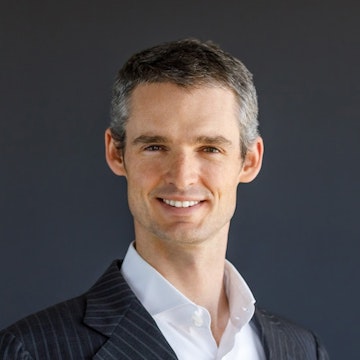
On a Tuesday in late August 2025, Nicolas Desmarais walked onto a stage in Austin and pitched the audience an idea that sounded slightly absurd until you heard him say it: every recurring service a business buys - software, telecom minutes, watt-hours, laptops, AI agents - should be sold through one storefront, billed on one invoice, managed in one console. He called it the Everything Store for B2B. The line landed because Desmarais had spent the previous sixteen years quietly building the plumbing required to make it true.
AppDirect, the company he co-founded with Daniel Saks in 2009, now powers digital marketplaces for thousands of providers, employs roughly 850 people, generates around $227M in annual revenue, and was last valued north of $1.5B. The Caisse de depot et placement du Quebec backed a $185M round in 2021 and added another $100M in debt financing in January 2024. The capital is not for a moonshot. It is for the slightly unglamorous work of subscription billing, partner onboarding, catalog management and lifecycle automation that has to exist before any "everything store" can ring up its first transaction.
That is the through-line of Desmarais's career. The interesting bet was never the front-end marketplace. It was the conviction, made in an apartment in San Francisco in 2009, that software would shortly stop being sold as a thing you owned and start being sold as a thing you rented from someone who rented it from somebody else. AppDirect is the registry of that chain.
From an apartment, two roommates and a quiet launch
The origin story is told in the way the best ones are - with embarrassment intact. Desmarais and Daniel Saks were 23, fresh from a summer of arguing about where business software was going. They both saw the same thing: a shift to subscription delivery that would gut the on-premise model. They moved into a San Francisco apartment, then into a tiny windowless office, and in early 2011 they pushed AppDirect's first product live.
Nothing happened. The team had been there overnight, staring at a monitor waiting for the user count to climb. It never did. The accounts of those weeks - retold years later in Inc. - describe the silence with a kind of fondness, because the silence is what forced the pivot. Instead of selling directly to small businesses, AppDirect repositioned to sell through the people who already had small businesses as customers: telcos, distributors, channel partners. The marketplace became infrastructure for someone else's marketplace.
A consultant's instincts, a founder's stamina
Desmarais came to the apartment from Bain & Company, where he had spent his post-college years as a management consultant in media and business services. Before Bain, Amherst College - a double major in economics and political science, class of 2007. The resume reads like a setup for a comfortable career inside a Boston tower. He chose a different one.
What he carried from Bain into AppDirect was a habit of treating ecosystems like systems. The early product roadmap was less about clever features than about clean interfaces between the parties that needed to transact: vendors, resellers, end users, billing engines, identity providers. The result was unsexy and durable. Storefronts. Subscription billing. Provisioning APIs. Reseller hierarchies. A back office.
In 2015 he and Saks were named to the Forbes 30 Under 30 list together. The recognition was nice. The more important thing that year was that AppDirect was becoming the default invisible engine for digital catalogs at companies most people had never heard of.
The Desmarais surname, used sparingly
Nicolas Desmarais is the son of Paul Desmarais Jr., co-CEO of Power Corporation of Canada - the holding company that, through its various arms, has been an early backer of Wealthsimple, Koho, Borrowell and other Canadian fintech names. He has also held the title of Senior Vice-President at Power Corporation.
It would be tidy to write that the family name explains AppDirect. It does not. The first cheques came from Inovia, the Montreal early-stage firm. The later cheques came from CDPQ, Quebec's pension manager, on terms that would not have been written had AppDirect not posted the numbers. What the family heritage explains is the geography. AppDirect's Canadian headquarters sits in Montreal, and its largest team in North America is in Quebec. The cross-border posture - San Francisco for product and customers, Montreal for engineering and capital - is the through-line that ties Desmarais's two worlds together.
A buying spree, on purpose
From 2024 onward, AppDirect's most consistent press release is an acquisition notice. Firstbase, in December 2024, added IT asset management for hardware. Broker Online Exchange and DNE Resources, in mid-2025, added energy procurement. Tackle.io, late in 2025, added hyperscaler marketplace integration. A network and mobility lifecycle platform closed in December 2025. PartnerStack, in April 2026, added partner relationship management.
The pattern is not financial engineering. It is category widening. Each acquisition installs another vertical inside the same catalog and billing rails. The pitch to a telco or a reseller becomes: you already use AppDirect to sell software subscriptions; here is energy, here is hardware, here is partner economics. The pitch to a CIO becomes: you already buy software through your channel; here is everything else you buy on a recurring basis. Desmarais is, in effect, turning the back-office of subscription commerce into a horizontal layer.
AI, on Desmarais's terms
The 2025 Thrive keynote framed the current AI moment with a number the audience apparently wrote down: the AI cycle, in AppDirect's read, is on pace to play out nearly ten times faster than the first two industrial revolutions combined. The ecosystem went from fewer than 25,000 models released annually in 2021 to nearly one million in 2025. The implication, in Desmarais's framing, is not that the world needs another model - it is that the world urgently needs a procurement layer for the models that exist.
That is what devs.ai, AppDirect's agentic AI marketplace, is meant to be. And it is what the broader "AI-led Everything Store" announcement was meant to signal. The thesis lines up with everything Desmarais has built so far: when a category gets noisy and fragmented, the company that wins is usually not the loudest vendor; it is the one that runs the catalog.
Outside the building
The personal record is short and that is deliberate. Public bios mention outdoor activities and international travel and leave it at that. He talks to NYSE Floor Talk about distribution. He posts AppDirect milestones to LinkedIn. He does not, by any visible measure, court the personal-brand economy. In a Bay Area moment defined by founder-influencers, this is its own posture.
If you want to understand how Desmarais thinks, watch the keynotes - the Thrive 2025 opening is the most current - and pay attention to which slides he lingers on. He lingers on slides about cycles. About fragmentation. About the boring fact that buyers want one bill and sellers want one channel. The pitch, in seventeen years, has not actually changed. The categories have.
What he is actually doing
Strip the press cycle away and the job is straightforward. AppDirect, under Desmarais, is consolidating the back-office of B2B subscription commerce across software, telecom, energy, hardware and AI, then renting it to the providers and resellers who already own the customer relationships. The acquisitions broaden the surface area. The capital structure - equity from CDPQ, debt facilities, an active capital program for partners - extends the runway. The AI announcements give the catalog a new aisle.
The interesting question for the next eighteen months is not whether AppDirect adds another vertical. It will. The question is whether the Everything Store frame holds: whether buyers will accept that energy and AI agents and laptops and SaaS all belong in the same procurement console. If they do, the company that wins the consolidation will be the one with the cleanest billing rails and the longest list of integrated providers. That is the bet Desmarais has been making, quietly, since 2009.
He has been right about cycles before.