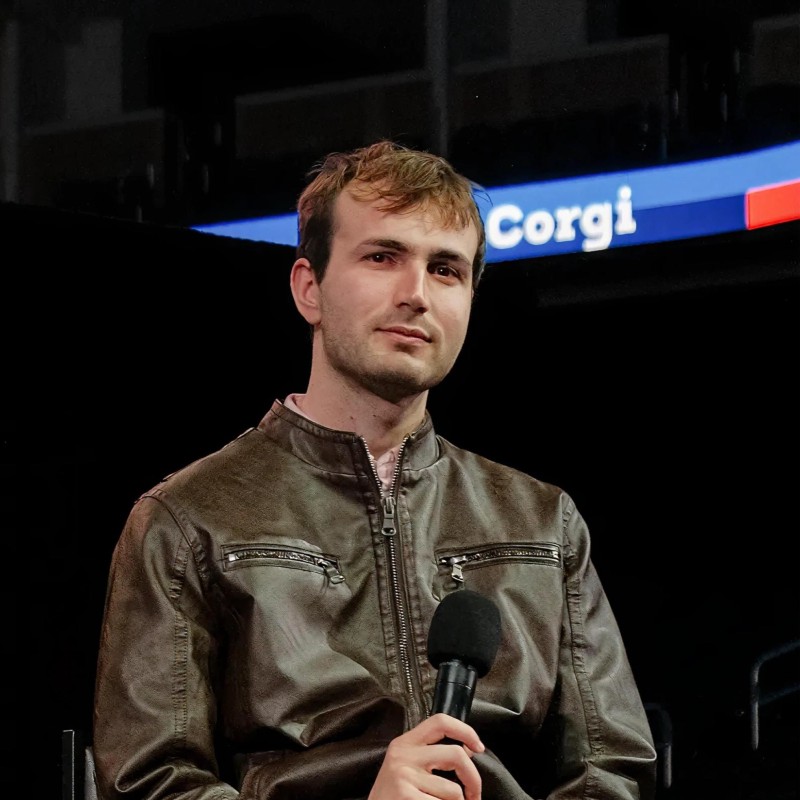
Not the Insurance Guy
Nico Laqua did not grow up wanting to sell directors-and-officers coverage to Series A startups. He studied neuroscience at Columbia, where he was a Rabi Scholar - a designation reserved for the top handful of STEM students per graduating class. He ran computational biology experiments with Nobel Laureate Hamilton Smith. He worked on protein folding. He built things with LSTMs before transformers were the story everyone told.
Then he made a social app called Picnic. It turned into something else. By 2023, Basket Entertainment - built from the rubble of Picnic's pivot - was a gaming publisher with 35+ titles and more than 200 million monthly active users. Between 25% and 50% of teens across most Western markets were touching one of his products at least once a month. The company had $6 million in revenue and earned Laqua a spot on Forbes 30 Under 30 in Consumer Technology.
Then, at 24, he walked away and started an insurance company.
Where other companies might take the boring but safe path, Corgi will always dream bigger, accomplish more, and take more swings for the fences.
- Nico Laqua, Corgi Series B AnnouncementWhy Insurance
The question gets asked. The answer is not romantic. Insurance is a $5+ trillion industry running on infrastructure designed for a world that moved at human speed. Quotes take days. Underwriting is manual. Policies are fax-machine-era documents wrapped in digital PDFs. Every startup in America needs it - D&O, cyber, GL, the works - and almost none of them can get a quote before their board meeting.
Laqua and co-founder Emily Yuan, a former OpenAI product manager, entered Y Combinator's Summer 2024 batch with a thesis: build the insurance carrier itself, not just a broker in front of one. Own the underwriting. Own the issuance. Use AI to do in minutes what underwriters spend weeks on. Strip out every middleman who exists only because no one built the infrastructure to remove them.
The strategy worked because it was structurally hard. Becoming a licensed insurance carrier is not a weekend project. Regulatory approval took until July 2025. Most competitors would not bother. That wait time became a moat.
Corgi by the Numbers (May 2026)
- $1.3 billion valuation — unicorn in under 2 years
- $268M total capital raised across seed, Series A, Series B
- $40M+ annual recurring revenue since July 2025 carrier approval
- 140 employees across SF, Salt Lake City, Atlanta, Chicago, Dallas, NYC, and London
- Products: D&O liability, cyber insurance, commercial GL, AI liability - expanding into trucking
- Series B led by TCV — January to May 2026: $630M to $1.3B valuation
The Cockroach Philosophy
Walk into Corgi's Financial District office and you will find live hissing cockroaches. Not metaphorical ones. Actual Madagascar hissing cockroaches. Laqua keeps them as a statement of organizational philosophy: "Cockroaches can't be crushed, and need to be able to scurry pretty quickly." He means it about the company. He means it about himself.
He requires seven-day work weeks from his team. He lives in the office - around four or five Corgi employees share that arrangement. He has said the minimum baseline for anyone building something real is working every waking hour, seven days a week. His brand head, Erika Lee, has quipped: "You'll find his charred body here if there's a fire." Laqua doesn't deny it.
His net worth is 99%+ held in Corgi equity. He drives a hand-painted 1965 Dodge A100 that he restored himself. He has a corgi named Trudy. The name of the company is not accidental.
You need to be pretty tough and hardcore - 7 day workweeks are the minimum baseline.
- Nico Laqua, on startup mentalityThe Cafe Nobody Asked For
In February 2026, Corgi opened a 24-hour cafe at 9 Claude Lane in San Francisco's Financial District. The street is literally named Claude. The investors, by Laqua's own account, "absolutely hated" the idea. He opened it anyway.
The Corgi Cafe is not a marketing stunt, exactly - it's a community play built around the thesis that the best insurance customers (funded startups, founders, VCs) are the same people who need a place to work at 2 AM. Baristas earn $20 an hour. Smoothies cost $14. Y Combinator alumni get 20% off. Laqua has compared the dynamic to African savannah watering holes, where animals have to drink and lions happen to be waiting. The cafe loses money. He is not concerned.
"We are losing some money on it," he said. "We are not making a profit on it." The plan, clearly, is not profit. It's proximity.
From $630M to $1.3B: Four Months
Corgi raised $108 million across seed and Series A in January 2026, valuing the company at $630 million. Four months later, in May 2026, TCV led a $160 million Series B at a $1.3 billion valuation. The doubling-plus happened in a single news cycle's worth of time. The company had been a licensed insurance carrier for less than a year.
Annual recurring revenue had already crossed $40 million by that point. The Series B announcement coincided with the launch of AI liability insurance - coverage for companies whose AI models produce errors or cause harm - and the company's expansion into trucking, where Corgi plans to bring faster quoting and adaptive risk models to commercial fleets.
"The job is not done," Laqua told TechCrunch after the round closed. "Our mission is bigger: we want to use the fresh capital to expand into more lines of insurance and build a generational company."
We will for sure always be the most passionate, genuine, curious, and ambitious of any company.
- Nico LaquaThe Columbia Thread
Laqua graduated from Columbia University around 2022 as a neuroscience major and Rabi Scholar. The Rabi Scholars program is named for Columbia Nobel laureate Isidor Isaac Rabi - it's reserved for the top ten or so STEM students per graduating class. Before he shipped his first startup, Laqua was doing oyster genetics research with Nobel Laureate Hamilton Smith, working on protein folding, and building AI systems when LSTMs were the dominant paradigm and GPT was still a research paper most people hadn't read.
He also did VR research from 2018 to 2020. The through-line in all of it: computational thinking applied to biological and complex systems. Insurance, in a certain light, is a complex system with biological-level messiness - probabilistic risk, emergent behaviors, feedback loops no one has modeled properly. The neuroscientist in Laqua sees that. The engineer in him wants to fix it.
What Comes Next
Corgi now operates out of seven cities - San Francisco, Salt Lake City, Atlanta, Chicago, Dallas, New York City, and London. The company has free SF bus routes running as of April 2026. It has a 24-hour cafe. It has 140 employees and $268 million in the bank. It has a dog.
Laqua has said the aspiration is a trillion-dollar company. That's not a rounding error from where Corgi sits today - it's two orders of magnitude. The insurance industry is large enough that the math is not insane. The question is whether the infrastructure Corgi is building can scale past startup coverage into the full commercial insurance stack - trucking, payroll, small business, and eventually whatever comes after those.
He's 26. He has a cockroach in his office and a corgi named Trudy. He's building at the speed of compute.