In 2004, David Lasker noticed something wonderfully unglamorous: recordable DVDs were getting cheaper. Lasker was a Chicago video journalist who had founded Nationwide News Monitors four years earlier. Television monitoring produced an awkward abundance. You recorded hours of local news, found the segment a client wanted, delivered it - and then faced the old storage question. Keep the rest, or throw it away?
The falling price of a disc changed the answer. Keeping broadcasts became affordable. A temporary stream could become a permanent library. That decision, more than any slogan about artificial intelligence or real-time insight, explains News Exposure LLC. The company Lasker created in 2011 inherited the earlier operation’s appetite for preserving things and added a high-definition archive begun in late 2010. The archive is not merely storage. It is memory for organizations that discover, usually at the least convenient moment, that yesterday’s news has become today’s evidence.
The first thing to fail is the clean keyword
Imagine a brand manager waiting for a mention on the evening news. The monitoring software sees closed captions. But the reporter gestures toward a product without naming it. A lower-third identifies an executive whose name is never spoken. A live shot matters because of its location, not its transcript. The machine has the broadcast and still misses the point.
News Exposure’s response arrived in 2013: a research department that hand-logged broadcasts. The loggers wrote down names, titles, brands, places and live reports, making visual information searchable alongside captions. The following year the company recruited veterans from Cision, Multivision and VMS. In its own account, the staff grew from one person in 2011 to more than 30 by 2018.
This is the company’s useful contradiction. It sells technology - dashboards, alerts, Boolean search, analytics and a portal for playing, editing, saving and sharing clips. It also sells relief from technology. A customer can work in DIY mode, or choose Done-for-You service and ask researchers, editors and analysts to turn the feed into something fit for a chief executive.
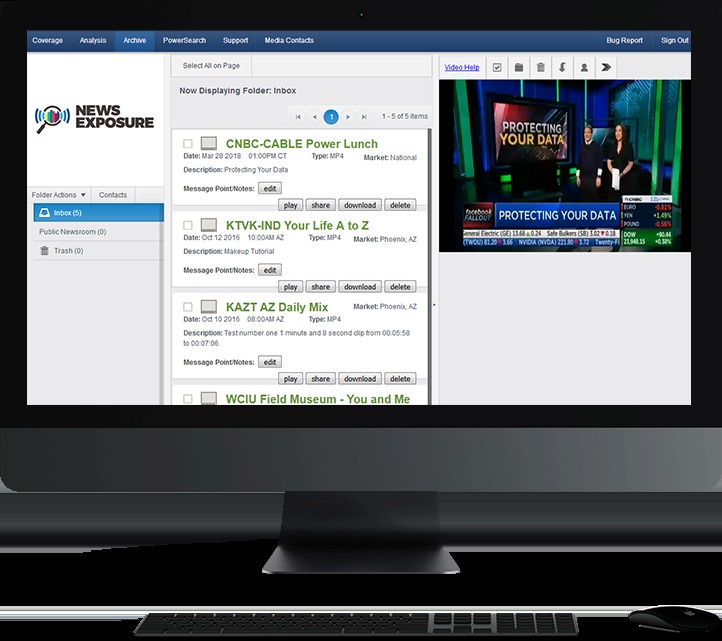
A dashboard, an archive and an outsourced newsroom
The product begins with collection. News Exposure tracks TV, radio, print, websites and social platforms. Its television footprint covers all 210 U.S. designated market areas, with more than 1,100 stations and over 100 cable channels and networks listed on its market page. Online monitoring ranges across news sites, articles, blogs and podcasts. Print still matters because local reporting often starts the chain that later reaches television and the web.
Then comes interpretation. Customers can chart coverage by source, city, state, tone, placement or prominence. Human analysts can add sentiment, share of voice, key-message pickup and quality rankings. Reports arrive as email, PDF, spreadsheet, presentation or portal view. The media-contact product adds more than 1.5 million profiles. Creative staff can turn earned coverage into a three-to-five-minute sizzle reel. A request can be as small as one old clip or as broad as a continuing national brief.
“Our News Exposure rep is a true extension of our agency, helping us to stay on top of the news so that we can be extremely proactive and responsive to our clients.”Kristy Jozwiak and Angela Menninger, Duality Public Relations
The customers follow the problem rather than one industry. Rust-Oleum praises the ease of clipping and downloading video. Make-A-Wish Arizona uses reports to share media success with supporters, volunteers and families. ASU Gammage has bought archive clips. The site displays brands including Fifth Third Bank, Costco, Edelman, Hilton and Skechers. Public records add schools, health systems and government offices to the mix. In 2024, the CDC said it intended to buy a News Exposure license and related services for its Injury Center, which handles roughly 1,200 media requests a year.
What did it cost? It depends on the job.
News Exposure does not publish a neat price grid. The business mixes subscriptions, custom service and one-off work, so public spending records are more revealing than a fictional “starting at” number. They show a wide range, not a standard tariff.
Publicly disclosed examples
Four purchases, four scopes
That range is the point. A district buying clips twice in a month is not buying the same thing as a national institution monitoring multiple topics. The company’s business model flexes from transaction to subscription, then layers on editing, analysis, newsletters, archive access and dedicated support. The obvious competitor may be Cision, Meltwater, Critical Mention, TVEyes, Onclusive or Brandwatch. For a tiny team with three distinctive search terms, however, the real competitor is free: Google Alerts and a patient intern.
The part worth copying
News Exposure’s most transferable idea is not “build a television archive.” It is a three-layer information workflow. Preserve the raw material. Let software create speed and reach. Put people exactly where ambiguity becomes expensive.
The sequence works beyond public relations. Compliance teams, researchers, customer-support groups and investors all face the same problem: too much signal-shaped noise. The mistake is assigning expensive judgment to every item or no judgment to any item. News Exposure splits the work.
Speed matters most when the room is tense
Crisis monitoring makes the model easiest to see. A product recall breaks after dinner. Coverage spreads from one local station to social posts and national pickup. The communications team needs clips, volume and reach, but also needs to know whether the company’s message appeared, whether the tone shifted, and which claim is escaping containment. News Exposure says its staff can activate monitoring quickly, deliver material near real time and remain available after hours.
A raw mention count will not tell the team what to say next. A lovingly edited daily brief that arrives tomorrow will not help either. The hybrid works only when the collection is fast, the search is broad and the humans are selective. Its limits are equally plain. If a company needs only occasional web mentions, free or low-cost tools may be sufficient. If the target conversation happens mainly in private communities, no broadcast archive can see it. And if nobody inside the customer organization has authority to act, a perfect alert simply documents the delay.
News Exposure occupies a practical middle of the media-intelligence market: more service than a self-serve alert, more software and archival reach than a boutique clipping shop. Its oldest insight came from storage economics. Its durable one came later. When the news machine accelerates, the valuable product is not the largest pile of results. It is the smaller pile that a person can trust.
Keep watching
Explore the company’s services, history, social channels and working notes.