An electricity bill is an unlikely place to look for a founder’s philosophy. It arrives, it demands money, and it rarely receives a standing ovation. Yet the machinery behind that ordinary transaction is where Neeraj Datta’s professional world comes into focus: meters, customer accounts, software, engineers, and the agreements that persuade all of them to cooperate.
Datta is the founder and CEO of Abjayon, based in Fremont, California. His business sits in the space between buying enterprise technology and getting it to work in the daily life of a utility. That space contains plenty of technical difficulty. It also contains people with different responsibilities, deadlines, and definitions of a successful project. Someone has to keep the conversation going.
His background is in information technology sales and business development. Those disciplines can sound distant from the control room. In his case, they form the route into it. The interesting question in Datta’s career is how a leader whose work involves customers and alliances helps assemble an organization capable of delivering the operational detail those customers need.
The promotion had a long preface
In March 2023, Abjayon announced Datta’s promotion to CEO. Its explanation centered on sales leadership, customer management, and alliances. The company credited him with helping enter new markets and develop partner relationships. The appointment put an existing commercial leader in charge of the wider enterprise, extending a remit already tied to the company’s growth.
There is a useful distinction between introducing a customer to software and accepting responsibility for an implementation. The introduction can fit inside a presentation. The implementation must survive contact with existing systems, real data, and people who have work to finish. Datta’s move to the chief executive role placed those two ends of the relationship under the same leadership.
His education includes Savitribai Phule Pune University, where his public professional profile lists study from 1992 to 1994 and identifies an MBA and a bachelor’s degree in engineering. The pairing supplies a modest but relevant detail: his professional vocabulary has room for both a technical problem and a commercial conversation. Neither degree, of course, can make a cutover happen by itself.
Today his responsibilities encompass business development, program and portfolio management, and operations. Read together, those responsibilities describe the full length of a promise: find the work, organize the work, and keep the organization able to perform it. For a services business, the distance between the first handshake and the final delivery is where a reputation gets made.
Portland puts the promise to work
Portland General Electric provides a concrete example of the world Datta leads. The utility needed to move its Oracle Network Management System from version 2.4 to 2.6. The objectives included modernization, continued platform viability, and improved performance. Even the version numbers suggest the unglamorous precision involved. A small change in a label can contain a large amount of work.
An outage management upgrade brings a particular kind of scrutiny. The people using the system need a coherent view of the network and the information required to respond. A project has to account for the operational setting in which the technology will be used. Architecture, testing, integration, and the transition into service all belong to the same story.
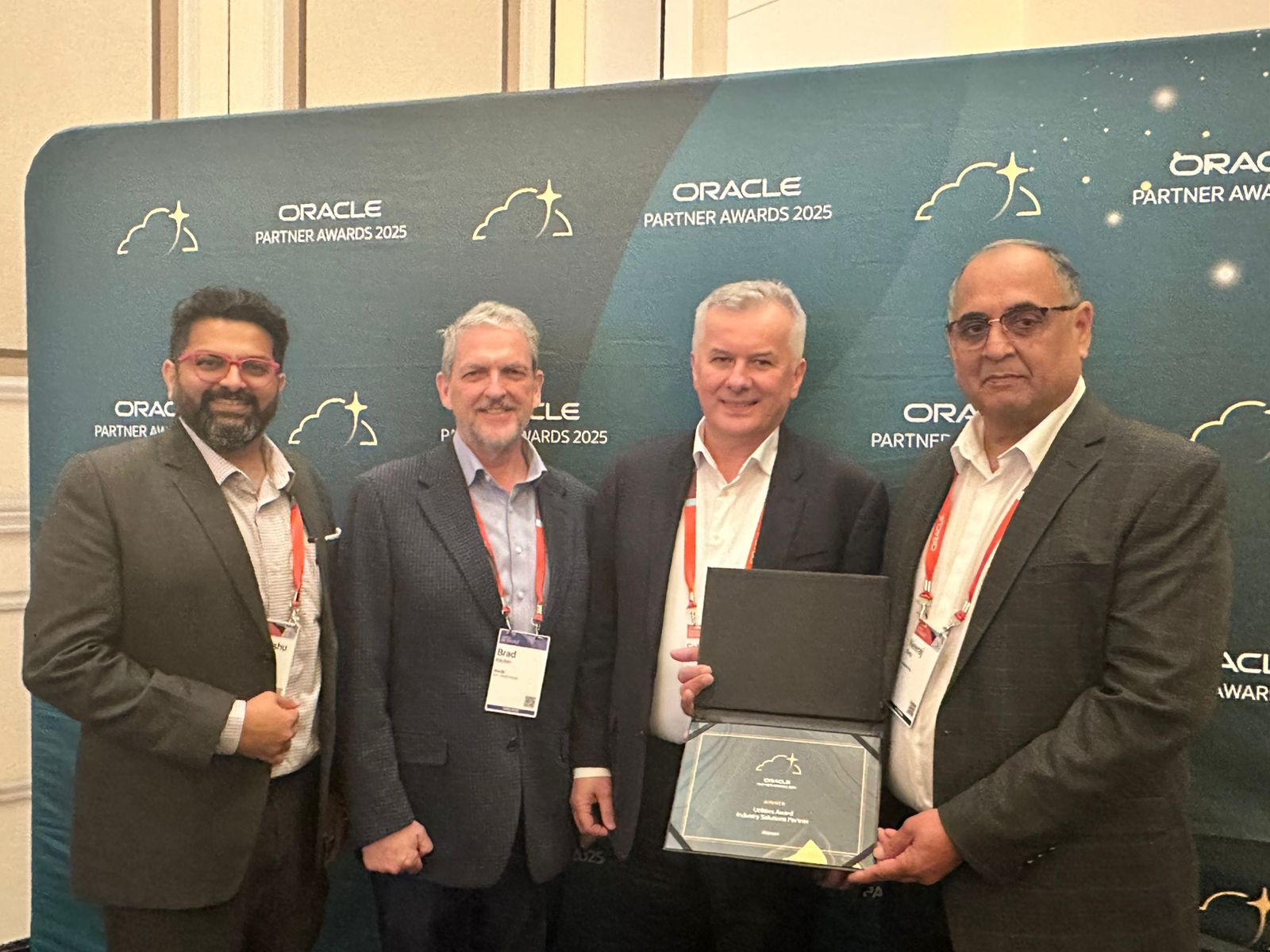
Abjayon received the 2025 Oracle Utilities Industry Solution Partner Award at Oracle AI World. Its announcement connected the recognition to the Portland project. Datta’s own celebration named HCL as a partner and extended credit to the teams at Abjayon, HCL, and PGE. The list of names matters: the achievement crossed organizational boundaries before it reached an awards backdrop.
The project also gave his partnership argument something measurable to stand on. Abjayon reported a 93 percent reduction in CPU utilization and a threefold increase in operator productivity through the FlexOps interface. These are the company’s reported project results, rather than a measure of Datta’s individual performance. Their value in his story is that they show what the business he leads is trying to deliver.
Reported for the PGE modernization in Abjayon’s October 2025 award announcement.
In the announcement, Datta described the need for partners who understand a utility’s “operational heartbeat.” The phrase is more revealing than the trophy. It locates the work inside an organization’s routines, where technology has to support the people already responsible for keeping a service functioning. An attractive system diagram still has to earn its place at someone’s desk.
A business built between departments
The breadth of Abjayon’s work helps explain the demands on its CEO. Its utility practice covers customer systems, meter data, assets, and network operations. Each area has its own specialists. Each also touches another part of the organization. A billing platform needs usable meter information; an asset system needs a workable connection to maintenance and financial processes.
A North American public power utility project illustrates the connections. The implementation began in mid-2023 and went live in September 2024, replacing a legacy system with Oracle Work & Asset Cloud Service. The described scope included integrations with enterprise resource planning, project management, supply chain, human resources, and field service systems. The client was unnamed in the announcement.
Datta shared that implementation with a brief congratulation to his team. The underlying work included maintenance plans, work orders, inventory planning, and financial integration. These are ordinary organizational nouns with substantial consequences. If they cannot exchange information, the customer inherits the gaps. A partnership business earns its fee by making those handoffs less troublesome.
data↔Customer
billing↔Asset
work↔Grid
operations
Abjayon’s Emicool engagement adds a customer-facing example. The company implemented Oracle Utilities Customer Cloud Service alongside Impresa CX. This places a customer engagement product beside a core utility platform. For a business leader, the relationship has two audiences: the utility buying the system and the customer who eventually uses the service it supports.
The product portfolio takes the argument further. Impresa CX offers customer self-service, account information, payments, and usage analytics. Impresa Insights addresses analytics across utility functions. The common thread is the movement of information toward a useful decision or action. That is a practical way to read Datta’s market: the software has to reach beyond the people who installed it.
The team behind the handshake
Datta works alongside co-founder Meet Antani, who leads delivery and corporate responsibilities. Antani spent 20 years at Oracle in the United Kingdom and India before Abjayon. The leadership group also includes specialists in digital engineering, technical services, and regional delivery. It is a structure in which customer relationships sit beside substantial experience of the products being implemented.
That arrangement is relevant to Datta’s own division of labor. A chief executive can establish priorities and maintain a relationship with a customer. Engineers and delivery leaders must turn the agreement into a system that can be maintained. The useful leadership question is how those people stay connected as a project moves from discussion into execution.
His public interests offer one lighter detail: he plays golf. The company’s biography also emphasizes his belief in teamwork and intelligence. Golf gives an individual plenty of opportunities to discover the limits of confidence. The teamwork emphasis belongs more directly to the business, where a polished sales conversation has little lasting value unless other people can deliver on it.
“This award is a proud milestone for us.”
Neeraj Datta, on Abjayon’s 2025 Oracle recognition
The plural in that short celebration is consistent with his public updates. Customers, partners, and colleagues recur in them. It would be excessive to turn a handful of posts into a complete psychological portrait. They do, however, show the way he chooses to describe progress: a set of shared undertakings, with credit distributed across the people involved.
The next conversation starts with the last delivery
At the beginning of 2025, Datta looked back on implementations of Oracle Customer Cloud Service and Work & Asset Cloud Service across multiple geographies. He also described new customers for Impresa CX and Impresa Insights, a stronger presence in the Middle East and Asia-Pacific, and additions to the United States utility customer portfolio.
His forward agenda included modernizing grids, handling asset and network complexity, and transforming billing and metering platforms. Those ambitions follow naturally from the work already underway. They are connected by a familiar executive challenge: how to expand the business while preserving enough attention to the specifics of each customer’s operations.
The Portland work remained part of Abjayon’s industry conversation in 2026. Its DISTRIBUTECH program listed a session with Abjayon’s Himanshu Bari and PGE’s Shalini Anbalagan on outage management modernization. Another session addressed Saudi Electricity Company’s experience with Impresa AI. The engineers and customers were given the floor to discuss the actual work.
Put the dates beside one another and a slower business rhythm emerges. His CEO appointment came in 2023. The public power utility’s asset system went live in 2024. The Oracle recognition followed in 2025, and the Portland project appeared on a conference program in 2026. A company can tell those events as separate announcements. Read together, they show a business accumulating work that can be discussed again with customers and peers. For Datta, the relationship continues through each stage, even as the people doing the talking change.
That is a fitting place to leave Datta’s story for now. The CEO helps create the conditions for the next agreement; the delivery team gives the agreement substance; the customer has to live with the result. Back at the electricity bill, nobody asks who negotiated the partnership. They expect the numbers to make sense. There is a considerable business in meeting that expectation.