A person moving house wants the electricity switched on. Inside the utility, that ordinary request can become a relay: an identity check, a billing check, a fraud check, a question passed to another department. The customer sees a form. The employees see the machinery. Avertra has built a business in the distance between those two views.
- MiCustomer connects customer requests with the systems and people needed to finish them.
- Avertra sells enterprise software alongside SAP, low-code, and consulting services.
- Its most instructive work starts with a process people already find frustrating.
There is a suitably unglamorous origin. According to Avertra’s account, founder Giancarlo Reyes was a meter reader whose leg injury brought him into back-office jobs. Those assignments exposed the administrative complexity behind essential services. A disrupted working day became an education in how utilities operate.
Established in 2007, Avertra now targets utilities, logistics, government, and financial institutions. The connecting thread is work that carries consequences: a payment, a service connection, an answer somebody needs. Its mission, “Simplify life,” sounds modest until you consider how many departments can participate in making one task difficult.


The expensive part was learning to change
Before Avertra could simplify other organizations, it had to confront its own development process. A Mendix customer story describes more than $10 million spent over five years building MiCustomer. Distributed engineering, misunderstandings, and architectural changes produced delays and rework. Bseirani concluded that continuing the same way would make change progressively harder.
The team tested the same application on competing low-code platforms and chose Mendix. Troubleshooting and integration flexibility mattered. The case reports developer onboarding falling from three to five months to four weeks, and a utility onboarding workflow shrinking from 16 minutes to five. These are reported examples, rather than promises for every deployment.
“We realized that unless we did something differently, these problems wouldn’t go away.”Bashir Bseirani, CEO, in Mendix’s customer story
The interesting decision was accepting another route after an expensive start. For a buyer, that history suggests a sensible question: how easily can this system accommodate the next change? A beautiful demonstration is one test. Updating a live process is another.
Read the training manual
MiCustomer is a modular digital experience platform. In plain language, it helps connect what a customer asks for with what an organization must do. MiPortal supports self-service; MiAgent addresses employee work; MiComm coordinates communications; MiVirtualAgent brings automated assistance into the conversation. Payments and service operations belong in the same broader product family.
Avertra also provides SAP modernization, Mendix application development, AI services, and managed services. Its market position sits between enterprise records and daily interactions. An internal development team, a systems integrator, or an existing enterprise vendor could address parts of that job. Avertra’s pitch combines utility knowledge, reusable software, and implementation expertise.
The TECO move-in case makes the method concrete. Avertra says the previous arrangement used forms, bots, and manual review, with escalations stranded in inboxes. Its team studied agent training guides, observed customer interactions, and mapped the handoffs between billing, fraud prevention, and escalation management.
Clear ownership for the exceptions that still need a person.
The resulting MiMove experience gave customers and employees shared process logic and visibility. In its October 2025 account, Avertra reported that 69% of start-service requests were fully automated. That detail matters because it leaves room for exceptions. Useful automation includes knowing where a person should take over.
There is a copyable practice here: read the manual people actually use, then follow one request across departmental boundaries. Count the handoffs before choosing the interface. Otherwise, a faster form can simply feed the same crowded inbox.
The software has to meet the storm
During an outage, a customer portal faces a different examination. People want to know which areas are affected and when service might return. Relatives may be checking from elsewhere. Demand arrives in a surge, at precisely the moment the organization has other urgent work.
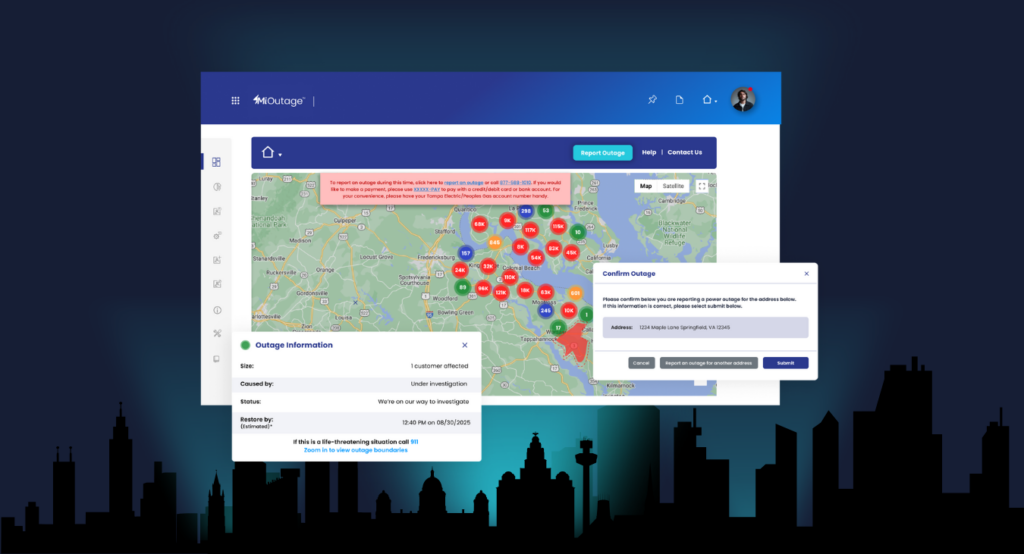
Avertra’s December 2024 Tampa Electric case reports 94,600 concurrent users during Hurricane Milton. It describes five-minute updates and access from 102 countries. Across Helene and Milton, the teams put in 1,078 engineering hours and shipped eight releases. The map was a service operation requiring attention while customers depended on it.
For an enterprise buyer, the lesson is practical: test a critical customer channel against peak demand and changing information. Average traffic says little about the hour when everyone wants an answer.
A portal can shorten a journey
The Navajo Tribal Utility Authority example changes the unit of measurement. Its territory spans roughly 27,000 square miles. For households far from district offices, handling a request online can replace travel as well as time on hold.
In January 2026, Avertra described an NTUA portal covering accounts, usage, and payments, followed by guided installment plans, payment deferrals, and reconnection requests. Work requiring review entered a structured queue. The relevant design question becomes whether a household can finish an important task with clear instructions and a dependable route to help.
Avertra’s commercial model reflects that complexity: business customers buy software and the services needed to connect and adapt it. Cypress Growth Capital announced a $4 million investment in December 2019, principally for MiCustomer sales and marketing. An implementation has its own economics, determined by integration, scope, and ongoing support.
Who gets to build the next version?
The people doing the work belong in this story. In 2023, the U.S. State Department recognized Avertra’s Jordan operation for women’s economic security. Its programs include skills training; a separate CareerWise and CityWorks DC initiative offered Washington high-school students training followed by paid, part-time apprenticeships.

The same emphasis appears in its August 2026 writing about AI: validation, staff judgment, and phased adoption come before producing more output. That is a useful boundary for its broader proposition. Software depends on reliable information, workable integrations, and people who understand the process. Where those conditions are missing, a new interface inherits the confusion. The place to begin is still that ordinary request, and every obstacle between it and completion.