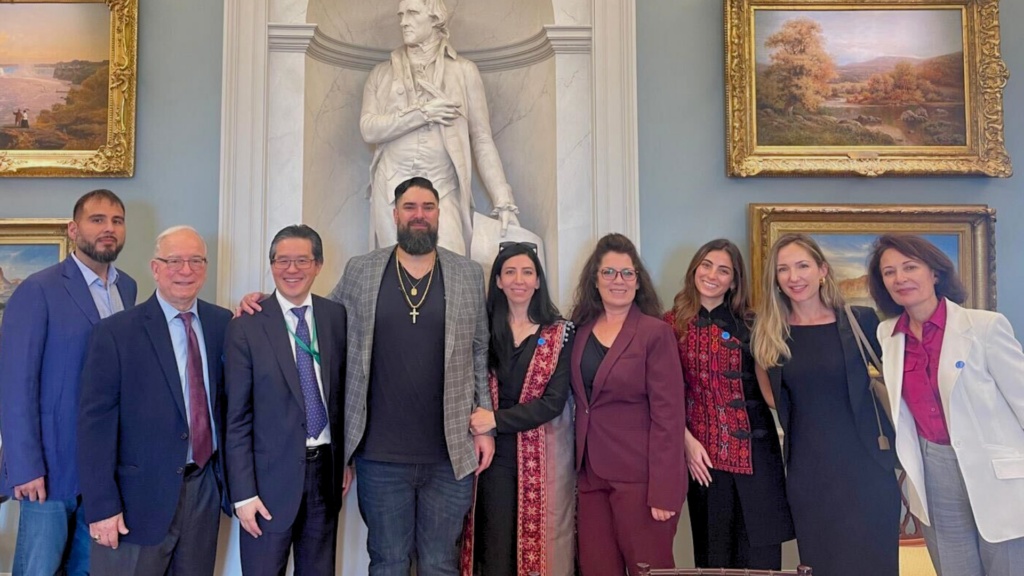
Bashir Bseirani missed his cue. In the Benjamin Franklin Room at the State Department, on October 30, 2023, the CEO and CTO of Avertra arrived at the microphone with an admission that drew laughter. “I definitely missed my cue,” he said. Then came another confession: he had initially wondered whether the recognition was a joke. It was real. His software company was receiving a Secretary of State’s Award for Corporate Excellence.
The setting invited a conventional speech about achievement. Bseirani talked about his mother. Born in Jordan, she had moved to the United States as a teenager. He thanked the women in his family and the women at Avertra. The award recognized the company’s contribution to women’s economic security in Jordan. For an executive whose working vocabulary includes integration architecture and decision automation, the explanation of what mattered was unusually direct: the people were already in the room.
That moment offers a way into a career usually described through enterprise technology. Bseirani holds two jobs at once: chief executive and chief technology officer. One requires deciding where a business should go; the other requires understanding the machinery that might get it there. Occasionally, the machinery has to be reconsidered. His story includes a costly example of doing exactly that.
A business built between systems
Before Avertra, Bseirani worked at SAP and HCL-Axon. His professional territory included the journey utilities call “meter to cash”: the operations connecting a customer’s service, consumption and payment. There are field crews, account records, billing rules and customer-service desks along the way. Much of the job involves making the handoffs work. A household experiences one service, even when the organization delivering it has divided the work among several systems.
This background matters because utility technology rewards familiarity with what already exists. A business cannot treat every old application as disposable. People rely on it; employees know how to operate it; other systems depend on its records. Improving the experience therefore becomes a question of connections. The glamorous part of software is the demonstration. The useful part often happens where two unglamorous systems agree about an address.
By 2014, Bseirani and his business partner Giancarlo Reyes were describing Avertra’s growth from a two-person operation into a company with offices and customers across several regions. Their early proposition combined consulting with products. Bseirani emphasized internally developed analytical tools and methods for understanding clients’ existing systems. He also described the company as self-funded at that point in its history.
There was ambition in those early accounts, but also a particular kind of apprenticeship. Consulting puts a team close to the recurring trouble. It sees which steps get repeated, which exceptions require a specialist, and which promises collapse when they meet the actual workflow. A product business tries to turn that accumulated knowledge into something another customer can use. Avertra’s shift toward its own utility software followed that route.
In 2016, Bseirani was discussing products that could work with established infrastructure, including mainframe applications. Customer self-service, bills and communication channels were central concerns. Compatibility was part of the proposition. The company wanted to improve what people could do without requiring every utility to begin its technological life again.
His approach to colleagues also carried an emphasis on familiarity and trust. He spoke about giving employees room to be themselves. For a business selling ways to connect people and information, that is a useful internal test. Teams must be able to describe what is going wrong before they can do much about it.
His interest in connections began well before the executive titles. At fourteen, he was paid to set up local networks for businesses in Amman. He remembers ICQ as his first social platform and valued the chance to talk across borders. Away from work, his interests include cooking, yard work and football video games. He has two sons. The details supply a useful change of scale: someone accustomed to discussing large organizational systems can also spend time over a meal, a game or the garden. The person operating the software company has other things to make, tend and occasionally win.
The courage to change the machinery
Avertra eventually faced its own version of the problem it sold help with. Building MiCustomer had consumed years and substantial investment. Distributed development introduced misunderstandings and rework. Changes in underlying technology created further delays. Bseirani evaluated another approach: low-code development. The company tested platforms by building the same application on each, then selected Mendix.
The decision involved accepting that earlier investment did not settle the next decision. In the resulting development environment, new engineers could get up to speed in around four weeks, compared with three to five months previously. Bseirani also described a preference for teams small enough to share one pizza. The catering budget, at least, had a clear architectural principle.
Reported time for a new engineer to become familiar with the development environment. Historical case-study figures; bars are schematic.
There is a broader management problem inside a technical change like this. A company can become very good at defending its original choices. It has language for them, specialists trained in them, and a balance sheet recording what they cost. Customers have a different concern. They need the service to work. A leader carrying both executive and technical responsibilities has to keep those perspectives in the same conversation.
Bseirani’s utility examples make the consequences tangible. In a 2018 interview, he described the work required to transfer an electricity or gas connection. He also discussed a utility’s bill-assistance programs, where outside agencies needed better access to customer information. The proposed improvements concerned the whole process: how information moved, how agencies used it, and how customers enrolled.
These are modest-sounding tasks until you are the person waiting. Moving into a home comes with enough administrative work to qualify as an unpaid second occupation. A company that removes a phone call or a repeated form has returned a little time. The achievement can be measured in a process diagram, but the relief belongs to someone with keys in one hand and a moving box in the other.
Who gets to build the future?
The technology business also depends on who gets a chance to learn it. In February 2023, at the opening of Avertra’s new office in Amman, Bseirani emphasized training young Jordanians and creating leadership opportunities for women. He described Jordan as an innovation hub for the company. The office was part of a business operating internationally, with local talent contributing to work beyond the country.
By the time of the corporate excellence award later that year, Avertra was describing concrete recruitment practices. Its academy aimed for women to represent at least 40 percent of each training cycle. The company reported that women made up 44 percent of its Jordan workforce at the time. Those are dated figures, but they make the subject more specific than a general statement of goodwill.
At the ceremony, Bseirani introduced himself as a first-generation American of Arab heritage. He connected the company’s work to the influence of women he knew personally. He also described support for education and training in Jordan and argued for opportunity across backgrounds. The speech gave the business a personal geography: American identity, Arab roots, and a company whose decisions touched both.
The people accompanying the award story included chief of staff Dalia Abu Zaid and operations director Mireille Bseirani. Their presence keeps the account from becoming a solitary-founder fable. Organizations do this work through the people who make training happen, support employees, manage operations and keep commitments alive after the announcement. An executive can describe an intention from a podium. A team has to turn it into next week’s calendar.
Avertra’s wider emphasis on paid apprenticeships fits that practical approach. Learning programming or design is one part of entering the profession. Learning how to work with colleagues, respond to feedback and deliver something useful is another. A route into employment needs room for both. The same company trying to remove unnecessary steps from customer service is also deciding which steps a newcomer needs to become capable.
Someone still has to check the answer
Bseirani has long argued that automation should give employees more time for demanding work. In 2022, his examples included connecting service requests to field-service systems and reducing the manual steps required to complete a task. He treated the employee’s experience as part of the customer’s experience. A person struggling through internal screens has less attention left for the person asking for help.
By July 2026, his public discussion of AI put particular weight on supervision. In a U2030 UNFILTERED conversation, he asked leaders to consider whether their teams were ready and what changes the work would require. He described a shift toward examining output. Fluency in producing material would need to be accompanied by the ability to question it.
“You have to onboard it, you have to do performance reviews for it”
Bashir Bseirani, on treating AI as a team member
The comparison makes automation sound almost bureaucratic. That is part of its usefulness. Reviews, training and accountability are familiar obligations. Giving a system a place in a workflow does not remove the need to decide whether its work is acceptable. The organization still needs a person willing to ask a tiresome question before a plausible answer becomes an operational mistake.
Another 2026 initiative put that boundary in public view. U2030 announced a session led by Bseirani around JanisseBot, an AI leadership companion modeled on the decision-making approach of Los Angeles Department of Water and Power CEO Janisse Quiñones. The announced discussion concerned digital twins, ethics and crisis leadership. Its central question was where automated insight could help and where human accountability had to remain.
Across these decisions, Bseirani keeps returning to the relationship between a tool and the person using it. Earlier software may need rebuilding. Existing infrastructure may deserve keeping. A new recruit may need a route into the profession. An AI answer may need sending back. Each requires someone to look past the apparent efficiency and ask whether the arrangement serves its purpose.
Back in the Benjamin Franklin Room, the missed cue had been easy to acknowledge. The more consequential admissions in his career concern work that has taken years, cost money and gathered momentum. Starting again carries a price. So does continuing because continuing has become comfortable. For an executive occupied with simplifying other people’s lives, that remains a demanding piece of unfinished work.