Alys Reynders has held the chief marketing officer title six times, which is enough repetition to reveal the actual job. It is not merely a longer business card or stewardship of a color palette. In enterprise software, the CMO is usually handed a crowded room: a technical product, a sales target, an investor narrative, customers with little time, and a vocabulary that has recently discovered several new nouns. The task is to make the room intelligible without pretending it is simple.
Reynders has done that work across workforce software, compensation data, healthcare intelligence, education technology, accounting systems and, now, an AI-powered operations platform. The industries shifted. The underlying puzzle did not. Useful software often exists because the work around it is complicated. Marketing must explain the complication, honor the people living with it and still find a clean sentence before the meeting ends.
Her preparation for that puzzle began with English literature at Hamilton College, not an MBA or a computer-science lab. She completed the degree in 1989, then built an early career in strategic communications and media relations. Agency roles at Miller Shandwick Technologies and Miller Consulting Group bracketed a spell directing corporate communications at IDG. By 2002, she was leading global communications and investor relations at Geac. Before she became the recurring CMO, she learned how a company sounds to reporters, employees and shareholders when each audience is listening for something different.
The English major enters the machine room
Literature is an unexpectedly practical education for software marketing. It teaches that language has an audience, that context changes meaning, and that the same facts can produce very different stories depending on where the narrator stands. It also teaches economy. Nobody has ever thanked a software company for a sixth adjective.
Between Geac and her first long CMO run, Reynders founded Whistle Hill Group. Then came eight years at PeopleFluent, followed by Salary.com and Definitive Healthcare. These were not consumer products that could pose beautifully on a kitchen counter. They sat inside consequential organizational decisions - hiring, pay, workforce performance and market intelligence. Their value had to be made concrete without sanding away the details that made them valuable.
The pattern became her specialty: enter a business where the technology and the market are moving, build a story sturdy enough for both, and turn that story into demand. Her public biography lists product marketing, digital growth, corporate communications, brand strategy and investor relations. On an org chart, those are separate boxes. In a growth company, they are one conversation conducted at different volumes.
The year with three clocks running
D2L compressed the breadth of that assignment into a single year. Reynders joined the education-technology company in January 2021. She helped shape a new identity and narrative, sharpen go-to-market strategy, modernize digital marketing and lead generation, and expand customer programs. In November, D2L completed its initial public offering in Toronto. In December, Reynders received an Aragon Research Women in Technology Award for Marketing.
A brand project asks a company to decide how it wishes to be understood. An IPO asks it to be precise about what it is. Demand generation asks the market to act now. Running all three clocks at once requires more than a campaign. It requires agreement, and agreement is a communications problem wearing operational shoes.
“This is, without question, the most rewarding part of my career.”Reynders, on developing and mentoring young professionals
Her reaction to the award disclosed the personal center of the work. She talked about human potential and cultivating the next generation of professionals. The line could have been ceremonial. Her record makes it structural. Reynders served on the St. Mark’s School Board of Trustees from 2014 to 2021 and chaired it for the final three years. She has also listed advisory or oversight service with the Steppingstone Foundation and Boys & Girls Clubs. Mentorship, in this telling, is not the pleasant activity after the quarterly review. It is part of how a leader’s standards outlast her calendar.
The St. Mark’s connection has several layers. School records identify Reynders as a 1985 alumna and later as a parent. Her progression from trustee to chair therefore joined institutional memory with present responsibility. It also placed a marketing operator inside a different kind of long-term conversation, one where the audience includes students who have not arrived yet and where the useful horizon is measured in generations rather than sales cycles.
Board work changes the angle of view. An executive owns a function and its results; a trustee must consider the whole institution, including decisions whose benefits may appear slowly. Reynders’s career has alternated between those perspectives. She has led specialized teams, founded a consultancy, advised community organizations and sat beside other executives while companies changed shape. The connective habit is listening across constituencies before insisting on a single story.
A global brief, with luggage
In September 2023, IRIS Software Group hired Reynders to support its worldwide expansion. The remit covered global go-to-market strategy, digital marketing and sales, and brand awareness. The company expected her to spend time in both Britain and the United States. It was another dense software portfolio - accountancy, payroll, human resources and education - and another moment when growth depended on a story crossing organizational and geographic borders intact.
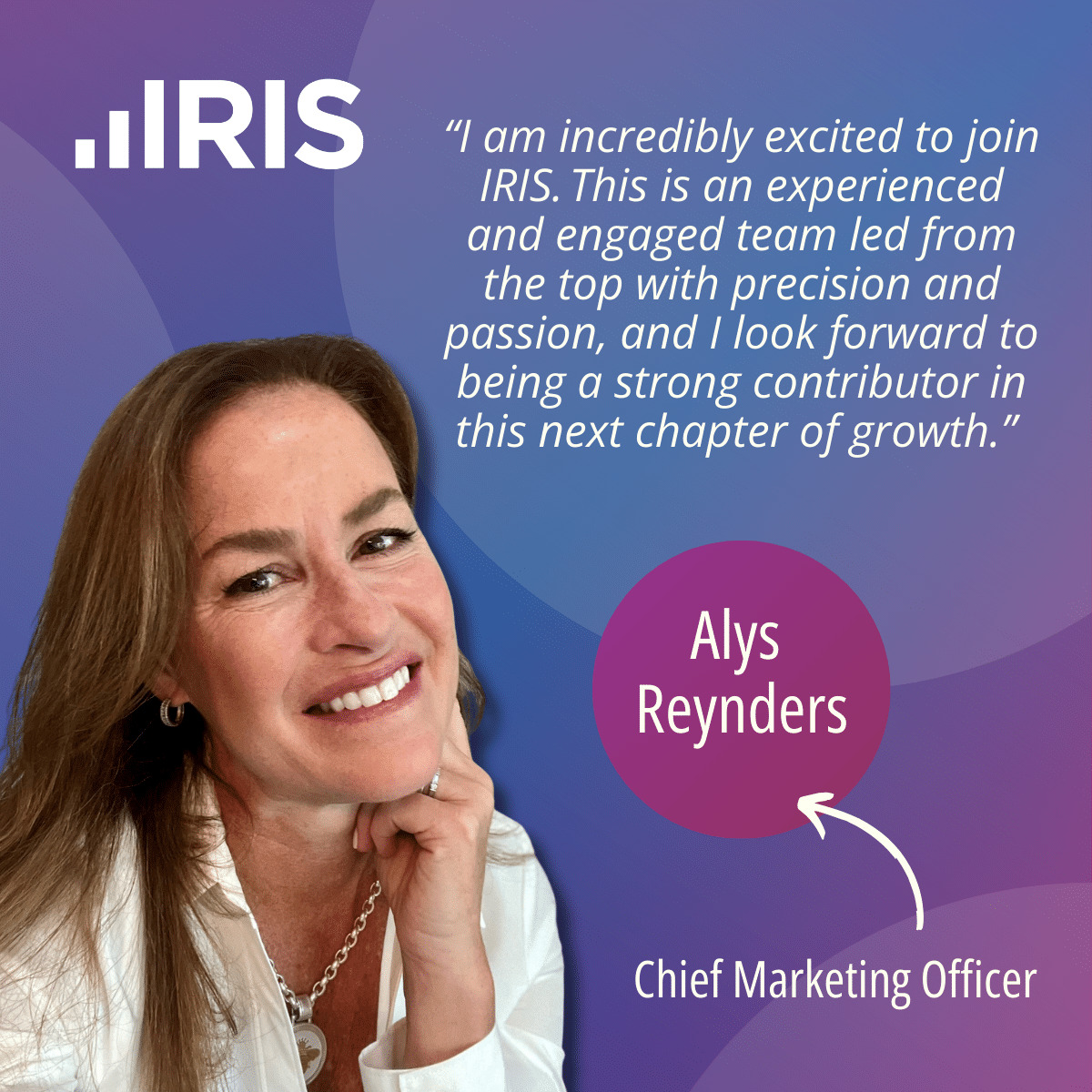
In the appointment announcement, she praised an experienced team led with “precision and passion.” Those two words make a tidy miniature of executive marketing. Precision without passion is accurate and forgettable. Passion without precision is a keynote searching for a fact-checker. A useful market story needs both.
Giving the invisible work a name
Quickbase appointed Reynders in May 2025 to lead global marketing, strengthen its market presence, accelerate pipeline and deepen customer connections. The company sells technology for operations that tend to resist neatness: large projects, field activity, forms, approvals, data spread across systems, and exceptions that arrive before breakfast.
Quickbase calls the friction between formal systems “gray work.” It is the spreadsheet created because the main system cannot bend, the status update copied into three places, the email thread acting as a database, and the hour spent asking which number is current. The phrase succeeds because it starts with recognition. Before a platform can be the answer, the customer must see their Tuesday in the question.
The trip nobody puts in the process map
A Quickbase program featuring Reynders and digital-transformation specialist Isaac Sacolick draws on research from 2,200 professionals across construction, manufacturing and other sectors. The topic is productivity lost to manual processes, siloed data and workarounds. This is classic Reynders territory: the product is technical, but the entry point is human exasperation.
AI still has to survive ordinary people
Her more recent public comments apply the same realism to AI economics. In a discussion of contact-center costs, Reynders noted that callers are less predictable than tidy text prompts. They ramble. They change subjects. They require different levels of attention. Every detour can add speech processing, model context, retrievals and tool calls.
It is a small observation with a large consequence. AI pricing models meet human behavior eventually, and human behavior has never accepted the average case as a personal obligation. The strongest part of the comment is its refusal to turn the customer into a standardized unit. A person on the phone remains a person on the phone - distracted, repetitive, complicated and occasionally in possession of a completely new question.
That instinct connects her early communications work to the Quickbase assignment. Begin with how people actually speak and work. Notice the distance between the clean diagram and the lived process. Then make the technology answer to that reality. It is less glamorous than inventing a new category every quarter, and more useful.
Six seats, one durable question
Nearly three decades into her career, Reynders’s biography contains the familiar architecture of an enterprise executive: acquisitions, private-equity-backed companies, international teams, boards, brands, revenue programs and an IPO. What makes the architecture distinctive is the route through it. The English major became a corporate communicator. The communicator learned investor relations. The strategist became an operator. The operator kept returning to language.
At Quickbase, her stated goals are commercial: market presence, pipeline, scalable growth and customer connection. There is no contradiction between those goals and the softer-sounding work of narrative or mentorship. A market cannot choose what it cannot understand. A team cannot sustain a strategy it does not own. Clarity and development are not decorations around growth; they are part of its machinery.
Software will keep acquiring nouns. The current stack includes AI, agents, low-code and operations platforms; another vocabulary is surely waiting in the wings, clearing its throat. Reynders’s career offers a steadier proposition. Name the real work. Respect the audience. Build the team that can carry the story. Then make the complicated thing clear enough to move.