The useful thing about Native Leaf Co. is that its idea sounds almost embarrassingly obvious: put cannabis flower inside a hemp leaf. Not hemp fiber pulverized, pulped and rebuilt as a tidy rectangle. Not tobacco wearing a fruit flavor. The leaf itself - veins, irregular edges and all. The Las Vegas company took a part of the hemp plant often treated as low-value residue and asked it to do a surprisingly demanding job: roll neatly, stay flexible in a pouch, burn evenly and contribute as little flavor as possible.
That last requirement is the trick. A fresh fan leaf is green with chlorophyll, variable in size and eager to dry into something closer to a cornflake than a consumer packaged good. Native Leaf does not merely bag farm scraps. It selects leaves, inspects them, manages moisture and, for its Reserve products, puts them through a 30-day curing process. The result is a taupe-brown wrap that still looks unmistakably botanical.
A $400 cigar started the chain reaction
Founder Sidney Quitorio did not arrive from tobacco manufacturing. He studied software engineering, worked in Silicon Valley and later described being content with the work but not especially happy. The turn came after he saw a cannabis cigar on Instagram. It promised a long, premium session. It also cost more than $400. Quitorio’s response was the engineer’s favorite form of thrift: build a device that could make the thing repeatedly.
That device became the basis of Purple Rose Supply, his cannagar-mold company. He shared it with friends and customers who wanted to pack compressed flower into cigar-like shapes. Then those customers asked a follow-on question: could he supply hemp leaves to wrap around the finished cannagar? Native Leaf grew from that request. It was not a brainstorm performed against a category map. It was the missing consumable beside an existing durable product.
The cannabis experience was diluted with non-natural wraps.Sidney Quitorio, founder and CEO
That origin explains the company’s place in the market. Rolling paper is cheap, consistent and easy. Processed hemp wraps borrow hemp’s halo while behaving like paper. Tobacco and palm leaves deliver a more obvious leaf ritual, but neither is native to cannabis. Home growers can cure their own fan leaves, if they have the crop, patience and technique. Native Leaf chose the narrow gap between all four: a purchasable, whole hemp leaf made for rolling.
The first thing to fail was the leaf
Whole leaves are charming precisely because they are not factory-perfect. They are also thin, delicate and inconsistent. Native Leaf’s own instructions acknowledge a learning curve. Reserve wraps must be dipped in warm water for roughly one to 10 seconds, removed when flexible, patted dry and handled carefully. Too dry and the wrap can crack. Too wet and it becomes difficult to seal. A public rolling guide devotes separate steps to hydration, drying, plant glue and final drying. The product promise may be “herb wrapped in herb,” but the user experience initially looked more like a small craft project.
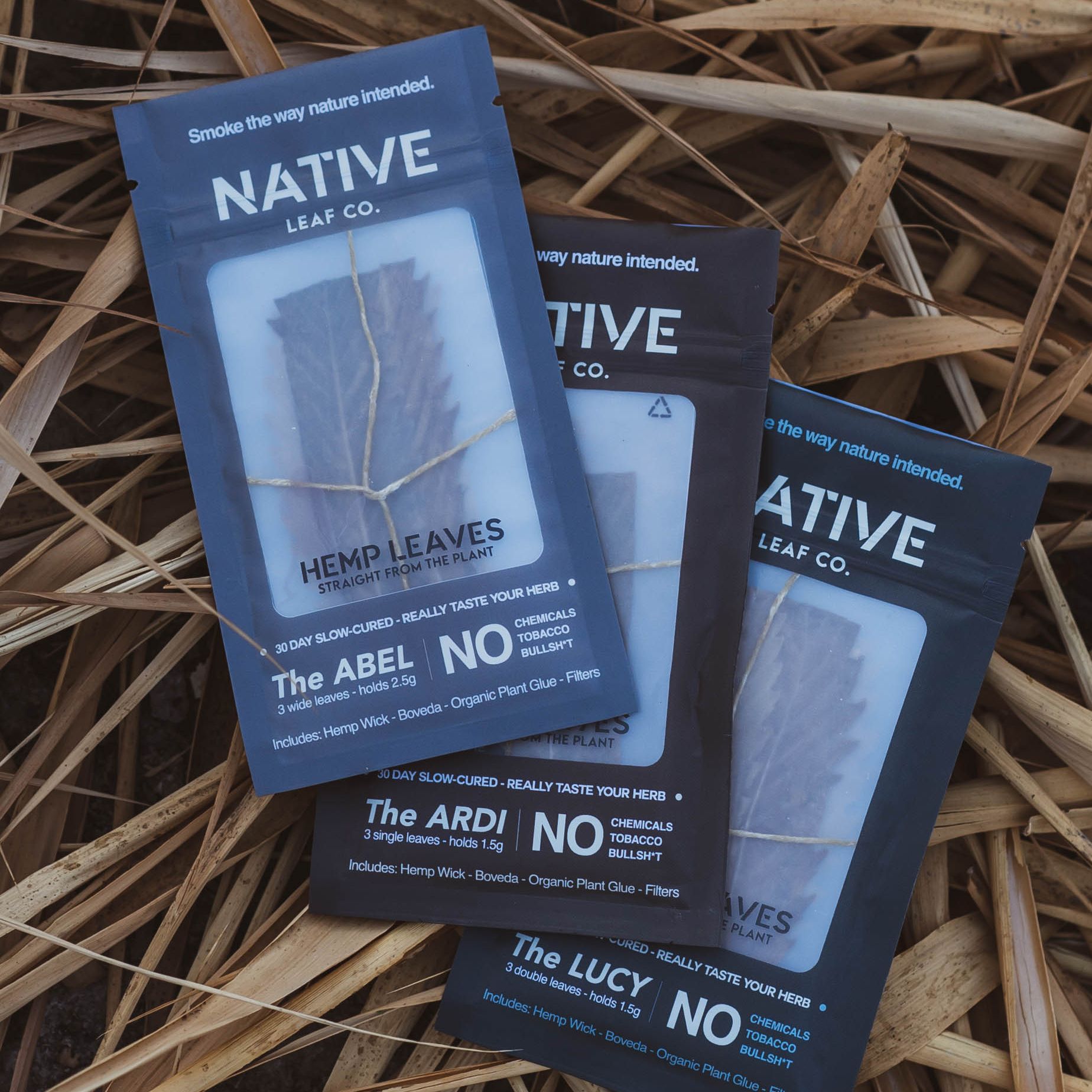
The original kit treats those failure points as product features. A Boveda pack controls humidity. Plant-based glue closes the seam. Filters improve airflow and keep flower out of the mouth. A hemp wick lets the user light without applying butane directly. Best of all, a miniature leaf patch is included for repairs. It is the botanical equivalent of a spare tire, and an unusually honest admission that an intact natural material will occasionally misbehave.
This is also what changed the product. The Reserve line leaned into ritual and taste. LUCY stacked two leaves with organic plant glue to make rolling easier. ABEL used a wider leaf and advertised room for as much as 2.5 grams. ARDI stayed with a single leaf and zero stacking. Later, the Fresh Ready line removed the hydration step entirely. Its green wraps arrive flexible and can be rolled out of the pouch. Each two-wrap pack has been listed at $7; each wrap measures about 4.25 by 1.875 inches and is designed for roughly 1.5 to two grams.
Fresh versus Reserve is the whole business lesson
The two lines make a neat product ladder. Reserve sells the connoisseur ritual: chlorophyll removed, starches changed during curing, a slower process and a cleaner-looking brown leaf. Fresh sells convenience and visual drama: bright green, minimally processed, no cup of warm water required. One preserves the ceremony; the other attacks the friction. Both keep the claim that the wrap remains recognizably a leaf.
Where the products sit
The distinction matters because Native Leaf is not likely to win a price war. Commodity papers and mass-market hemp wraps can cost a fraction of several dollars per wrap. Public comments about whole-leaf products repeatedly mention the effort and price. Native Leaf instead asks customers to pay for material integrity, flavor neutrality and the pleasure of seeing the plant. That audience includes adult cannabis enthusiasts, cannagar makers and buyers trying to avoid tobacco. It is not every smoker, and it does not need to be.
Distribution follows a small consumer brand’s practical path. The company sells directly online, creating repeat purchases around wraps, glue, humidity packs and wick. Specialty retailers in several countries have also listed its products. Purple Rose Supply is a particularly useful channel because its molds create the exact moment when a customer needs a leaf. One brand sells the tool; the other sells what gets used up.
A sustainability pitch with a sharp edge
Native Leaf describes fan leaves as previously underused and frames whole-leaf wraps as a fuller use of the plant. That is a more tangible sustainability story than printing a green leaf on a box: the visible material is the point. Still, “uses a byproduct” does not automatically settle the environmental math. Individual inspection, curing, humidity packaging and international shipping all carry costs. The credible claim is narrower and better - the company found a consumer use for leaves that may otherwise have little value and avoided reducing them to paper.
Its reported capital history is equally modest: one $10,000 debt-financing round. Team data points to roughly four employees, although LinkedIn uses a broader company-size band. This is a small operation selling a narrow set of physical products, not a venture-backed platform pretending every smoker is a network effect.
What a founder can steal
- Follow the accessory request. The next business may be the consumable customers need after buying the first product.
- Keep the constraint visible. Veins and irregularity prove the material claim better than a paragraph of packaging copy.
- Bundle around predictable failure. Humidity, glue and patch leaves turn fragility from a return into a ritual.
- Split purists from pragmatists. Reserve protects the full process; Fresh removes the chore without abandoning the premise.
When the playbook stops working
Native Leaf’s approach is copyable, but not universal. It works when customers can perceive the raw material, care about what was removed, enjoy some ritual and accept a premium. It works better when an adjacent product - in this case a cannagar mold - reliably introduces the use case. It becomes harder when biological variation destroys margins, when moisture control fails in shipping, or when a retailer needs every unit to behave exactly alike.
There is evidence that the sensory pitch connects, though it remains small-scale. In a published blind comparison with three participants, all three said Native Leaf let them taste the flower more clearly; two preferred it overall. That is an interesting product signal, not a clinical trial. The more persuasive proof may be simpler: the company has kept both ritual and convenience versions in market, and specialist retailers continue to explain a product that requires more explanation than rolling paper.
Native Leaf belongs in the premium smoking-accessory market, beside cannagar tools and natural wraps, rather than in the race for the cheapest paper. Its expertise is not merely “hemp.” It is the fussy intersection of curing, material selection, humidity and user education. The company took the part of the plant most likely to curl, crack and vary, then made those problems the basis of a kit. Obvious idea, difficult object. That is often where a small brand can still matter. It is a stubborn, useful kind of differentiation: easy to understand at shelf, difficult to reproduce reliably behind it.