The fryer was already there. That was the inconvenient detail. In a 2016 essay, Narayn Sridharan described a restaurant technology project whose first idea involved new, connected cooking equipment. Replacing the installed machines across thousands of outlets would cost too much. The answer was rather less glamorous: keep the fryers, add a sensor board and software, and test the arrangement. Progress, on this occasion, had the good manners to leave the furniture alone.
That small episode offers an appealing entrance to Sridharan’s working life. He has worked inside Cognizant, co-founded PeerIslands and served as its CEO, and now leads Quest1. The settings have changed: restaurant kitchens, cloud applications, a Cayman Islands engineering operation, and tools for data and AI systems. The recurring question seems remarkably durable. How do you introduce something new into a world that is already running?
Businesses rarely offer engineers an empty room. They bring equipment, software, deadlines, colleagues and customers who would prefer the lights to remain on. Sridharan’s career is interesting precisely because so much of it concerns those awkward continuities. The future must find somewhere to put its coat.
A modest proposal for the kitchen
At Cognizant, Sridharan led an Internet of Things venture. His September 2016 account of the connected kitchen described a familiar commercial problem: a fast-food operator wanted tighter control over cooking consistency, waste and operating costs. The initial vision was a smart fryer. The practical response became a retrofit, with an alternative identified within six weeks and a proof of concept implemented at four locations.
The distinction matters. A working prototype can be persuasive; a replacement bill can be persuasive in the opposite direction. His essay encouraged experimentation, quick prototypes and the willingness to discard approaches that failed. It was an argument for finding out, with an actual business problem attached.
Elsewhere, when explaining connected devices, he drew a useful distinction between displaying information and causing something to happen. A wearable using location information for navigation was one case; using that information to open a door was another. His emphasis was on the physical consequence. The door, unlike a conference audience, cannot be impressed into opening.
There is also an inventor’s thread. Sridharan is named alongside Parasu Pillai and Manish Chadha on a US patent concerning the aggregation and delivery of enterprise data to mobile devices. Filed in June 2014, it became patent 9,843,625 in December 2017, assigned to Cognizant Technology Solutions India. It places a specific piece of engineering work behind the later executive titles: making information travel between established enterprise systems and the devices people use.
An island has practical advantages
PeerIslands took a different kind of existing constraint seriously: where engineers could work. The company was founded in 2018 and established its Cayman Islands technology operation in 2019. Its other co-founders included Sowri Krishnan and Rajesh Rajagopalan. Sridharan brought experience of cloud transformation at Cognizant to the enterprise.
The Cayman choice had operational reasons. US visa restrictions could complicate moving skilled people into client-facing work. North American customers needed colleagues available during their working day. A location close to the United States offered another way to organize delivery. A beautiful view is a pleasant office benefit; an overlapping calendar is a business tool.
TechCayman helped with permits, relocation logistics and setting up the operation. Its later case study described support for moving more than 60 engineers and 80 family members, as well as the freedom to establish a campus in East End. Those are company-level figures, rather than a tally of people personally recruited by Sridharan. They nevertheless convey the scale of the arrangement around the engineering work.
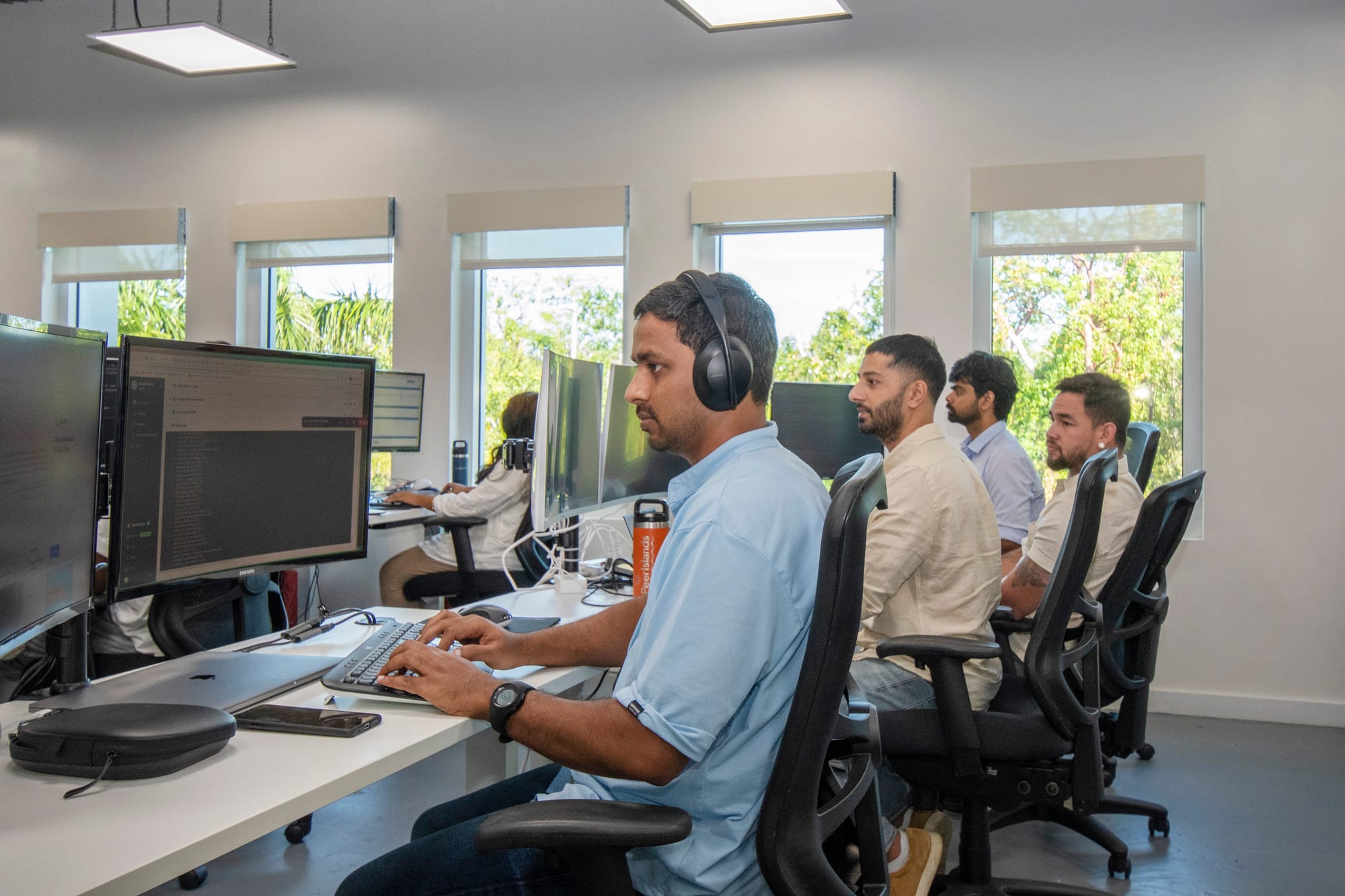
Relocation is an unusually literal form of commitment. People must decide whether a place can accommodate ordinary life as well as a job. The engineering operation depended on practical help that extends well beyond a laptop. The case for Cayman therefore joined two kinds of infrastructure: the arrangements that let a company deliver work and the arrangements that let its people settle.
That is a useful corrective to the habit of describing international teams as dots on a map. A dot has no luggage. An engineer usually does, and quite often someone else’s luggage to consider too.
The learning clause
In March 2022, Sridharan described PeerIslands as a 65-person business. He also discussed plans for further hiring. The distinction between the actual headcount and the ambition is worth preserving: an intention is a direction of travel, rather than an arrival.
His explanation of the work was more revealing than the hiring target. Cloud tools could automate straightforward tasks while making implementation more demanding. People needed to understand established systems and keep learning the newer ones. That creates a rather particular recruitment problem. Experience matters, but experience must remain willing to be interrupted.
“They require people who are willing to learn all the time.”
Narayn Sridharan, on cloud tools, 2022
PeerIslands’ MongoDB partnership supplied a concrete setting for that requirement. In August 2021, the company received MongoDB’s Boutique System Integrator Partner of the Year award. The recognized work included ecommerce and inventory modernization, helping software and retail customers move applications toward software-as-a-service environments. This was the unromantic machinery beneath a fashionable phrase such as cloud transformation.
The company was also creating local routes into that work. By the award announcement, PeerIslands had provided paid internships to three Caymanian students and was expecting another student in the autumn. It participated in mentoring with the Cayman Islands Chamber of Commerce. For a business recruiting internationally, those local connections gave the story another dimension: a place to learn as well as a place to land.
A new company, a familiar question
Quest1’s stated founding year is 2024. Sridharan is its founder and CEO, with responsibility for its direction, growth and work with customers and teams. The company describes its field as data engineering and applied AI. Read alongside his earlier career, this looks like another encounter with the same difficult question: what becomes valuable when technology changes the work?
In a public recruitment post around the start of 2024, he discussed applying AI to legacy application modernization and invited engineers and product managers to join the team in India. The invitation attached AI to a recognizable job. There were existing applications to modernize, and people were needed to help do it.
The surrounding team gives that invitation some texture. Vishy Iyer, Quest1’s chief technology officer, previously held architecture roles at Red Hat and Cognizant. Arun Madhavan G leads customer success. Ram Sankar heads platforms. The company says each employee is paired with a senior mentor from the first day. Learning, in that description, has someone’s name against it.
There is evidence of an entry point for younger engineers too. A Shiv Nadar University Chennai placement announcement celebrated five students from the class of 2025 receiving offers from Quest1. These are small, specific details, preferable to grand pronouncements about talent. Someone gets an offer. Someone reviews the work. A career acquires its next step.
The appeal of a visible result
Quest1’s products give the present chapter a useful focus. Under its Shinro name, the company offers tools for adopting partner platforms. One supports migration to ClickHouse. Another, the Shinro Query Analyzer, helps engineers investigate queries that consume too much time or memory. The language has become more contemporary since the fryer project. The attraction of a measurable improvement remains familiar.
In his public announcement of the analyzer, Sridharan singled out comparing successive runs. Change a schema, index, setting or version, then look at what happened. The feature addresses an everyday engineering anxiety: a change may help one part of a system and inconvenience another. Side-by-side evidence is a welcome companion to confidence.
He credited the team members who built it and the ClickHouse partners involved. That is a modest but telling feature of the announcement. A founder can describe a product while leaving room in the sentence for the people who made it.
Source profiling
Schema generation
Migration validation
Architecture choices
Cutover sequencing
Exceptional cases
The broader partner network includes Ditto, whose technology supports applications that must work with intermittent connectivity. Ditto identifies Quest1 as an implementation partner, with work spanning architecture, synchronization and integration. It is another instance of bringing a platform into the troublesome conditions of an actual enterprise.
Quest1’s own explanation of Shinro separates repeatable technical work from decisions that require engineering responsibility. Profiling and validation can be packaged; architecture and unusual cases require judgment. Whether that division succeeds is something each implementation must demonstrate. As an idea, it gives Sridharan’s current business a clear task to perform.
There is a pleasing continuity here. The kitchen needed an affordable retrofit. Enterprise data needed a route to mobile devices. An engineering team needed somewhere practical to work. A slow query needs an explanation before anyone can sensibly celebrate its improvement. Across these episodes, the interesting part arrives when an attractive possibility meets a stubborn detail.
Sridharan’s story lives in that meeting. Technology changes its vocabulary with remarkable enthusiasm. The useful questions have a longer shelf life: what is already here, what needs to work better, and who will understand it well enough to make the change?