The orange sofa looked better on the internet. Nancy MacIntyre discovered this while furnishing Fingerprint’s first office in 2011, a headquarters of 1,625 square feet. She had gone online to order furniture from Ikea, only to discover that the conference table required a visit to the store. The trip rescued her from a purchase she would have regretted: an orange vinyl sofa whose charms had failed to survive physical inspection.
Then came the whiteboards. The online prices were too high. The store’s computer insisted the item was unavailable. A salesman named Bob went into the warehouse and found it anyway. Her husband, equipped with a pickup truck, became the delivery department. For an executive accustomed to large companies, starting a business involved an unexpectedly detailed education in furniture logistics.
MacIntyre enjoyed the shopping, but she also noticed the lesson. A customer experience could collapse between an attractive picture and a completed transaction. Sometimes the person who understood the problem was standing beside a computer that did not.
A phone changes the competition
MacIntyre had spent years bringing games and learning products to market. At Hasbro Interactive, her work included family and children’s games. At LucasArts, she became vice president of global sales and marketing, working with Star Wars games and leading the launch of Lego Star Wars. At LeapFrog, she was executive vice president of product innovation and marketing, working on connected learning through products including the Tag Reader, Learning Path Online, and Leapster Gaming System.
Her degree was in finance from Drexel University. The route to a children’s app company ran through commercial responsibilities: products, marketing, distribution, and the question of whether anybody would buy what a team had made. Familiar characters helped attract attention. The experience still had to earn its place in a household.
At LeapFrog, she saw the competitive picture changing. A parent’s iPhone could become a child’s gaming device. The familiar transition from educational toys to a dedicated games machine suddenly had another possibility. The next platform might already be in somebody’s purse.
Fingerprint, which she co-founded in 2010, addressed that change. She wanted a network of learning and play experiences for mobile devices. Making an appealing individual game was part of the task. Connecting games, developers, families, and commercial partners was the larger business.
A game needs somewhere to go.
The experience investors couldn’t see
The departure from corporate life was personal as well as professional. In her account of the transition, MacIntyre described losing her job after 20 years of increasingly senior roles. There were two children, a mortgage, and the disorienting loss of an established identity. She chose to build something of her own.
She also described driving across the Golden Gate Bridge in her Mini Cooper, roof down, music loud, with Diet Pepsi taking the place of morning coffee. That was thinking time. Entrepreneurship had room for fear, but it also offered the pleasure of deciding where the next stretch of road should lead.
Investors were less readily persuaded. She recalled more than 80 rejections. Years of corporate responsibility did not automatically settle their questions about her ability to run a startup. A familiar résumé could apparently become an unfamiliar proposition when its owner wanted to own the company.
“They’re already starting at a run.”
Nancy MacIntyre, on experienced founders
She began Fingerprint around her 50th birthday, with two children in college. That timing gave her a different view of the supposed disadvantages of age. Experience brought knowledge of customers, products, and business plans. It also brought a clearer understanding of what she wanted to spend her time doing.
By 2018, Fingerprint had 32 employees and had raised $25 million. Paying subscriptions through partner services had grown fourfold to 250,000 over the preceding year. Those were concrete answers to the doubts. They were also the result of years of work between the initial idea and the gratifying figure.
The pitch, again. And again.
MacIntyre’s fundraising advice became notably practical. Research the investor. Understand the investment profile. Treat the plan as a résumé and the pitch as an interview. Ask for feedback while still in the room, rather than waiting for a follow-up call to supply clarity.
By 2016, she said she had pitched hundreds of investors and kept every business card. The stack had become an informal record of persistence. She urged founders to find people willing to tell them the truth, alongside the people willing to cheer them on. Both had a job to do.
The early calendar was full of meetings, and her descriptions of them had the eye of a comic travel writer. At The Grove in San Francisco, she noted the difficulty of performing a product demonstration while managing oatmeal and a vanilla latte. At Sears Fine Foods, tourists seated nearby listened to her entire pitch and photographed her demonstration. Breakfast had acquired an audience.
She liked the soup and couches at Crossroads Café, while finding the lack of Wi-Fi annoying. Menlo Park’s Starbucks appeared to be populated by entrepreneurs preparing for investor meetings. The observations give those startup years a useful texture: meetings happened in public, with bowls, cups, strangers, and the occasional unsolicited spectator.
Fewer slides, better conversation
Her memory of corporate business reviews was equally sharp. At Hasbro, an internal review prepared people for another management review. At Lucas, slide production could threaten to eclipse the substance. At LeapFrog, the presentation workload generated hundreds of slides and an unflattering nickname for the people making them.
Fingerprint’s first review, in May 2011, still had slides and demonstrations. MacIntyre’s pleasure was in the conversation about the product and the business. An investor’s question about making a boys’ version of a fairy-princess game supplied a reminder that smaller meetings could contain familiar absurdities.
She had not lost her affection for the work inside the larger companies. She remembered seeing Bop It! in a Hasbro review and recognizing its promise. She remembered learning songs interrupting the business machinery at LeapFrog. The products could remind everyone why they had turned up in the first place.
Building a route to the family
For Fingerprint, finding the right technical leadership was an early decision. MacIntyre recruited Brad Edelman, an MIT-trained engineer and PlayFirst co-founder, as CTO. His platform and mobile experience mattered to the company she wanted to build. Her own background supplied other parts of the undertaking.
The platform had to work for several parties at once: the mobile operating systems, the brands distributing the service, the developers supplying content, and the families using it. That made the business more complicated than a shelf of children’s games. The connections required engineering and commercial work of their own.
Samsung, Astro, and Sylvan Learning were among Fingerprint’s partners. For those brands, the company offered a way to deliver a children’s mobile network without constructing the whole operation themselves. For developers, it offered additional distribution. For families, it offered a more navigable selection of things to play and learn.
- 2010Co-founds Fingerprint
- 2021Fingerprint joins Sandbox
- 2023Named Game Taco CEO
- 2026Joins THNDR as advisor
In March 2021, Sandbox & Co. acquired Fingerprint and named MacIntyre to lead the newly formed Sandbox Kids division. Kidomi joined Hopster and Curious World. The combined products offered more than 8,000 videos, games, interactive books, songs, and audio experiences, available in over 100 countries and 23 languages.
The acquisition extended a business built around partnerships. MacIntyre’s stated plan was to expand the catalogue and work with mobile carriers, pay television companies, and device makers. A family’s route to a learning activity might pass through several companies before reaching a screen. She had built a company to make those connections work.
Another kind of player
Later in 2021, MacIntyre joined Game Taco to lead its direct-to-consumer business. In May 2023, she became CEO. The company credited her work as general manager and chief marketing officer with more than doubling real-money player numbers and tripling WorldWinner’s cash entry fees. The figures described her tenure before the May 2023 appointment.
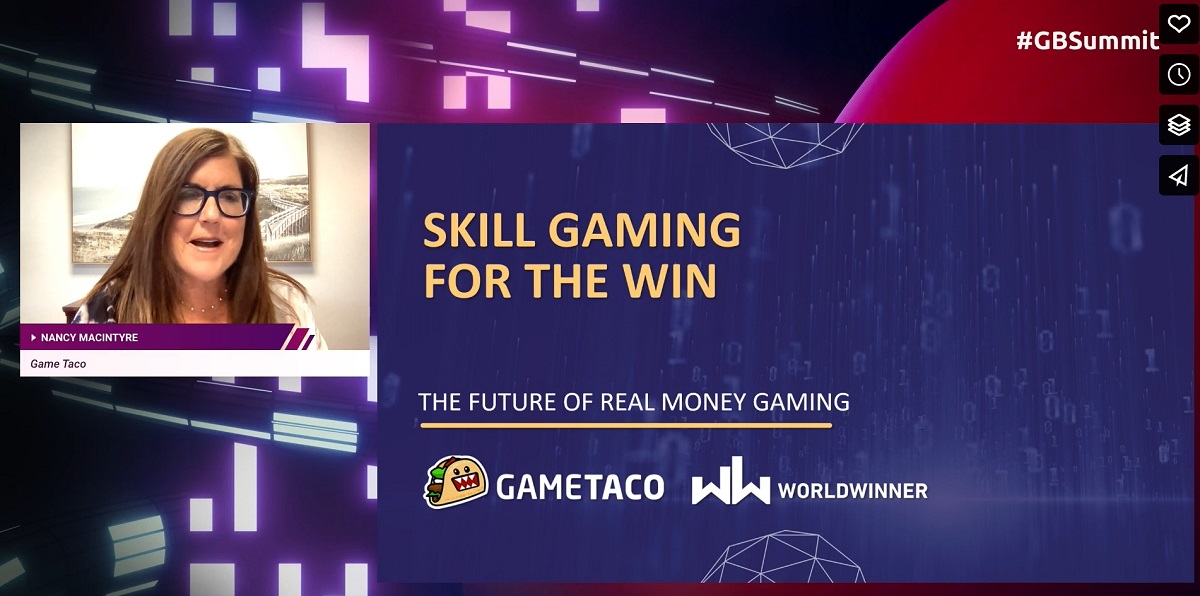
Game Taco took the WorldWinner name in October 2023. Its familiar games included solitaire, word games, and licensed titles. The career that had included learning devices and children’s apps now included adults competing for cash prizes.
Her explanation of product development remained grounded in enjoyment. In a 2025 interview, she argued that monetization begins with understanding what makes a game fun and how people play it. A famous licence cannot compensate for disappointing gameplay. Recognition can bring people through the door; the experience determines whether they stay.
“The reality is I always start with what’s fun for the player.”
Nancy MacIntyre, 2025
In June 2026, THNDR announced her appointment as a strategic advisor. The company builds infrastructure for player-versus-player skill games. Her remit was to advise its leadership as it expanded its operator network, bringing her recent experience with competitive gaming into another platform business.
A book worth getting wet
There is another side to MacIntyre’s interest in entertainment. Her summer reading list was cheerfully unconcerned with appearing scholarly. She liked beach books that could be finished quickly and talked about afterward. She also described returning to Pride and Prejudice every year.
One memory involved reading Gone with the Wind at 14 in Avalon, New Jersey. Her cousin Jenny took over the book. With about 50 pages remaining, MacIntyre’s brother threw it into the bay. Jenny went in after it. A reader willing to retrieve a book from the water makes a persuasive argument for the value of a good story.
Across her work, MacIntyre has paid attention to that willingness to continue: the child choosing another game, the family returning to a service, the player coming back to compete. Her own early writings show a person just as interested in the awkward business of getting there. Sometimes it takes a partner, sometimes another pitch, and sometimes Bob knows where the whiteboards are.
Keep the conversation going
MacIntyre’s founder diaries ↗
LinkedIn ↗ · Twitter / X ↗
THNDR ↗ · WorldWinner ↗
Watch: her conversation on player loyalty ↗
Read her fundraising advice ↗
Read the interview on founding after 50 ↗