Neetu Seth’s first angel investor was unusually easy to locate. After approaching investors who would not back her young business, she found support at home: her husband invested. It is a pleasingly domestic detail in a story about enterprise technology. Before there were international operations, product names and rooms full of colleagues, there was a person close enough to believe the proposition.
Seth founded NITS Solutions in 2009. She was 38 and had spent a decade as a stay-at-home mother. That beginning gives her career a different rhythm from the familiar account of uninterrupted professional ascent. Here was a new company arriving after a long interval devoted to family. The interval belongs in the story. So does the fact that she chose to begin again.
Today, she leads a business working in technology and marketing analytics from Novi, Michigan, with operations in India. Its automotive work concerns the less theatrical side of the motor trade: parts, service, customer relationships and the information needed to manage them. A new vehicle may get the showroom lighting. The work after the sale still requires someone to pay attention.
A second beginning at 38
Before NITS, Seth worked in financial services. At CitiFinancial, her responsibilities included branch operations and developing business. She also worked as a consultant at ADP-Ebanking. Her education crossed institutions in India and Michigan: a Bachelor of Arts from Guru Nanak Dev University, and a Bachelor of Science and MBA from Eastern Michigan University.
These are useful details because they give the founder a working history before the founding date. Branch operations, account development and consulting all place a person near the awkward meeting point between a business promise and its delivery. It would be too neat to assign every later decision to those earlier jobs. They nevertheless form part of the experience she brought to her own company.
Starting at 38 also makes the chronology worth reading slowly. A career can have several beginnings, and the most consequential one need not be the first. Seth’s decision offers a specific example rather than a universal prescription. She had a family, earlier professional experience and education; in 2009, she added the responsibilities of a founder.
The investor closer to home
Her recollection of the funding search is plain: prospective investors did not open their doors. She turned to her husband for investment. By the time she discussed the business in a 2023 conversation about women founders in technology, NITS was described as fully self-funded, operating in the United States and India.
The early work included a tool to help large automotive businesses see dealership and service operations more clearly. Customer relationship management products and digital services followed. That sequence suggests a practical route to product development: begin with something a client needs to understand, then follow the work into the next problem. There is little glamour in untangling business records. Glamour, fortunately, is a poor substitute for a usable answer.
A company founded after a decade spent raising a family.
A dashboard earns its keep
By 2013, the company’s reporting platform was already central to its identity. It gathered data, cleaned and checked it, and presented the results through reports, charts and interactive dashboards. An automotive client’s particular problem had helped shape the platform. NITS also handled marketing activity, including direct mail, email and survey work.
The underlying ambition was modest enough to be comprehensible and demanding enough to sustain a business: help a client make a better decision. Seth put the commercial test succinctly: “Client delight is the only metric we use to measure our success.” That phrase leaves the customer with the casting vote. A technically impressive system still has to be useful to the person paying for it.
In her 2015 discussion of NITS, Seth described a self-service portal through which users could arrange marketing activity on weekly, monthly or quarterly schedules. The company presented information in short reports and compact dashboards. This is the everyday texture of her enterprise: someone needs to organize an activity, understand its results and decide what to do next.
Consider the difference between possessing a great deal of information and being able to read it. An overflowing filing cabinet has never deserved a medal for insight. The same courtesy need not be extended to its digital equivalent. Seth’s business sits in that gap, turning records into something that a working manager can approach without first becoming a specialist in the machinery beneath them.
Growth needs somewhere to sit
In July 2016, NITS had 30 employees. It had hired ten people during the preceding year and was seeking another fifteen in technical and management roles. Revenue had grown 200 percent in the previous year, largely through automotive work. The company had gone from one vehicle manufacturer as a client to three.
Those figures describe a particular moment, and it was a busy one. Seth wanted the team to reach 50 by December. NITS was also doubling its office space to 10,000 square feet, making room for marketing and product development. The distinction between a staff count and a hiring ambition matters. One tells us who was there; the other tells us what the founder was preparing to support.
The international structure had begun taking shape earlier. NITS opened its Gurgaon development center on July 22, 2014, then moved its Michigan team from Farmington Hills to Novi in 2015. The company records reaching 100 employees worldwide in 2017. Read together, these milestones show a founder’s remit becoming wider: more colleagues, more locations and more work that has to arrive intact at the customer’s desk.
The work after the sale
On July 19, 2017, NITS announced Aftersales IQ, a reporting platform bringing together information from multiple systems. Its modules covered parts sales and inventory, service, wholesale parts, accessories, pricing and parts loyalty. The breadth is revealing. A dealership’s business continues long after the congratulatory handshake over a new vehicle.
The platform addressed questions such as inventory turns, idle stock, customer retention, repair-order trends and workshop productivity. Reports could be downloaded as PDFs or spreadsheets. Data cleansing and auditing were part of the design. The promise depended on the unshowy preparation underneath: a report is only as useful as the information it has been given.
Different systems→Check
Clean & audit→Understand
Reports & metrics
For Seth, this was a product announcement attached to an established field of work. For the user, it meant fewer places to look before making a decision. That is an appealingly concrete standard for software. The product must justify the time someone spends with it, preferably by giving some of that time back.
A bigger room, a longer view
In 2016, Seth joined the North American class of EY Entrepreneurial Winning Women. The program placed her among founders from different industries and business models. Her company’s work was described through the combination of data, technology and marketing analytics. Recognition gave a public name to a business she had already spent seven years building.
NITS had also been selected for Michigan 50 Companies to Watch in 2013. A 2016 alumni update recorded expanded offerings, a larger location and a high-school internship program. Those details widen the picture beyond sales. A growing company becomes a place where people get early experience, learn from colleagues and acquire responsibilities of their own.
The company’s history records a WBENC platinum sponsorship in 2018 and support for women in technology. That sits alongside Seth’s participation in conversations about women founders. Her own path gives those conversations a specific reference point: the business began after motherhood and with family investment, then developed across two countries.
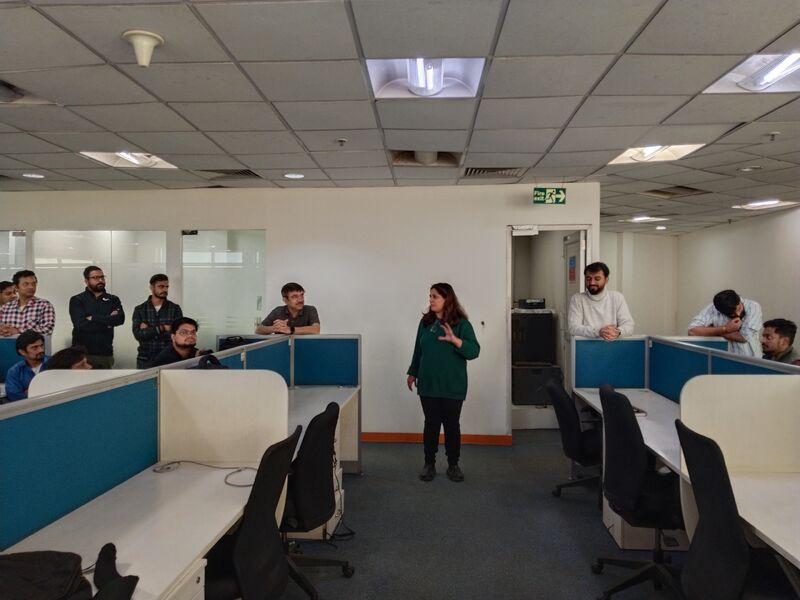
In February 2023, a Gurgaon town hall celebrated employees who had been with NITS for five years or more. Seth was there, along with colleague Bindesh Patel. The photograph offers an ordinary workplace scene: people gathered among desks, listening. It is a useful companion to the founding story. Years after the initial investment, a company’s life is also measured in the people who stay.
The mother in the meeting
Seth has spoken candidly about the effort behind entrepreneurship. In a 2021 discussion, she challenged the assumption that founders enjoy effortless control of their time, describing the demands of launching and advancing a company. The attractive view from outside, in her account, leaves out much of the work.
Her later comments on motherhood add another part of the picture. In May 2026, she said: “Being a mom in fact helps me prioritize my work and family.” It is a precise claim about her own experience. She describes motherhood as helping her decide where attention should go, a skill with obvious relevance to someone responsible for both strategy and daily operations.
“Being a mom in fact helps me prioritize my work and family.”
Neetu Seth · May 2026
There is a satisfying connection between that observation and the business she built. Her company organizes information so that other people can choose where to act. Her account of family life returns to the allocation of attention. Both put a premium on deciding what matters next.
Seth’s story starts with a return to work and an investor at home. It continues through client problems, colleagues, offices and products. The human detail survives the corporate milestones: at 38, after ten years spent raising a family, she chose another beginning. A résumé can record the date. The life around it explains why it deserves a closer look.
Follow the thread
Explore the work and conversations around Neetu Seth.