Nancy Coyne was leaving the stage with three bouquets when the exit became a little more dramatic than planned. She tripped. Roses went into the audience. It was 1964, she was appearing in The Man Who Came to Dinner at Montgomery Blair High School, and the evening had acquired an unscheduled flourish.
Years later, the embarrassment had lost to the pleasure. “Even looking like an idiot,” she recalled, “couldn’t dampen the high of applause and roses and romance.” An unfortunate exit had become a fond memory. Theater could apparently survive a great deal, including the performer’s dignity.
Coyne’s school years also included Bye Bye Birdie, Li’l Abner and Carnival, along with yearbook work and sock hops. She remembered those years with affection. The adult career that followed would keep her close to the stage, although her principal responsibility would be getting other people to come through the doors.
A business built around the evening out
In 1977, Coyne and Matthew Serino founded an agency specializing in live-entertainment advertising, marketing and promotions. Serino Coyne placed the business of selling a theatrical experience at the center of its work. A production needed a public identity before most people had any opportunity to judge what happened onstage.
The agency’s campaigns would encompass Annie, Cats, 42nd Street, The Producers, Hairspray, The Lion King and Wicked. That range matters. Familiarity with one audience did not remove the need to understand another. A new production brought a new set of decisions about what to emphasize and whom to invite.
By 2007, when Serino stepped down as president, the firm had offices in New York, Los Angeles, Las Vegas and San Francisco. Coyne remained CEO, supported by a management team covering accounts, creative services and finance. The company had grown around a specialty without abandoning the specialty.
The cats stayed out of the picture
Consider the problem of advertising Cats. A musical full of people dressed as cats offers an advertiser an obvious temptation: show the cats. Coyne’s recollection of the original campaign describes a different decision. The costumes were part of what a ticket buyer would discover inside.
The television commercial concentrated on the eyes in the graphic identity, moving close enough to reveal dancers within the pupils, then pulling back to the title. The campaign gave curiosity somewhere to go. A complete explanation might have been less inviting than the promise of an encounter.
Coyne is credited with the slogan “Now and Forever.” Looking back in 2019, she remembered the excitement surrounding the original production and attributed her expectation of a long run to the music. Her account puts musical appeal and visual restraint together: let people hear a reason to come, while leaving something for the evening itself.
There is wit in selling a show crowded with feline characters through the discipline of keeping them out of sight. The advertisement knew when to stop talking.
The people behind the persuasion
A company also leaves its mark through the people who work there. Rick Elice, later the co-writer of Jersey Boys, described an advertising copy job that developed into work as a creative director, commercial director, radio producer and trailer cutter. He also described a lasting friendship with Coyne.
That recollection gives the agency another dimension. Behind a finished campaign were careers that could move between theater and advertising. The skills traveled: finding the phrase, shaping a scene, giving an audience enough information to want the next thing. Elice’s account makes the office part of a theatrical life rather than a detour from it.
Diana Salameh offered another view years later. Recalling her early arrival at Serino Coyne, she remembered meeting its founder within her first half-hour and feeling she had found the work she wanted to do. She spoke with pride about the agency’s origins under a woman founder and leader. An introduction had helped make an occupation imaginable.
Even a hit needs a budget
Affection for a show could coexist with an unsentimental conversation about money. Paul Blake, a producer of Beautiful, recalled being summoned with his fellow producer after an early advertising meeting. Coyne told them that their advertising budget was only a third of what it ought to be.
Blake’s memory contains a producer’s education in miniature. A show that sold tickets still required work after its opening. The creative achievement gave the advertising team something to sell; it did not settle the question of how to keep selling it. Coyne’s intervention brought the conversation back to the resources needed to do that job.
It is a useful scene because it resists the charming idea that a successful musical will simply introduce itself. Someone has to make decisions about the next audience, and someone has to pay for reaching it. The ovation is a gratifying sound. It is a difficult item to enter in a budget.
“We get you there.”
Nancy Coyne, 2003
Her account of selling Wicked in 2003 emphasized getting people into early performances so they could recommend it to others. She understood the appeal through the relationship between its two central women. The invitation could begin with a friendship an audience might recognize, even in a story populated by witches.
Coyne also described a practical ceiling on theatrical revenue: a finite number of seats and performances. Advertising expenditure had to bear a relationship to what a show could take in. Her enthusiasm for the experience came with arithmetic. A theater cannot sell an extra row merely because the campaign has been clever.
A finite room puts a ceiling on revenue. Coyne’s 2003 explanation made that constraint part of the advertising conversation.
A seat at the Tonys
In 2004, Coyne received a Tony Honor for Excellence in the Theatre. The honors recognize achievements outside the established competitive categories. An advertising executive could be recognized for her contribution to theater without having written its score or appeared in its spotlight.
The other honorees that year included the cast of the 2003 Big River, photographer Martha Swope, and restaurateurs Frances and Harry Edelstein and Vincent Sardi Jr. Taken together, the list described a theater community broader than the stage: people who performed, people who preserved its images, people who fed its company, and someone who helped bring in its audience.
A 2010 UJA-Federation tribute placed Coyne among another gathering of that community. Charles Grodin emceed, and performers from client shows including Wicked, The Addams Family and Promises, Promises took part. Producers and colleagues contributed tributes. The evening connected her business relationships with her philanthropic commitments.
Her work also extended beyond commercial Broadway productions to organizations including the Metropolitan Opera and Lincoln Center Theater. The task of attracting a public could serve several kinds of institution, with different resources and different reasons for needing the room filled.
There were smaller favors, too. Wendy Orshan and Jeffrey M. Wilson recalled that Coyne created the logo for their company, 101 Productions. Their name had a connection to 101 Dalmatians; the design worked spots into the lettering. A relationship that might be summarized as a business connection had produced a small visual joke. It is an agreeable detail in a career associated with advertising budgets and Broadway campaigns. The task was modest, the reference personal, and the result belonged to the people who had asked for it.
A little room to play
When Coyne addressed Taproot’s pro bono consultants in 2012, she gave the subject of professional generosity an advertiser’s specificity. Nonprofits needed help with websites, brochures, public-service announcements and visual identities. Their missions could occupy so much attention that explaining the work came last.
She spoke as a board member of Rosie’s Theater Kids, describing an ambition to help young people integrate theater education into their lives and pursue performing-arts schools and colleges. Success there was measured in opportunities for children. Creative professionals had skills that could help such organizations become better understood.
She also invited the volunteers to recover the pleasure of making things. Freed to help an organization tell its story, they might find room for experimentation and play. It was an appeal to generosity with a pleasant extra inducement: the work could be enjoyable.
“I sell memories”
Nancy Coyne, remarks published in 2012
That compact description of her own occupation kept the purchase and its aftermath together. The ticket admitted a person to a performance. What followed them home was harder to put on an invoice.
The company carries on
In September 2015, Angelo Desimini succeeded Coyne as CEO and she became chairman. The handover followed a 15-year working relationship. Desimini had joined the agency as an account executive in 1999 and become chief operating officer in 2010. Coyne praised the trust he had earned and his ability to nurture talent.
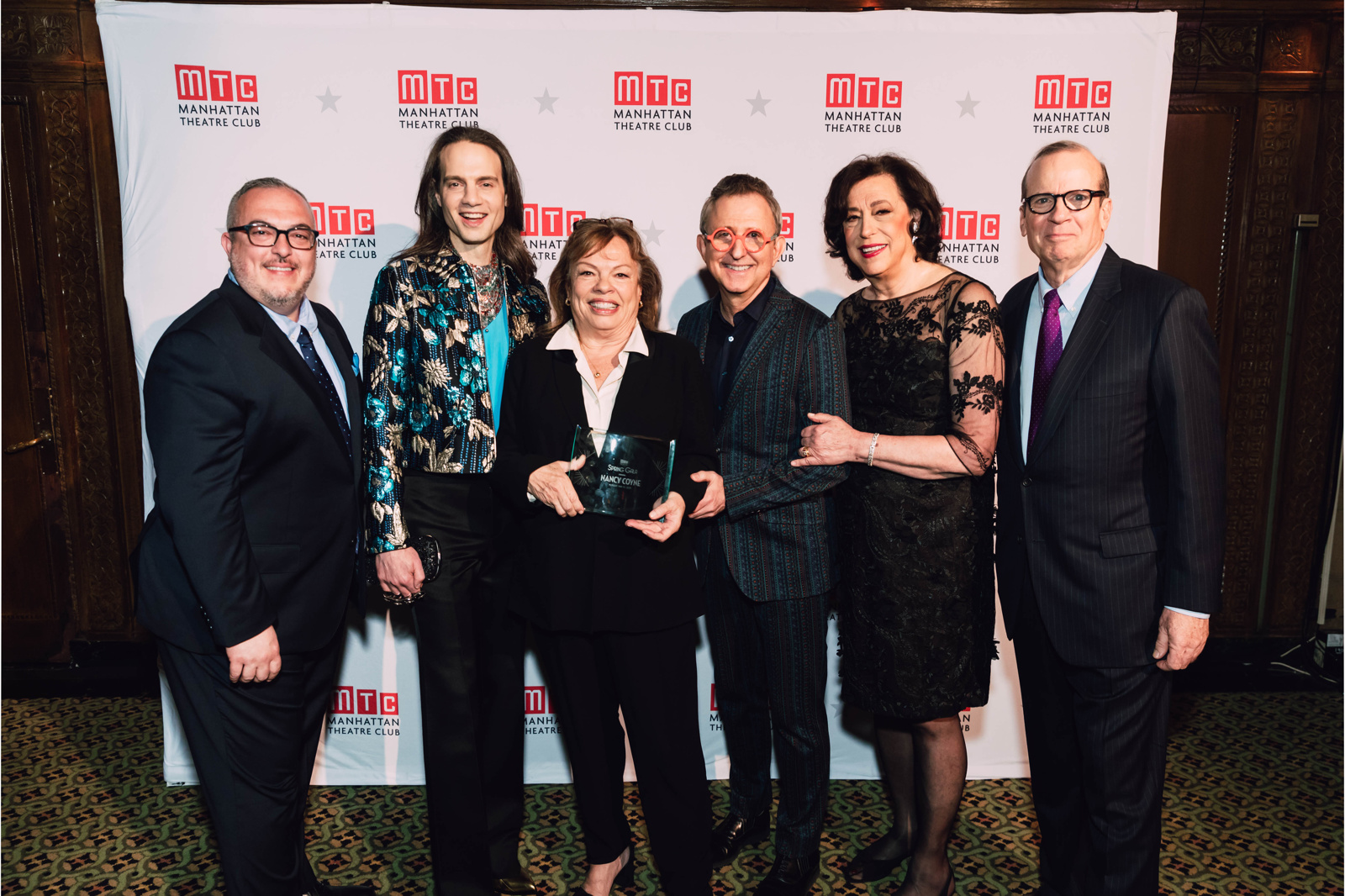
Four years later, Manhattan Theatre Club honored her at its Spring Gala. The May 13, 2019 gathering at Cipriani 42nd Street included performances from shows ranging from Choir Boy to Hadestown. Its tribute recognized her advocacy for the arts and mentorship of women alongside the advertising career.
The agency entered another chapter in 2026, when CEO Matt Upshaw acquired it from Omnicom. The transaction closed on February 27, returning the company to independent ownership after its 2003 acquisition. Upshaw’s purchase belongs to the story of the institution Coyne helped establish, now carried forward by a later generation of leadership.
Her own story retains a satisfying connection between the school stage and the advertising office. At one end are roses scattered by accident and an undiminished love of applause. At the other are years spent arranging the invitation for strangers to have an evening they would remember. The room changes. The pleasure of being there remains the reason to go.