Before Elina Onitskansky started Ilant Health, she gave the idea six months of questions. She talked to industry experts, tested her hypothesis, and tried to determine whether the gap she saw could support a business. For someone with a career in strategy, this was a consequential change of position. She would eventually have to make the decisions herself, hire the people, find the capital, and live with the result.
“I didn’t want to start a company just for the sake of it,” she said. It is a useful opening line for a founder story, particularly in a culture that can make starting a company sound like a personality requirement. Onitskansky already had a substantial professional life. The question was whether this particular company deserved to exist.
Her route to that decision had taken her through Harvard, McKinsey, private equity, and corporate leadership. But an earlier chapter supplies a pleasing complication. Long before Ilant, before the MBA and the senior strategy titles, she had already been a CEO. Her organization was an undergraduate research journal. The recurring business of getting people to do difficult things together had arrived early.
A scientist with an early CEO title
At Harvard College, Onitskansky studied chemistry and physics, graduating magna cum laude. It is a combination that asks for considerable patience with things that refuse to behave as expected. Her early research record includes work on detecting metal ions in water. A published 2001 patent application names her among four inventors, alongside Meijun Shao, Laurie Dudik, and Chung-Chiun Liu.
The application concerned an electrochemical sensor and was assigned to Hathaway Brown School. Her early work also included presenting research on a sensor and plating system to detect and remove metal ions from polluted water. The detail is modestly technical and unusually specific. Before she was working through the economics of organizations, she was helping investigate how to measure something in the physical world.
By June 2005, another responsibility had appeared. She was CEO of the Journal of Young Investigators, an undergraduate publication built around scientific writing and peer review. Selby Cull was its editor-in-chief. During their leadership, the journal received a second grant from the Burroughs Wellcome Fund to develop a Science Career Center.
A student journal has its own operational difficulties. People graduate. Knowledge walks out of the room with them. The next group must learn enough to keep publishing. The journal’s founding generation had worried about exactly that problem. Onitskansky’s appearance in its history places her inside an institution that had to keep renewing its staff while continuing its work. There are less useful introductions to management.
A laboratory question. An organizational one.
Several seats around the same table
Onitskansky later earned an MBA with distinction from Harvard Business School. Her business experience includes an associate role at Hellman & Friedman and an associate partnership at McKinsey. These are different vantage points. An investor has to consider what an enterprise might become. A consultant has to understand a problem quickly enough to recommend a course of action. An operator has to make the recommendation survive contact with Tuesday.
Her subsequent titles brought her closer to that last responsibility. At Molina, she led strategy, eventually serving as senior vice president and head of strategy. At Help at Home, she became chief growth and strategy officer. She also spent time as an executive in residence at Centerbridge Partners. Each role added another institutional setting to a career already comfortable moving between them.
There is a temptation to read such a résumé backward, as if every appointment had been carefully selected for a future founder biography. Careers are rarely so obliging. What the sequence does establish is breadth: she had worked around investment decisions, strategic planning, and the practical demands of growth before starting her own enterprise. The founder arrived with experience of organizations larger than the one she was about to create.
That background gives her move into entrepreneurship a particular texture. She was taking an idea into an arena whose buyers, budgets, and decision processes were already familiar to her. Experience does not settle whether a new venture will work. It can, however, make the questions more pointed. Knowing the room is useful when the next task is persuading the room.
“the value of starting from first principles”
Elina Onitskansky, on a lesson shared by physics and consulting
When she discusses her early career, Onitskansky connects physics and consulting through a common habit: returning to first principles. She also describes herself as an extrovert, recalling that long stretches in a clean room were an awkward fit. That gives the transition out of laboratory work a human explanation. An interest in difficult questions does not oblige someone to enjoy every setting in which those questions are asked. She found a working life with more conversation in it. The scientific training remained part of her account of how she thinks, even as the daily work moved toward businesses and the people inside them.
Six months spent asking
The six months before Ilant belong in the story because they interrupt the usual speed of a startup origin. An idea is easy to describe in a sentence. Testing it requires other people, inconvenient answers, and time. Onitskansky’s account of that period centers on conversations: she took her own hypothesis to industry experts and investigated whether it held up beyond her initial experience.
Read as a business decision, the method is straightforward. A founder can be convinced that a problem matters and still need to establish what kind of organization should address it. The two judgments demand different evidence. Her period of inquiry sits between them. It also puts listening inside the act of founding, where it tends to receive less attention than the eventual launch.
Ilant was founded in 2022 and emerged publicly in October 2023 with $3 million in funding. Among the early financial backers named at launch were executives Matt Klitus, Iyah Romm, and Brandon Kerns. The company entered public view with both a founder and a network of people willing to support the venture. The private testing had become a public commitment.
By July 2024, she was describing a plan to seek further investment and expand operations. She discussed using early capital to build technology and analytics while designing the business to remain financially sustainable as it grew. Those are operating choices with consequences well beyond a fundraising presentation. A company has to decide what to build first, what to pay for, and what it expects each new stage to make possible.
Spent talking to industry experts and testing the hypothesis behind the company.
The founder and the allocation of capital
Onitskansky’s work with investors also continued outside her own company. She joined Valeas Capital Partners as a senior advisor in 2022. Her responsibilities there include supporting its partnership with portfolio company CINQCARE, evaluating strategic growth opportunities, and helping with longer-term positioning and capital-market readiness. It is work that requires attention to the future shape of a business as well as its immediate choices.
For her own enterprise, June 2026 brought a $15 million Series A led by Cornucopian Capital. The announced participants included naturalX, PeakBridge, SEMCAP AI, Evidenced, and Operator Partners, alongside existing investors Celtic, LifeX, and AlphaLab. Reported total funding rose above $22 million. These are company financing figures, and they describe the resources available for the next chapter of the business.
The financing provides a clear date in a story whose preparation stretches much further back. The student executive, the investor, the consultant, and the corporate strategist now appear in the same professional life. It would be tidy to call the round the destination. For a working founder, it introduces another allocation problem: more resources, more decisions, and a wider set of commitments to carry.
Two markers along the way
An institution has to keep working
There is another strand to Onitskansky’s organizational life. She served on the Carter Burden Network’s board of directors, appearing among its directors for fiscal 2023. The New York nonprofit supports older adults through community services, advocacy, and arts programming. The board credit adds a civic institution to a biography otherwise crowded with commercial ones. It also keeps the geographical scale human: alongside national business ambitions, there is a city and its residents.
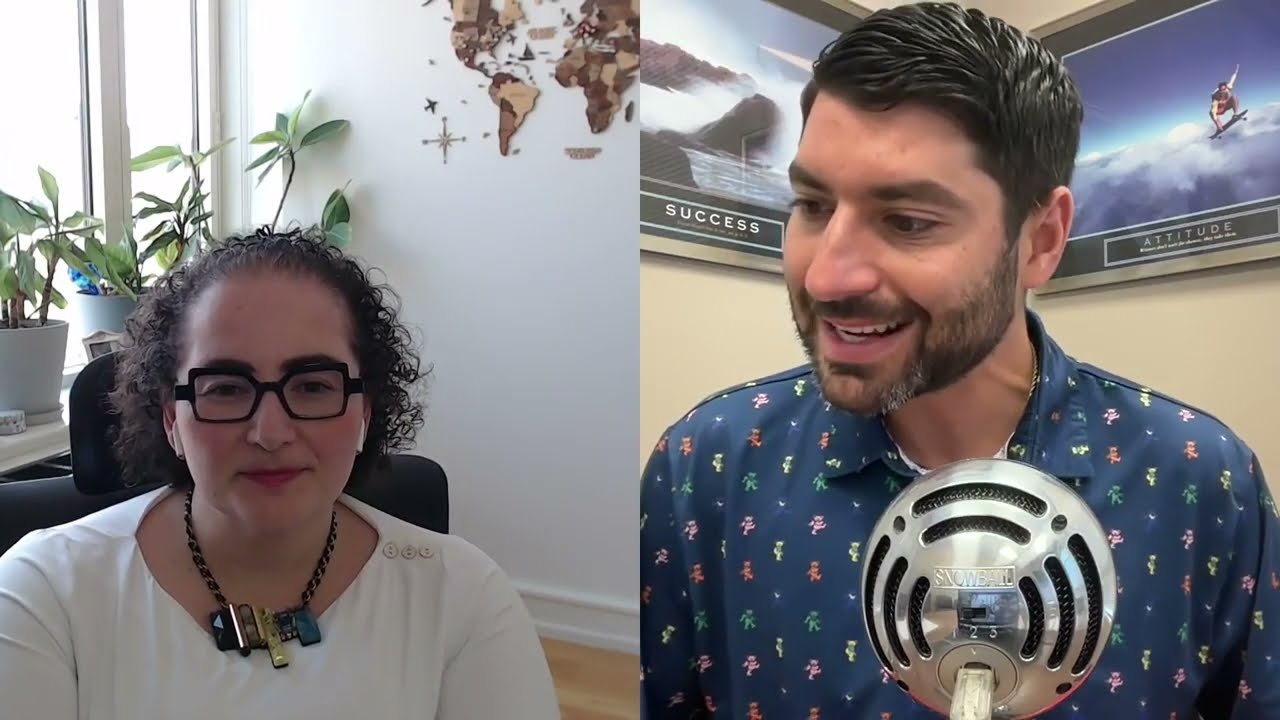
Her public calendar has continued to fill with conversations. In July 2026, she joined Kevin O’Leary for a company presentation and Q&A at Health Tech Nerds. In September, she appeared in a CB Insights CEO interview. By then, the company had moved through its public launch and a further financing round, while she remained its founder and chief executive.
Looking across these chapters, the interesting change is the object of her attention. Early on, it was a measurable signal in water. At the student journal, it included a publication that depended on volunteers and successive generations of leaders. Later came investment choices, strategy, growth, and the construction of a company. Each required a way to turn an observation into work that other people could carry out.
The six months of questions make sense in that company. They give the leap a period of preparation and the founder a life before the title. There was time to ask whether the idea deserved an organization around it. Then came the less theatrical, continuing task: making that organization work.
Continue the conversation
Follow her work, watch the interview, or explore the earlier chapters.