Matt Upshaw worked his way up at Serino Coyne until, in February 2026, he bought the place. There is a pleasing economy to that ending. The assistant account executive who arrived in 2007 became the chief executive in 2019, then the owner nineteen years after his first day. Meanwhile, according to a colleague, he continued singing show tunes around the office. The promotion of his voice has apparently lagged behind the promotion of its owner.
The purchase from Omnicom returned the New York advertising agency to independent ownership. More than seventy employees stayed through the transition. The company kept its name and a strategic relationship with its former parent. For Upshaw, the change placed ownership alongside a responsibility he already knew: running a business whose clients need people to get out of the house and come together.
That is an unusually physical destination for advertising. An impression on a screen can be counted. A seat in a theater can be occupied. Between the two lies the part of the job that has held his attention through changing titles, channels and company structures.
A route that did not start at the stage door
Upshaw studied civil engineering at Georgia Tech. After graduating, he spent five years working in Navy intelligence. He then moved to New York looking for a job in marketing. His first account at Serino Coyne was Hairspray. Put those details in order and the résumé briefly resembles a filing error: engineering, intelligence, musical comedy.
The temptation is to turn that sequence into a theory about his mind. The facts are more interesting left in their own shape. He brought an education and a period of work outside advertising to an entry-level agency role. His route into Broadway ran through a job search and account work, rather than a performance credit.
He subsequently became a group director, vice president of account management and insights, and managing director. Each title widened the frame. An account concerns a client. Insights concern what the agency can learn. Management concerns how people and responsibilities fit together. By 2018, he was one of three managing directors alongside Leslie Barrett and Michael Hartman.
The following year brought the chief executive job, effective November 17. Angelo Desimini, his predecessor, moved to Disney Theatrical Group, an agency client. A working relationship acquired a new arrangement: the colleague would now be on the client side. Broadway careers have a way of moving people around the same table.
- 2007Assistant account executive
- 2015VP, accounts & insights
- 2018Managing director
- 2019Chief executive
- 2026Owner
The seat is the point
When he became CEO, Upshaw offered a compact description of the agency’s purpose: methods would change, but the goal was to fill seats. It was an answer with little patience for abstraction. He brought an advertising conversation back down to the furniture.
A live event gives marketing a deadline with a door attached. Someone has to choose an experience, pay for it, arrange the journey and arrive. A compelling campaign can begin that process. It cannot take the trip on the customer’s behalf. The distinction makes audience knowledge a practical necessity, rather than decorative evidence in a presentation.
For an agency executive, the word audience can also hide differences that matter. A person discovering a show for the first time and a person deciding when to return may look similar from the stage. They have different decisions to make before they get there. Advertising has to meet them earlier in that journey.
“How we do it may change over time, but our focus remains the same: butts in seats.”
Matt Upshaw, 2019
Serino Coyne’s service list reflects the number of decisions involved: brand development, communications, media, partnerships, research, websites and ticketing. Creative work sits beside revenue management. An executive in that environment needs to keep the emotional invitation and the mechanics of attendance in the same conversation. Otherwise, a beautiful idea can have nowhere useful to send its admirers.
A little of the show, before the show
In late 2019, four oversized “Show Globes” appeared in Times Square. Developed by Serino Coyne with the Times Square Alliance, they represented The Lion King, Wicked, Dear Evan Hansen and Ain’t Too Proud. The installation offered pedestrians miniature encounters with productions before asking them to enter a theater.
Upshaw described their appeal in terms of the feeling of each musical, something a flat billboard could convey less fully. The idea makes sense on a street where almost everything is already asking to be looked at. Give the passerby an object with a world inside it, and the promise of a show becomes something to explore.
The globes are a useful example of the business he leads. A campaign borrows some of the pleasure of its subject. The invitation becomes an experience in its own right, with the larger experience waiting nearby. It is a small act of translation: take something that happens in a room and give a stranger outside a reason to care.
Making room for other people’s strengths
In October 2024, Upshaw announced Diana Salameh’s promotion to executive vice president and the arrival of Tina Wargo as director of content. He connected Salameh’s expanded responsibility to her work building the agency’s marketing partnerships team. Wargo came from TodayTix to oversee agency content, social media and influencer marketing.
The appointments put two different kinds of audience contact into view. Partnerships bring a production into another organization’s world. Content reaches people in the places where they watch, read and share. Both require a sense of how to earn attention without assuming that a Broadway title already has it.

There is a particular kind of leadership visible in a promotion announcement: the explanation of what another person has contributed. Upshaw’s account of Salameh’s role was specific about partnerships and the way that work had spread into strategy across departments. It gave the new title a history. For a reader following his own rise through the agency, the symmetry is appealing. Having accumulated responsibilities himself, he was now describing how a colleague had done the same.
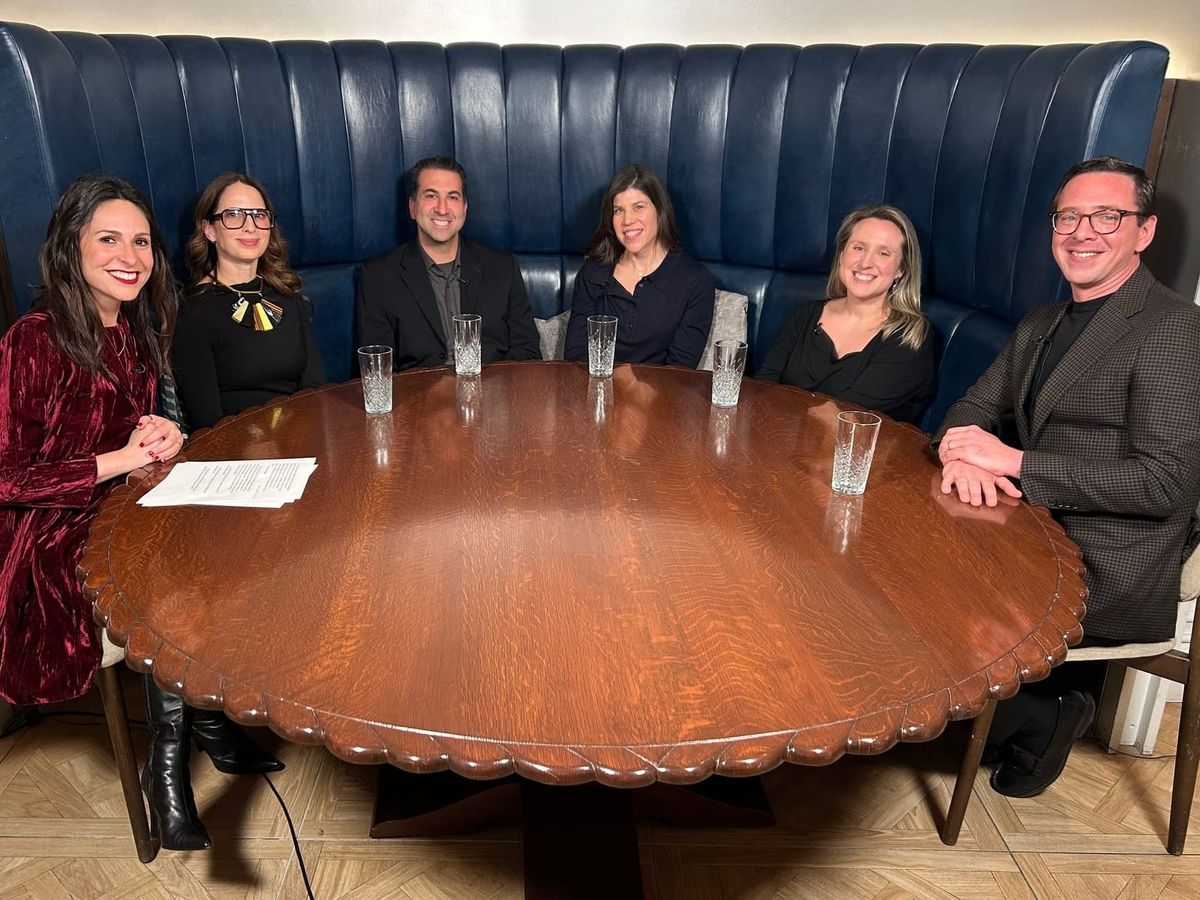
His public industry participation also places him among fellow advertising executives. In February 2026, he joined Liz Furze of AKA, Jeremy Kraus of Situation, Ilene Rosen of RPM and Callie Goff of SpotCo at the Algonquin Hotel for a Broadway advertising roundtable. Data, social media, artificial intelligence and making cultural moments were on the agenda.
The setting supplied a suitably New York image: people responsible for getting audiences into rooms, gathered in a room themselves. It also puts his work in a broader community. Broadway’s campaigns compete for attention, but the practical questions about reaching theatergoers extend beyond any single agency.
The owner and the office soundtrack
The acquisition closed on February 27, 2026, and was announced on March 16. Its price was undisclosed. Serino Coyne had begun as an independent agency in 1977 under Nancy Coyne and Matthew Serino; Omnicom acquired it in 2003. Upshaw’s purchase restored that earlier ownership structure with a different person holding the responsibility.
The earlier stages of his career had changed his position within the agency. This one changed his relationship to the agency itself. There is a difference between being appointed to lead a business and deciding to purchase it. The acquisition makes his commitment concrete without requiring a grand speech about loyalty. A date, an ownership transfer and the retention of the people doing the work carry the story.
A company can change hands while retaining much of its daily life. Here, retaining the full staff made continuity tangible. Those were the people who knew the accounts, produced the work and carried the relationships. Independence arrived with colleagues attached.
Salameh’s public response to the purchase supplied the warmer portrait. She described Upshaw’s belief in the people around him and his care for the agency’s work. Then came the complaint: “He sings show tunes off key in the office.” It is a splendidly specific thing to say about your new owner. The business announcement gets a soundtrack, and the soundtrack needs rehearsal.
Outside work, the interests he described in 2018 had a quieter rhythm. He enjoyed time with his husband Nathaniel at their Hudson Valley cabin, liked classic cars, cooking and the outdoors, and called himself a bourbon aficionado. He also preferred reading The New York Times in print. A man working across digital advertising channels still enjoyed a newspaper that required turning a page.
Those details do not explain an acquisition. They make its buyer easier to recognize. The professional biography contains titles and dates; the person beside it has weekends, tastes and an audible enthusiasm for musicals.
In his ownership announcement, Upshaw described an ambition to connect experiences with the people who would appreciate them, using independence to act more quickly. That leaves him with a familiar task under new terms. He has bought an agency, retained a team and taken responsibility for their next chapter. The performance still needs an audience. Somewhere in the office, it may already have a singer.