Consider the dirty plate. A dishwasher can wash it. That leaves the scraping, the loading, the unloading, the drying, the stacking and the small matter of putting it somewhere useful. The machine has done its job. The kitchen still has several jobs left. Nala Robotics, an Illinois company making automated kitchen equipment, has built a product called Spotless around precisely this unglamorous distinction.
- Nala builds robots for cooking and the handling that surrounds it.
- Its range runs from multi-cuisine kitchens to pizza, wings, bowls, sandwiches and dishes.
- Published monthly starting prices: Wingman $2,999; Spotless $2,995; Pizzaiola leasing $7,000.
- The business case depends on how much useful work each station actually does.
The appeal of a robot chef is easy to understand. An arm moves; something edible appears. Dinner acquires a little theatre. But a restaurant owner has a less romantic interest in the performance. Can the machine finish an order? Can it keep a station moving? Does its impressive cooking leave a person standing nearby, waiting to perform the next step?
Nala’s product catalogue keeps returning to that next step. Its Wingman fry station can bread food, lower baskets into oil, drain them, add seasoning or sauce, and pack the result. Pizzaiola extends pizza preparation through slicing and boxing. Spotless addresses handling from pre-cleaning to storage. The company is selling sequences of work, with robotic arms inside them.
The jobs between the jobs
Take a chicken wing. Frying is the obvious task. A saleable order also requires selecting a portion, managing the basket, choosing a sauce, coating the food and getting it ready to leave. Automating one movement may simply relocate the queue. Nala introduced Wingman in September 2022 with multiple fryers and separate seasoning bins, describing a system that could cook different foods and route them to their respective finishes.
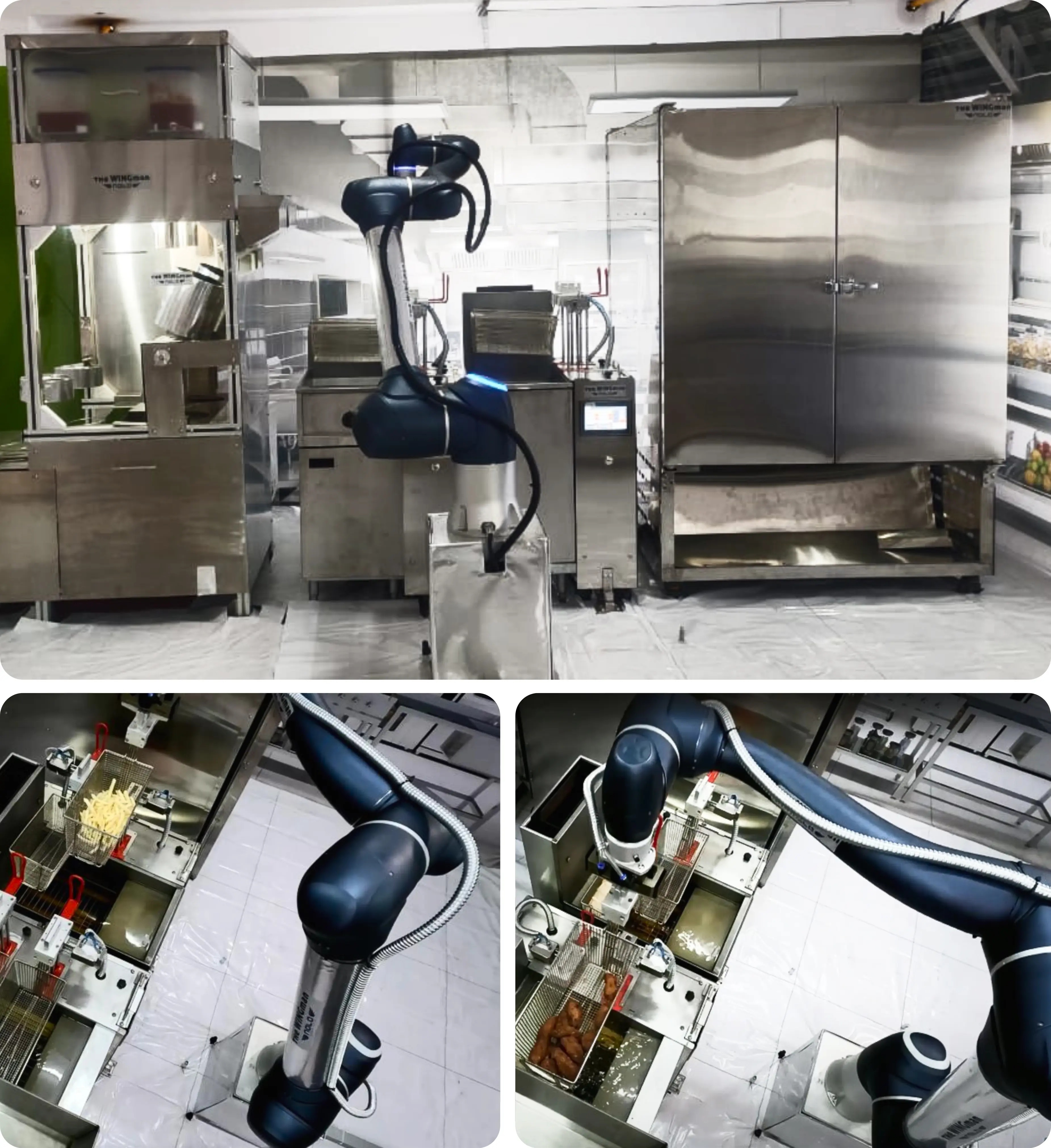
This helps explain why dishwashing belongs beside cooking in the catalogue. Spotless, introduced that December, uses cameras and machine learning to recognize kitchenware and handle it around the cleaning process. Nala’s current product page says it can work with existing dishwashers. The wash cycle already has machinery; the surrounding movements are the opportunity.
For operators, that means choosing a task before choosing a robot. A pizza restaurant, a convenience store and a senior-living kitchen have different bottlenecks. Nala offers specialist stations alongside its broader Nala Chef system. There is no reason every customer needs every machine.
- 01Portion
& bread - 02Fry
& drain - 03Sauce
& toss - 04Pack
the order
The handoffs are part of the product.
Start with the difficult dish
Nala’s first cooking problem was Indian cuisine. In a 2023 interview with US Manufacturing Report, co-founder and CEO Ajay Sunkara explained that the team chose it for the complexity of its recipes, reasoning that other cuisines could follow. Nala Chef debuted in 2021. The wider range came later.

“Whether it’s salty or spicy, it’s a huge variable.”Ajay Sunkara, speaking to US Manufacturing Report, 2023
A recipe gives instructions. A kitchen must turn them into repeatable physical actions. Nala combines recipe software, vision systems, sensors and robotic handling to do that work. Its Nala Chef interface lets operators create and customize recipes, monitor equipment status and track ingredient use. This is useful to a business trying to reproduce a dish across orders rather than merely demonstrate it once.
The naming is unusually apt. Nala takes its name from the figure in the Mahabharata known for his cooking. The company has continued pursuing culturally specific dishes: in November 2024 it announced BIRYANIMAN, a robotic biryani maker advertised as capable of up to 100 varieties. Its debut installation was planned for BIRYANIBUFFET in Naperville. The number describes the promised recipe range, rather than a count of restaurants using it.
Bowl and sandwich robots, announced in May 2023, expand the same idea into assembly. The Bowls product page lists 28 ingredient choices and configurable bases, proteins, toppings and sauces. Customization can be orderly: a customer chooses a variation, while the machine follows an established set of movements.
A robot with a monthly bill
Kitchen automation becomes more interesting when it acquires a price. Nala lists Wingman rental from $2,999 a month and Spotless from $2,995. Pizzaiola leasing was announced from $7,000. These are starting prices tied to configuration, with different rental and leasing terms; they are not interchangeable quotes for a finished installation.
Spotless and Wingman: listed rental. Pizzaiola: announced leasing. Configuration and contract terms vary.
The Wingman and Spotless pages describe monthly packages including hardware, software updates, professional maintenance, service calls, training and live support. That makes servicing part of the proposition. A restaurant purchasing automation is also purchasing a relationship with the people who keep it running.
Here is a small calculation with large consequences. Divide Wingman’s $2,999 starting rent by 300 operating hours in a month and the rental component is roughly $10 an hour. At 150 hours, it is roughly $20. Neither figure includes the rest of the kitchen’s costs. Both expose the importance of utilization. A machine available all night needs orders all night to earn money all night.
$2,999 ÷ monthly operating hours. Food, utilities, installation and other operating costs excluded.
Nala also announced Nala Marketplace in March 2022, a Restaurant-as-a-Service platform for virtual food brands using robotic kitchens. The company pitched rapid launches through that infrastructure. An operator evaluating it would need to understand which kitchen capacity, recipe configuration and delivery arrangements the service actually supplies. The platform’s attraction is access to production without building every part from scratch.
The 28-inch exception
Restaurants complicate tidy engineering plans. Slice Factory, the Chicago-area chain, sells 28-inch pizzas. In June 2022, Nala announced an agreement to custom-design Pizzaiola installations for new locations, including those unusually large pies. The detail matters: a recognizable product can require very particular machinery.
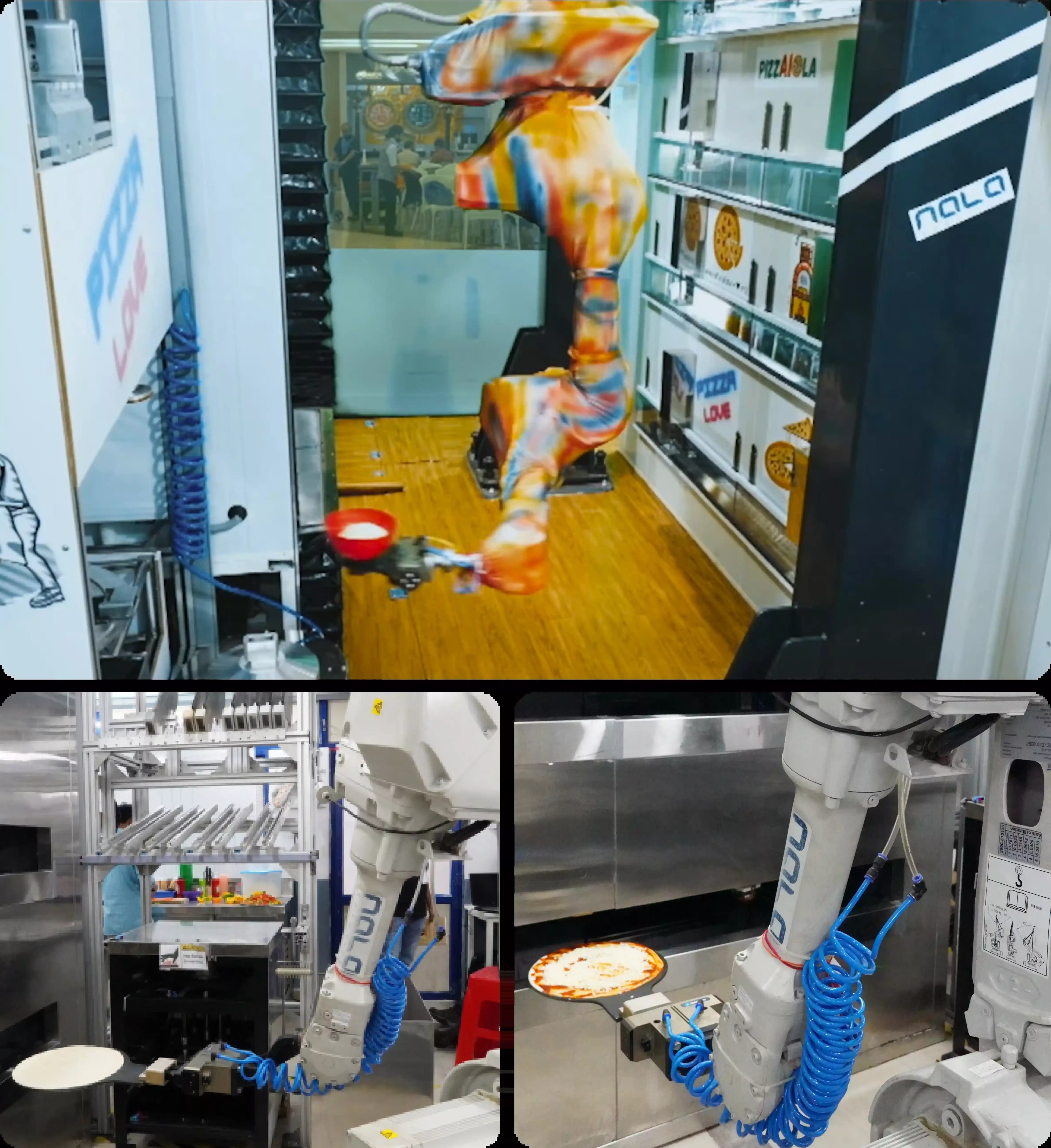
In January 2023, Nala joined Ovention and Hatco on a different pizza proposition. Their announced system placed robotic preparation, an Ovention Shuttle oven and Hatco pickup lockers within a 10-by-10-foot footprint. It followed the order through cooking to collection, giving the final handoff its own piece of equipment.
Convenience stores offer another setting for that logic. Re-Up announced a Wingman rollout in April 2024, when it reported nine open stores and more than 30 in its pipeline. Hot food could extend what a fuel stop sells. Those figures describe Re-Up’s estate and plans at the announcement date; they should not be read as a completed fleet of Nala installations.
Nala competes in commercial kitchen automation, where Miso Robotics’ Flippy also automates frying. Its distinctive pitch is breadth across kitchen tasks and cuisines, plus customized systems and equipment partnerships. For a buyer, that breadth matters only where it matches the menu and the premises.
Count the handoffs before buying the arm
The useful thing to copy from Nala is the habit of following a dish beyond its headline task. Watch an order travel through your own kitchen. Count the touches, the waits and the people pulled away from other work. A modest delay repeated through a shift can deserve more attention than an elaborate cooking flourish.
Then test the proposed system with the actual menu. Include replenishment, cleaning, packaging and a stopped machine in the demonstration. Nala’s product pages specify footprints, utilities and safety clearances. The Bowls, for example, lists a 10-by-10-foot footprint and recommends three feet of distance during operation. Floor space has a cost even when the robot has a charming name.
A quiet station, an awkward layout or a menu requiring frequent unconfigured changes can weaken the case. A busy, repeatable workflow gives the operator something concrete to measure. The question is how many orders reach the customer with less friction, at an acceptable total cost. The last clean plate belongs in that calculation.