The truck is 15 minutes away. The wagyu needs eight minutes. In Kish Shin’s kitchen, this does not mean the food waits seven minutes under a heat lamp. It means the kitchen waits. At the correct moment, a refrigerated canister begins its trip through a robotic system, ingredients tumble into a hot rotating wok, and dinner cooks while the road unspools beneath it. The meal is meant to finish shortly before the vehicle reaches the customer. The last mile becomes a cooking timer.
This is the delightful oddness of Shin Starr Presents, the company Shin co-founded in 2019 and now leads as chief executive. Its OLHSO food trucks place an automated kitchen where another delivery business would put insulated bags. A human drives. Behind the cab, refrigeration, conveyors, robotic handling, induction-heated auto-woks, serving equipment, and a cleaning cycle perform a compact metallic ballet. The operation does not merely transport dinner. It tries to protect dinner from transportation.
Shin’s explanation of the system is revealingly free of worship. Machinery is allowed to be clever, but the customer did not order cleverness. “They care about the value they’re getting,” he has said. It is a sentence that should be taped to every robot arm in the building.
01 / Before the machineA career assembled like a modular kitchen
Shin did not arrive here by the usual robotics route. He studied social sciences at Hanyang University, graduating in 2008. His working life then moved through sales and trading at Mirae Asset Securities in the United States, business development at the materials company JIOS Aerogel, a managing director role at restaurant group 678 Corporation, and a managing partnership at BTBL Corporation. Finance taught one language of systems. Restaurants supplied another, louder one: leases, labor, consistency, franchise operations, and the nightly fact that a hungry person has very little interest in your excuses.
That mixed education matters. An autonomous kitchen is not simply a machine that gets hot. It is a restaurant compressed into a sequence of decisions: who prepares ingredients, where they are held, when cooking starts, how temperature is controlled, where the finished bowl goes, how the vessel is sanitized, and what happens when any part misbehaves. Shin’s career placed him close to the commercial and operational edges of that sequence before he tried to automate its center.
He founded Shin Starr with Jay Shin, an old friend who shares his surname but not his family tree. The distinction has made its way into local reporting, perhaps because two Shins founding Shin Starr sounds almost too neatly scripted. Their complementary backgrounds joined restaurant experience with technology and investment thinking. They set out from Seoul to build automated cooking equipment around Korean cuisine, then brought the operating experiment to the Bay Area.
“At the end of the day, it has to be about the food, not the robotics.”Kish Shin
02 / Cook-en-routeThe kitchen that knows when to wait
The system is called Autowok, an admirably literal name. A prepared meal begins in a steel canister inside a refrigerated unit. When software decides the time is right, the canister moves to an auto-wok. The cooking chamber is tilted, cylindrical, induction-heated, and able to rotate. It can stir-fry the ingredients, tip the finished dish into its container, and enter a cleaning cycle. In OLHSO’s early Foster City operation, the trucks carried four auto-woks and a human driver completed the handoff.
A dinner’s short mechanical journey
The choreography makes the truck look autonomous, but the word can flatten the people around it. A chef develops the food. Kitchen staff prepare and portion ingredients off-site. People load and restock refrigeration. A driver handles the road and customer handoff. Technicians maintain a damp, hot machine asked to perform while moving. The automation occupies a specific middle: repeatable cooking, transfer, and cleanup.
That middle is hard enough. Movement adds vibration and changing road conditions to an environment already governed by heat, moisture, grease, sanitation, and timing. From concept to OLHSO’s May 2024 launch, the work took roughly four years. Certification proved especially awkward because a robotic kitchen cooking en route did not fit comfortably inside an existing regulatory category. New machines are often described as if invention ends when a prototype moves. Restaurants have the impolite habit of requiring permits, safe food, clean equipment, and another service tomorrow.
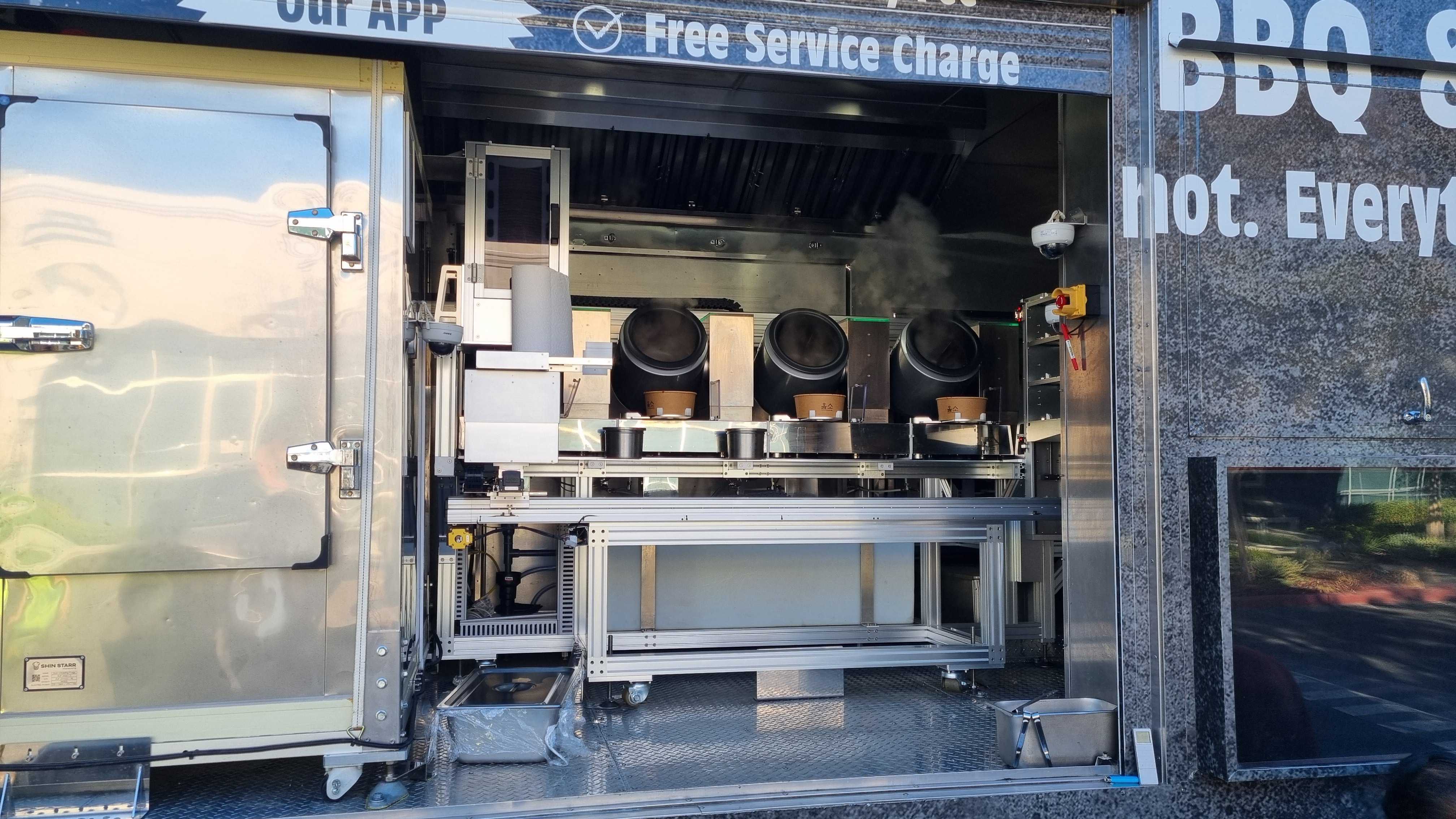
Foster City offered a sensible test bed. The first two trucks served a limited geography where most destinations could be reached quickly. The menu was similarly disciplined: dishes including wagyu galbi, spicy dak galbi, japchae, and a pork-and-seafood combination. A constrained radius and concise menu are not signs of a small imagination. They are how an ambitious machine gets enough repetitions to become less ambitious and more dependable.
03 / The plate’s vetoNovelty gets one order
Food robotics has a theatrical problem. Flames, arms, conveyors, and glowing control panels photograph beautifully. They also invite a customer to visit once, film the spectacle, and return to the restaurant they already trust. Shin speaks as an operator alert to that expiration date. He has argued that customers are indifferent to the “rocket science” hidden in a truck or kitchen. The phrase is funny because the equipment plainly required formidable engineering. His point is commercial: no mechanism gets to overrule the meal.
That priority explains the role of chef Han Sungil, who came from a Korean restaurant portfolio to lead the company’s culinary work in the United States. The recipes supply the judgment; the platform tries to reproduce it. Induction matters because temperature can be controlled precisely. Portioning matters because the same amount must meet the same heat. Cleaning matters because the next bowl should inherit the recipe, not the previous order. Automation becomes a preservation system for culinary intent.
Shin’s public manner follows the same hierarchy. He talks about freshness before autonomy, customer value before science, and partnership before conquest. When a retail executive praised the company’s mobile launch, his response thanked the host, team, and partners. It is a small social clue, not a grand theory of character. Still, it fits an operating reality: a food truck may run with very few people inside it, but no new restaurant format reaches the street alone.
04 / Smaller rooms, longer hoursThe restaurant after midnight
The truck is only one arrangement of Shin Starr’s modular platform. The company also operates OLHSO House, a chef-led restaurant in San Mateo, and is developing a compact micro-restaurant intended to fit in less than three square meters. That unit is designed for high-traffic places where conventional restaurant economics become brittle, particularly during off-hours.
Airports are the opening argument. Late flights continue after kitchens close, leaving travelers to make a melancholy choice between a vending machine and a wrapped sandwich. A stocked automated unit could cook through the night without keeping a full restaurant staffed. Shin Starr has also discussed hotels, hospitals, and college campuses, other places where hunger keeps inconvenient hours.
The ambition extends back onto the road. Shin has said the company is open to working with delivery robots and driverless-truck partners, imagining a future vehicle without the human driver now required. That remains an aspiration rather than the present operation. It also exposes the platform’s larger wager: once a kitchen can tolerate motion, coordinate itself with a route, and fit into a modular footprint, the room around it becomes negotiable.
The most intelligent act in this robotic kitchen may be the seven minutes when it does nothing.
05 / The useful lessonAutomate the promise, not the performance
There is an idea here worth stealing beyond restaurants. Most automation is sold through visible activity: faster movement, more output, fewer hands. Shin’s example begins with the customer’s desired ending and works backward. The meal should be freshly cooked at arrival. Therefore travel time becomes input. Therefore the machine sometimes waits. Efficiency is not maximum motion; it is coordinated motion in service of a promise.
The distinction protects the company from its own spectacle. A blue-lit auto-wok is a fine invitation. Consistent galbi is the business. A moving kitchen attracts a camera. A clean wok, accurate temperature, and dinner finished at the right minute create the possibility of a habit. Somewhere between those two truths sits Kish Shin, a former trader and franchise operator asking a robot to learn hospitality’s least robotic skill: timing.
There is a pleasing modesty in the sequence. The robot does not invent hunger, choose the recipe, or decide what tastes good. It accepts a carefully prepared canister and performs its narrow assignment under unusually difficult conditions. The founder’s job is wider: make cooks, engineers, regulators, landlords, drivers, and customers agree that the assignment is useful. Shin’s story is compelling because the machine is visible while most of that work is not. The steel arm gets the photograph. The operating system around it earns permission to serve lunch.