Before Omar AlShamsi put restaurants and suppliers on a screen, he put his grandmother’s nickname above a café door. Mama Tani meant “second mother”. He and his sister Maitha had grown up eating khameer at her house, and their Dubai café carried some of those memories into a business. The bread was made with date syrup, with saffron and cardamom in the mix. The proposition was pleasingly direct: give people something they would be glad to eat.
By November 2013, the siblings were welcoming customers to a place that described itself as a taste of home. Omar spoke about the pleasure of watching someone enjoy a meal. “It’s so beautiful to see people smile after they eat.” Years before Watermelon, the business already had a human purpose. A satisfied customer was a result you could see across the table.
A grandmother’s name on the door
A family memory gives a café character. It does rather less for an unpaid invoice. AlShamsi would eventually encounter the distance between the experience a restaurant offers and the machinery required to keep offering it. His later work makes more sense with both sides in view: the warm welcome out front and the purchasing decisions behind it.
The café also makes his route into food technology unusually concrete. He had been responsible for a food business himself. His connection to hospitality preceded the pitch deck, the marketplace and the partnerships. Mama Tani was a place with a family name and a particular kind of bread, long before it became part of an explanation for a software company.
The banker meets the back office
There was another education running alongside the food business. AlShamsi studied accounting and finance at Case Western Reserve University in Cleveland, then completed executive MBA studies at INSEAD. His professional life included Daman Securities, investment work for Dubai Group in Hong Kong, and treasury roles at National Bank of Abu Dhabi. He later became chief of staff at the bank and handled government relations at First Abu Dhabi Bank.
In 2019, he helped establish KPISOFT in the UAE, moving into enterprise performance software. Finance, business operations and technology were becoming connected parts of his working life. By the time he was building Watermelon, a restaurant’s purchasing problem was something he could approach with more than a restaurateur’s frustration. He had also worked with money and with the systems companies use to understand their performance.
The career can look like a collection of changes when reduced to job titles. Seen through Watermelon, it has a practical continuity. Buying stock, understanding spending and paying for the next order all sit close together in the working day of a food business.
The café closes. The question stays.
Mamatani eventually closed. Difficulties securing and retaining suppliers disrupted its cash flow. AlShamsi later described the struggle to find suitable suppliers and systems while keeping track of how the business was performing. The food at the table was only one part of what required his attention.
In August 2024, looking back on his coffee-shop years, he connected that experience directly to Watermelon’s beginnings. He had seen an industry split across disconnected operations and wanted to bring those activities together. The memory that remained useful was an operating problem: how a business finds what it needs and manages the transaction.
Watermelon Market launched in 2021. By August 2022, it had 170 restaurant customers in the UAE, up from two the previous year. Those are early snapshots, but they give the idea some scale. A difficulty experienced in one café had become the basis of a service other businesses were willing to use.
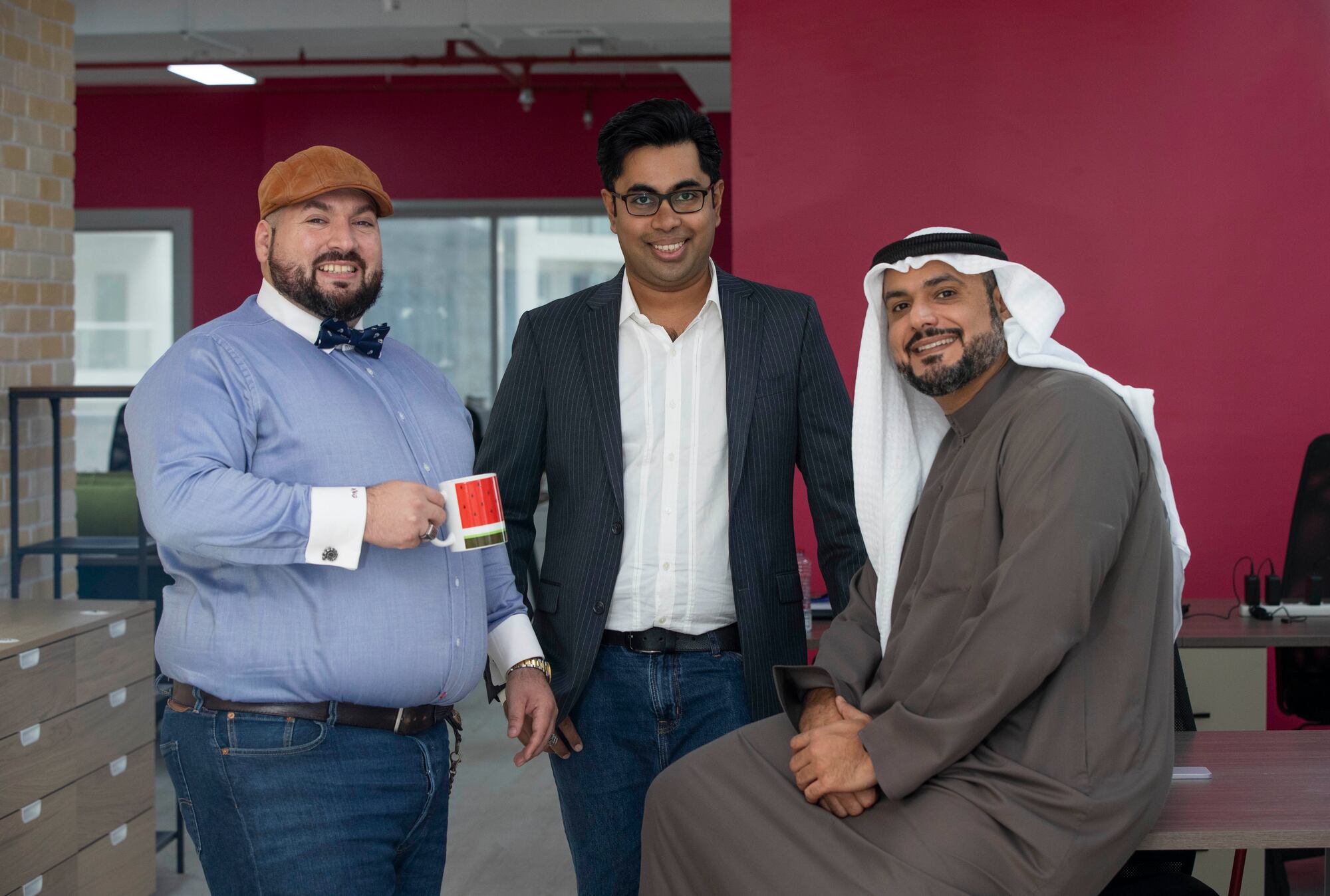
Three people, different parts of the problem
AlShamsi built the business with Archya Sengupta and Cristobal De Nadai Albornoz. Sengupta brought experience in technology and management applications; Albornoz brought food distribution and supply-chain knowledge. Their combined backgrounds help explain why the project reached beyond a directory of suppliers.
In his 2022 writing about operating models, AlShamsi argued that businesses need systems suited to their capabilities and objectives. He considered digital readiness, the relationship between ambition and capacity, and the way an organization’s culture affects execution. A tool cannot do much useful work if the rest of the business cannot work with it.
There is a modest discipline inside that argument. Putting a process online leaves plenty of questions about what happens next. Records must connect. Employees need clear responsibilities. The technology has to fit the business using it. His account of Watermelon is grounded in that ordinary organizational work, with all the patience it tends to demand.
“If you are in the ecosystem, you’re in my home”
Omar AlShamsi, on looking after Watermelon customers, 2022
Customers who bring the next customers
AlShamsi has described customer care through the language of hospitality. The comparison is revealing. A business platform can speak in the abstract about users and transactions; he reached for the obligations of a host. The welcome from the café had found another place to live.
In a separate account of Watermelon’s early growth, he credited recommendations between clients as a major source of new business. He also emphasized the cooperation of sales and customer-service staff. For a service that depends on bringing buyers and sellers together, those relationships have an immediate commercial purpose. A restaurant’s recommendation to another restaurant can carry the weight of shared daily experience.
Watermelon also pursued purchasing beyond commercial kitchens. In February 2023, Watermelon Home was introduced to connect households with suppliers previously serving commercial operators. Minimum quantities varied by supplier. The extension carried a recognizable question into another setting: how can a buyer reach the products and producers they want?
Watermelon Home’s launch included suppliers such as Aramtec, Golden Loaf Bakery and Waynik by Safco. The appeal was access to products used by restaurants, with orders delivered directly by suppliers. That introduced a different kind of buyer into AlShamsi’s business. A household buying for its kitchen has its own requirements around quantity and convenience. Extending the platform meant accounting for those requirements while keeping the connection to the producer. The familiar hospitality question had followed him again: what does the person placing this order actually need?
The order and the money belong together
In July 2024, Watermelon announced a $4 million Series A at a $29 million post-money company valuation. Daman Investments acted as exclusive fundraising adviser. The stated uses of the money included local and regional growth and further development of the product offering. For AlShamsi, it was capital for the business whose origins he still connected to Mamatani.
Company funding, with Daman Investments as exclusive fundraising adviser.
The financing work also concerned Watermelon’s customers. In September 2024, Biz2X announced a partnership to provide embedded lending and invoice financing through the ecosystem. Merchant purchasing and transaction histories would inform financing offers. Suppliers could seek finance against outstanding invoices. The announcement described processing as fast as 24 to 48 hours, depending on the lender.
The relationship fits the problem AlShamsi had encountered as an operator. Finding an ingredient and being able to pay for it are connected decisions. A useful purchasing system can reveal activity that also matters to a lender. Bringing those functions closer together gives the former banker’s experience a direct application in the food business.
- 01PurchaseA business orders through Watermelon.
- 02Build a recordTransactions create a purchasing history.
- 03Assess financingHistory informs offers through lending partners.
In September 2025, Watermelon and Gainz announced another partnership, adding access to Sharia-compliant crowdfunding and other financing options. The announcement described a Watermelon network of more than 1,000 food-and-beverage outlets and plans to extend the partnership across GCC markets. The next stage remained rooted in the same practical concern: money available when a business needs to buy and operate.
A local producer at the hotel door
AlShamsi’s view of the food business also includes the people producing what gets bought. In March 2024, he highlighted a collaboration with Millennium Plaza Downtown Hotel and chef Christophe Prud’homme aimed at making local produce a primary choice for hotels and restaurants in the region.
The relationship puts a specific buyer beside the ambition to support local suppliers. For a grower or producer, being discoverable is part of reaching a market. For a hotel kitchen, sourcing involves knowing where a product comes from and arranging to receive it. The platform’s purpose becomes easier to grasp when the two sides have actual work to do together.
At the Dubai International Food Safety Conference in 2023, AlShamsi described a fragmented industry and called for its participants to work together. He connected that cooperation with efficiency, transparency and trust. It is consistent with a founder whose business crosses several different occupations, each with its own pressures and timetable.
The next table is farther away
By February 2026, AlShamsi was appearing in a Plug and Play UAE video as a participant in the Dubai Founders HQ Emirati Accelerator. He spoke about the program helping him take Watermelon global. “I want the world to know what we're doing here.” The geographic ambition was explicit.
His earlier reflections on entrepreneurship were less tidy than the standard growth story. In 2022, he described the need to keep adjusting when plans fail to survive experience. That willingness to revise matters for a business expanding from procurement into software, household purchasing and finance. Each extension creates another set of people whose needs have to be understood.
The distance from a grandmother’s table to an international ambition is considerable. Yet the daily test remains close to the café: can the business get what it needs, understand its spending and keep serving people? AlShamsi has chosen to work on those questions. Somewhere beyond the orders and invoices, a guest is still waiting for dinner.
Continue the conversation
Follow the work and explore the interviews.