A credit-card surcharge is among the smallest numbers capable of starting a large argument. To a customer it is an unwelcome line on a receipt. To a merchant it is a fraction of margin retrieved from the expensive business of accepting plastic. To Nagendra Jayanty, it is the visible point of a system involving card networks, local law, payment software, customer expectation and the precise second before somebody clicks Buy Now.
Jayanty is the chief executive and co-chief compliance officer of InterPayments, a San Francisco company devoted to this sliver of financial life. The title pairing is revealing. His job is to grow the business and to mind the rules that could undo it. Sales and restraint occupy the same office.
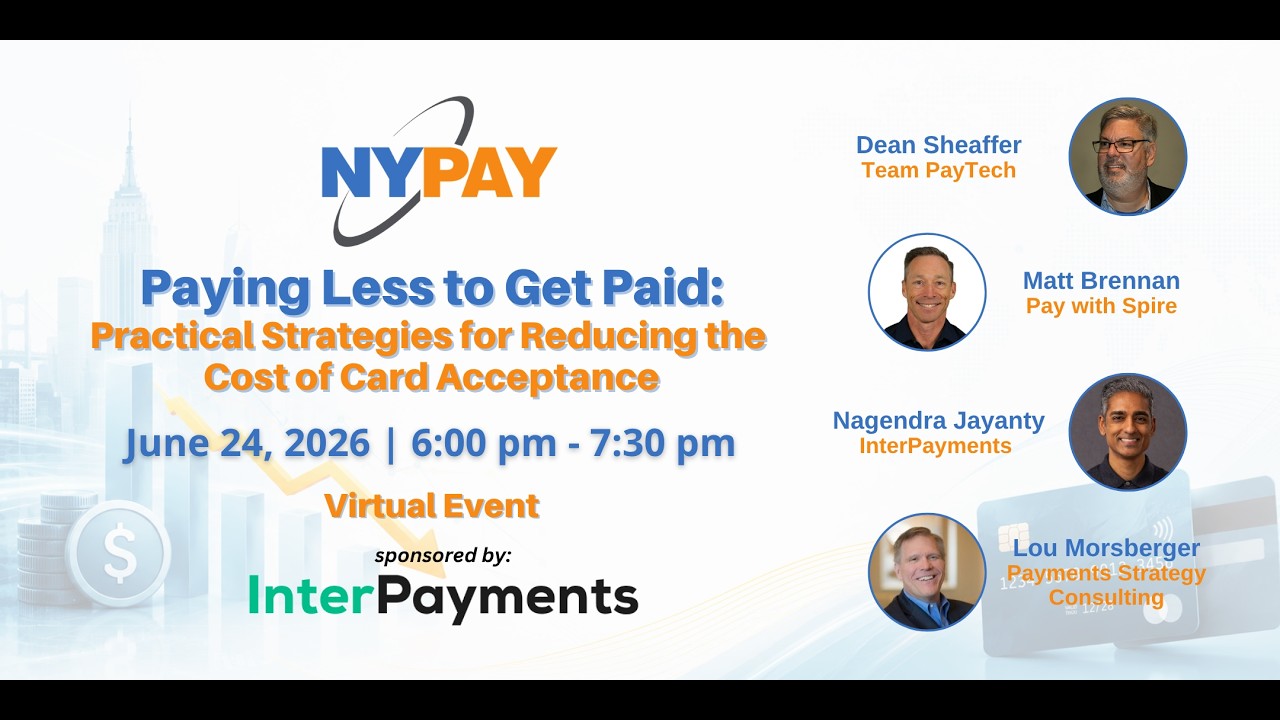
On an industry panel in June 2026, he introduced himself with an invitation: call him NJ. Then, within minutes, he delivered the sentence that explains his operating style better than any polished pitch could. “Surcharging is not for everybody. Just full stop.” Software executives are generally paid to enlarge markets. Jayanty began by drawing a boundary around his.
01 / The cost of getting paid
A fee with a long shadow
The basic proposition is easy to grasp. Credit cards cost merchants money to accept. A surcharge passes the applicable acceptance cost to the customer who chooses that card, rather than folding it into prices paid by everyone. But even the nouns are fussy. Surcharges, convenience fees and service fees are legally distinct concepts. The fee cannot simply be invented at the register because a merchant has grown tired of its processing bill.
Jayanty argues that context determines whether the arrangement feels fair. Invoice-based transactions can be a natural fit because the goods or services have already been delivered and the payer can usually choose among a card, ACH, check or another method. Main Street businesses may offer cash or debit. A commodity e-commerce shop has a harder problem: spring a fee on a shopper late and the next tab is only a click away.
That distinction is less tidy than a universal conversion funnel, which is precisely why it is useful. Jayanty treats customer choice as part of the product. If a fee is attached to one option while realistic alternatives remain, the customer can decide whether card rewards, credit terms or convenience are worth the cost. The arithmetic meets psychology at the payment page.
02 / Learning to price risk
The bond trader enters checkout
Jayanty did not arrive through the usual payments route. He studied economics and Spanish at Duke, graduating in 2003, then worked in fixed-income research and trading at TIAA-CREF. During an MBA at Wharton, he spent a summer with Deutsche Bank’s distressed-products group in London. He graduated in 2009 and moved into portfolio management at PIMCO.
His Wharton years coincided with a useful stress test. In the autumn of 2008, while the financial crisis was turning banking into front-page theatre, Jayanty and classmate Spencer Reich co-chaired the Wharton Investment Management Conference. They introduced and moderated an address by professor Jeremy Siegel at a New York summit whose bill also included Alan Greenspan, Carly Fiorina and Martin Feldstein. It is difficult to imagine a more dramatic season in which to organize a conversation about capital.
At Carlyle affiliate Claren Road Asset Management, his work covered real estate, distressed and special situations, and structured products. Those fields train attention on obligations nested inside other obligations. The label on an instrument is rarely the whole instrument. Cash flow, priority, collateral and the behavior of people under pressure matter too.
Fixed-income research and trading at TIAA-CREF.
Distressed-products work at Deutsche Bank, a Wharton MBA and portfolio management at PIMCO.
Real-estate credit and special-situation investing at Carlyle affiliate Claren Road.
Operating and advisory work at InterPrivate, followed by a leadership role at Conventus.
CEO and later co-chief compliance officer at InterPayments.
The connection to payments is not mystical. Both worlds ask the same unromantic questions: What is the exposure? Who bears it? Which assumption breaks first? At InterPayments, the object is no longer a bond. It is a transaction traveling through software under overlapping rules.
03 / Below the waterline
The useful part is invisible
Jayanty calls the fee shown to the customer “the tip of the iceberg.” Below it sit the card-network rules, state and provincial requirements, court precedents, industry-specific regulation and merchant decisions about which customers or business lines should be included. These requirements can conflict. They still have to be resolved before authorization.
The fee is the smallest part
InterPayments packages that submerged work as a managed service. Its technology can sit over existing gateways, processors and enterprise systems rather than demanding a replacement. The company helps configure the program, identify cards, calculate eligible charges, produce disclosures and records, monitor rule changes and support the merchant after launch. It contractually indemnifies clients against covered card-network penalties and regulatory violations.
This is a product built from an organizational truth: many companies can write code to add a percentage, but few want permanent responsibility for maintaining the policy engine around it. The inconvenience renews whenever a rule changes. InterPayments volunteers to own the inconvenience.
The company’s recent moves extend this overlay philosophy. In October 2024 it announced a Red Maple partnership that brings surcharge tools into Microsoft Dynamics products. In January 2025 it added former Discover CEO and president Roger Hochschild to a board that already drew from banking, payments and investment firms. In April 2026 InterPayments launched a verified integration for eligible Stripe Checkout, Checkout Sessions and Payment Link Sessions users.
Each integration meets a merchant in software it already uses. That sounds modest beside the traditional technology promise to replace everything, but replacement carries its own tax. Payment credentials, reporting routines, reconciliation processes and staff habits have accumulated over years. A surcharge layer earns its keep partly by leaving those things alone. The product changes the economics of a transaction without staging a small coup in the finance department.
For that launch, Jayanty supplied another sentence with little patience for set-it-and-forget-it software: “Surcharging is not just a feature you can configure once and forget.” Continuous monitoring is not glamorous. Neither is reconciling general-ledger entries. Glamour, fortunately, is not accepted at checkout.
04 / The operating principle
Sell the boundary, not merely the button
There is a lesson here for founders working far from payments. A narrow product can earn a place in a large system when it absorbs a specific burden better than the system’s owners can. The trick is to define the burden honestly. For InterPayments, the feature is a calculated fee. The burden is maintaining trust and compliance while that fee moves through an enterprise.
Jayanty’s public comments keep returning to limits. A merchant should consider its industry, the way it sells, the alternatives it offers and the likely customer response. Product-level surcharging can vary the rate by card type. Selective programs can apply only to certain channels, customers or business units. Precision matters because a blunt instrument turns a cost-recovery program into a customer-relations hobby.
His dual title also keeps the tension visible. A CEO is expected to find demand; a compliance chief is expected to place conditions around it. In this category, either instinct by itself can cause trouble. Growth without discipline creates exposure. Discipline without useful implementation leaves merchants exactly where they began, absorbing fees and studying rulebooks. Jayanty’s remit forces the two conversations to share a calendar.
Even the company’s stated values sound designed for a market where a quick answer can become an expensive answer. Its language favors being thoughtful and then decisive, building trust, and doing the harder thing. Corporate values often float above the work like decorative clouds. Here they correspond to a practical sequence: investigate the rule, resolve the conflict, then authorize the payment.
There is a gentler detail in Jayanty’s otherwise technical public record. In 2024 he celebrated his wife’s first Telugu children’s board book, calling attention to the persistence required to make a dream real. It is the sort of post that briefly opens a door beyond titles and transactions: a husband cheering a creative project into the world, delighted that persistence has become an object a child can hold.
Persistence is also what regulated infrastructure demands. The rulebook moves. Networks revise their terms. Jurisdictions change disclosures. Customer tolerance shifts. A surcharge remains a small line, yet the work required to make that line accurate never quite ends.
Jayanty has moved from examining bonds to examining checkout, but the habit survives: read beneath the label. Find the party carrying the risk. Notice which details other people would prefer to skip. Then build the quiet mechanism that lets everyone else get on with business.