There are easier ways to run a beer company than passing it down for six generations. Sell to a giant. Trade the family name for global buying power. Let someone else negotiate shelf space. Moosehead Breweries has refused that route since Susannah Oland began sharing October Brown Ale from her Dartmouth backyard in 1867. Today, from Saint John, New Brunswick, it remains the last major brewery in Canada still owned by Canadians. That independence is the brand story. It is also the operating problem the company wakes up to solve every day.
Moosehead is not a tiny craft producer cosplaying as a national label. Its core brewery says it can brew and package 25 million cases a year. It sells in every Canadian province and territory, exports abroad, operates near rail, road and ocean links, and has roughly 350 employees according to company data supplied for this profile. Its own family of labels stretches from Moosehead Canadian Lager and Light to Radler, Cracked Canoe, Alpine Lager, James Ready and rotating Small Batch releases.
The company also does work that disappears behind somebody else's can. It sources ingredients and packaging, brews to a partner's recipe, performs quality control, packages multiple can formats, stores inventory and helps move it. That contract business has more than two decades behind it. The pitch is wonderfully unpoetic: the plant is two miles from Atlantic Canada's largest international shipping port, about 70 miles from the U.S. border and connected to major rail lines. Romance gets the first meeting. Freight economics closes it.
The green bottle became a math problem
For almost half a century, Moosehead Lager's green bottle performed like a silent salesman. It looked imported in American bars and distinctly Canadian at home. Andrew Oland, the sixth-generation president and CEO, began his full-time brewery career in the bottle shop. He knew exactly what the object meant.
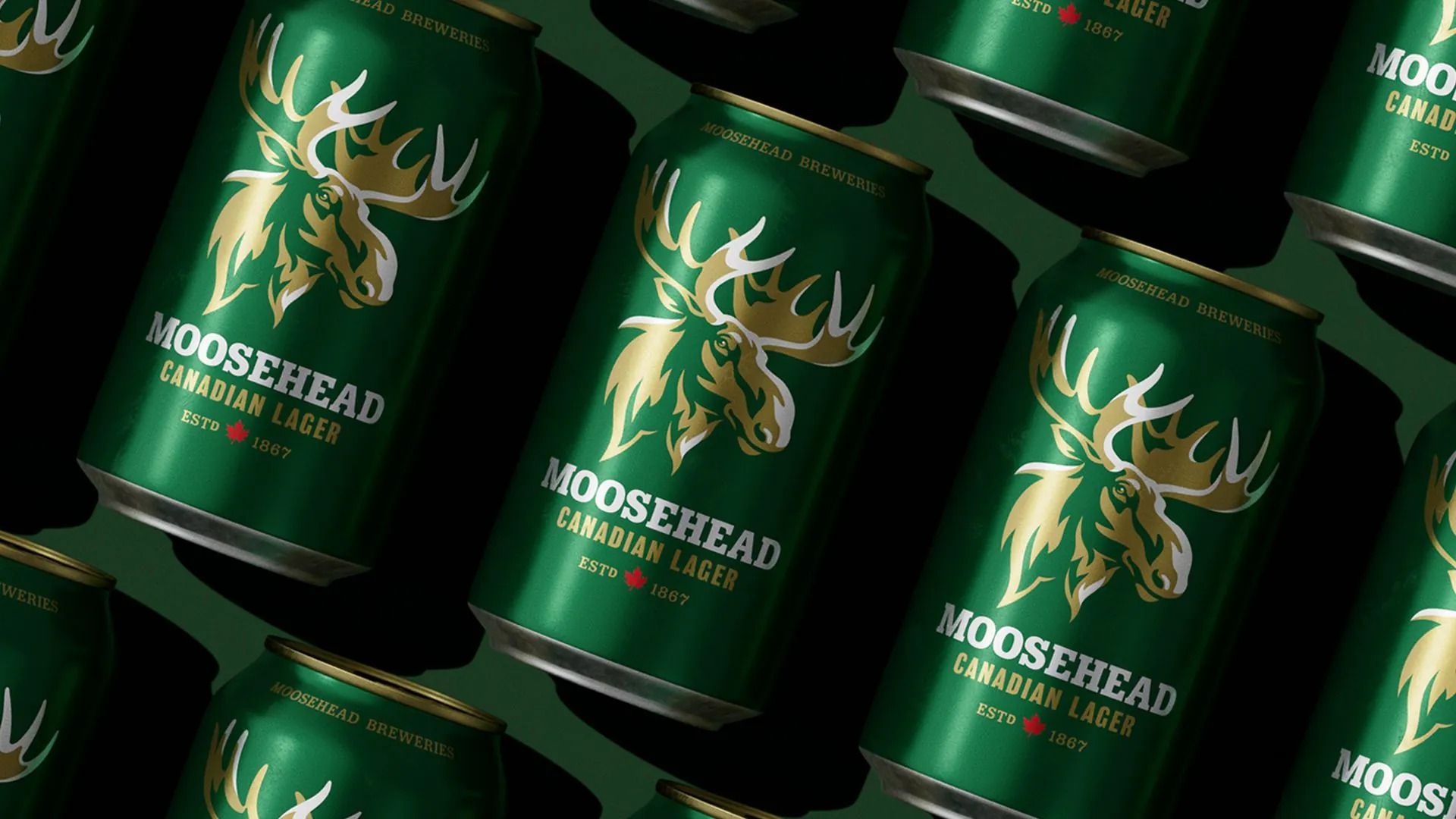
Then shoppers voted with their refrigerators. When Moosehead announced the phaseout in September 2025, it said bottles represented only 7 percent of Canadian beer sales while cans represented 85 percent, up from 65 percent five years earlier. The final bottle run came that December. Limited inventory lingered into early 2026, but production had moved to cans and kegs.
What the drinker carried home
Canadian beer sales mix cited by Moosehead at its September 2025 packaging announcement. The remainder includes other formats.This was not merely a cheaper-package story. Cans block light and oxygen, weigh less to transport and fit the capacity Moosehead intends to deepen. Yet the customer reaction mattered because packaging is tactile memory. The useful move was to acknowledge the loss, stage a send-off and give the final bottle to a fan. The company did not pretend the icon was meaningless. It converted a funeral into a campaign.
Preserve the principle. Change the package.
What failed first: the beautiful version
Moosehead's cleaner lesson arrived before the cans. In 2016, it proposed a 10,000-square-foot small-batch brewery and taproom on the Saint John waterfront, timed as a 150th-anniversary statement. Planning exposed unforeseen problems. Costs exceeded the assigned budget. The company would describe the concept only as a multi-million-dollar project and did not disclose the exact overrun.
In January 2017, Moosehead cancelled it. The important sentence was not about disappointment. It was the refusal to compromise quality to rescue the plan. This is where many heritage companies become hostages to their own announcement: too much pride to stop, too much sunk cost to rethink. Moosehead stopped.
What broke
A waterfront showpiece grew beyond its budget as planning revealed unforeseen issues. The public concept and location had become liabilities.
What changed
Moosehead separated the goal from the glamorous plan. It still needed an innovation brewery and a place to meet drinkers, just not at any cost.
A year later, the company opened a revised Small Batch Brewery and taproom beside its existing Saint John brewery. It began with five new beers, growler sales and a direct line between experimentation and production knowledge. Today the room has ten rotating taps, from the flagship lager to East Coast IPA and taproom-only oddities. The pivot did not shrink the ambition. It moved the ambition closer to assets Moosehead already controlled.
One moose, several businesses
The obvious customer is a legal-drinking-age consumer reaching for a lager at a liquor store, bar, restaurant or stadium. But Moosehead has built more doors into the same brewery. Visitors buy tours and pints. Fans buy hoodies, hats, glassware and gift cards online. Beverage companies buy production capacity. Global brands use Moosehead's Canadian sales and distribution reach.
Consumer beer
National lager scale, lighter options, fruit-led Radlers, value brands and limited releases.
Partner portfolio
Canadian representation for brands including Samuel Adams, Twisted Tea, Truly, Sun Cruiser and Angry Orchard.
Manufacturing
Contract sourcing, brewing, can packaging, quality assurance, warehousing and distribution.
Experience
Taproom, tours, events and ecommerce turn the factory into a place fans can visit and buy from directly.
That mix distinguishes Moosehead from two ends of the market. Against Molson Coors and Labatt's multinational parent, it can sell domestic ownership as a real corporate fact. Against a neighbourhood craft brewer, it brings national distribution, export history and industrial throughput. It occupies the awkward middle: too big to be local craft, too independent to enjoy a global parent's balance sheet. The discomfort is also the position.
Inside the company, that position becomes a culture of coordinated handoffs rather than a brewer's lone-genius myth. Moosehead names passion, respect and courage as its values, and its employment materials are specific about the team effort required to put a drink in a fan's hand. Flexible working arrangements, partner or paternity leave and vacation programs sit beside the production demands. Andrew and Patrick Oland lead the sixth generation, but the company does not market every employee as family. It describes a family business with a national sales force, warehouse teams, brewers, marketers and quality specialists. That distinction matters. Family ownership can supply patience; it cannot replace professional operations.
Marketing that can be lifted with a forklift
In March 2025, amid Canadian anxiety over U.S. tariffs and political threats, Moosehead offered the Presidential Pack: 1,461 cans, one for every day of an American presidential term. Price: C$3,490 plus tax and deposit. Home delivery was available in Ontario, New Brunswick and Nova Scotia. It was absurd, legible in one photograph and perfectly attached to the company's Canadian-owned status.
The stunt worked because the joke had inventory behind it. Any brand could post a maple leaf. Moosehead could put 1,461 cans in a wooden crate and ship the punchline. The same logic shaped its 2026 Space Beer, developed with Future Food Studio: flagship lager freeze-dried into shelf-stable, zero-alcohol snacks during a Canadian spaceflight moment. Not a volume engine, certainly, but a compact demonstration that a heritage brand can be playful without impersonating a startup.
Distribution partnerships turn the identity into sampling. Since December 2024, Porter Airlines has served Moosehead Canadian Lager and Cracked Canoe as part of its onboard offer. Earlier, the Canadian Premier League made Moosehead its official domestic beer. The fit is nearly mechanical: Canadian-owned partners, captive occasions and a product already built to travel.
The part worth copying
Write down the non-negotiable
For Moosehead it is independence and product quality. A bottle shape, a waterfront address and any single campaign are negotiable.
Let operations become a product
If a factory already sources, brews, tests, packs and ships at scale, sell that capability to brands that do not own one.
Prototype beside the machine
Small Batch works near the main brewery, where experiments can borrow people, knowledge and infrastructure.
Make the stunt physically true
The Presidential Pack was not a render. The comedy landed because Moosehead could assemble, sell and deliver the thing.
Give change a ritual
When killing a beloved artifact, say why, respect the attachment and make the last one matter.
The template has limits. National identity is weak if ownership is complicated or the supply chain contradicts the claim. Contract brewing only works with spare or expandable capacity, serious quality systems and economical access to transport. A giant novelty pack fails when fulfillment cannot survive the attention. And heritage becomes dead weight when leaders use it to veto obvious customer behavior.
Moosehead's reported annual revenue in the supplied company data is approximately C$134.3 million, but as a private company it does not publish audited results or a valuation. That makes the precise financial payoff of these choices unknowable from the outside. The strategic result is visible: a brand born before the telephone still reaches national shelves, aircraft cabins and other companies' production plans without surrendering family control.
The Olands have survived literal explosions and figurative ones. That history makes for good copy, but survival is not caused by a stirring timeline. It comes from noticing when the bottle line, the building plan or the old route no longer serves the business. Moosehead's most transferable habit is not stubbornness. It is deciding exactly where to be stubborn.
Keep exploring