A beer bottle is a tiny stage. The label has a few seconds to carry history, taste, place and price before a hand reaches past it. James Jawanda works in the business of winning that pause. From the Greater Toronto Area, his marketing and sales career now runs through Moosehead Breweries, the Saint John company whose green bottle arrives with more than a century and a half of Canadian memory attached.
That inheritance sounds convenient until you consider the assignment. A heritage brand can be recognized and still be overlooked. Familiarity helps customers find it, but familiarity can also turn a product into scenery. The working marketer has to preserve the signal while giving people a fresh reason to notice. Every display, promotion, partnership and post becomes a small negotiation between what the brand has meant and what it can mean today.
Jawanda's public record is spare, which makes its pattern more useful. He describes himself as a results-oriented marketing and sales professional. He studied at York University from 2009 to 2013, where the activities listed alongside his education include basketball, soccer, floor hockey and time in the gym. Years later, he returned to structured learning for credentials in cloud computing and web development. Then came PrintBlock, a project built around print, design and creative inspiration. These are not identical pursuits. Together they sketch a person interested in how ideas move from concept to object, and from object to audience.
The useful detour below the surface
In September 2021, Jawanda completed an introductory cloud-computing course. Two months later, he added a credential covering HTML, CSS and JavaScript essentials. Neither certificate turns a marketer into a software engineer, and that is not the interesting point. They show a willingness to look one layer beneath the interface where customers meet a brand.
Modern consumer marketing is full of hidden machinery. A campaign passes through a content system, an ecommerce store, an analytics layer, a media platform and, eventually, a physical place. A marketer who understands the vocabulary of those systems can make clearer requests and spot weak handoffs. Knowing why a page loads slowly, how a tag records a visit or what structure holds a product story does not replace judgment. It gives judgment more places to work.
How a heritage story becomes a customer moment
The same instinct surfaced in a more tangible form in 2023. Jawanda announced PrintBlock as a hub for print, design and creative inspiration. The launch pointed people toward Facebook, Instagram, LinkedIn, X and a dedicated website. Its stated ambition was broad, but the mechanics were concrete: build a home for the idea, then connect each social doorway back to it.
“Let's make art, design, and innovation collide!”James Jawanda, introducing PrintBlock
Print is a revealing interest for someone in beverage marketing. A printed object has weight, finish, scale and a place in the room. It cannot be reduced to a click-through rate. Beer works the same way. Packaging catches light. A case stack becomes architecture. A tap handle occupies a sightline. A can on an airplane tray can turn distribution into a compact experience of place.
A long story, handled in small decisions
Moosehead traces its beginning to Susannah Oland brewing October Brown Ale in Dartmouth in 1867. The family business survived fires, the Halifax Explosion, Prohibition, economic shocks and competitors with far greater scale. It moved to Saint John, found the Moosehead name in the records of an acquired brewery, introduced Alpine Lager and eventually carried Moosehead Lager into the United States in the 1970s. Today, sixth-generation brothers Andrew and Patrick Oland lead the company.
None of that history belongs to Jawanda personally. It is the material surrounding his work. The distinction matters because corporate heritage is easy to borrow and hard to use well. A timeline can fill a wall. A useful brand story has to help a customer make sense of the product now.
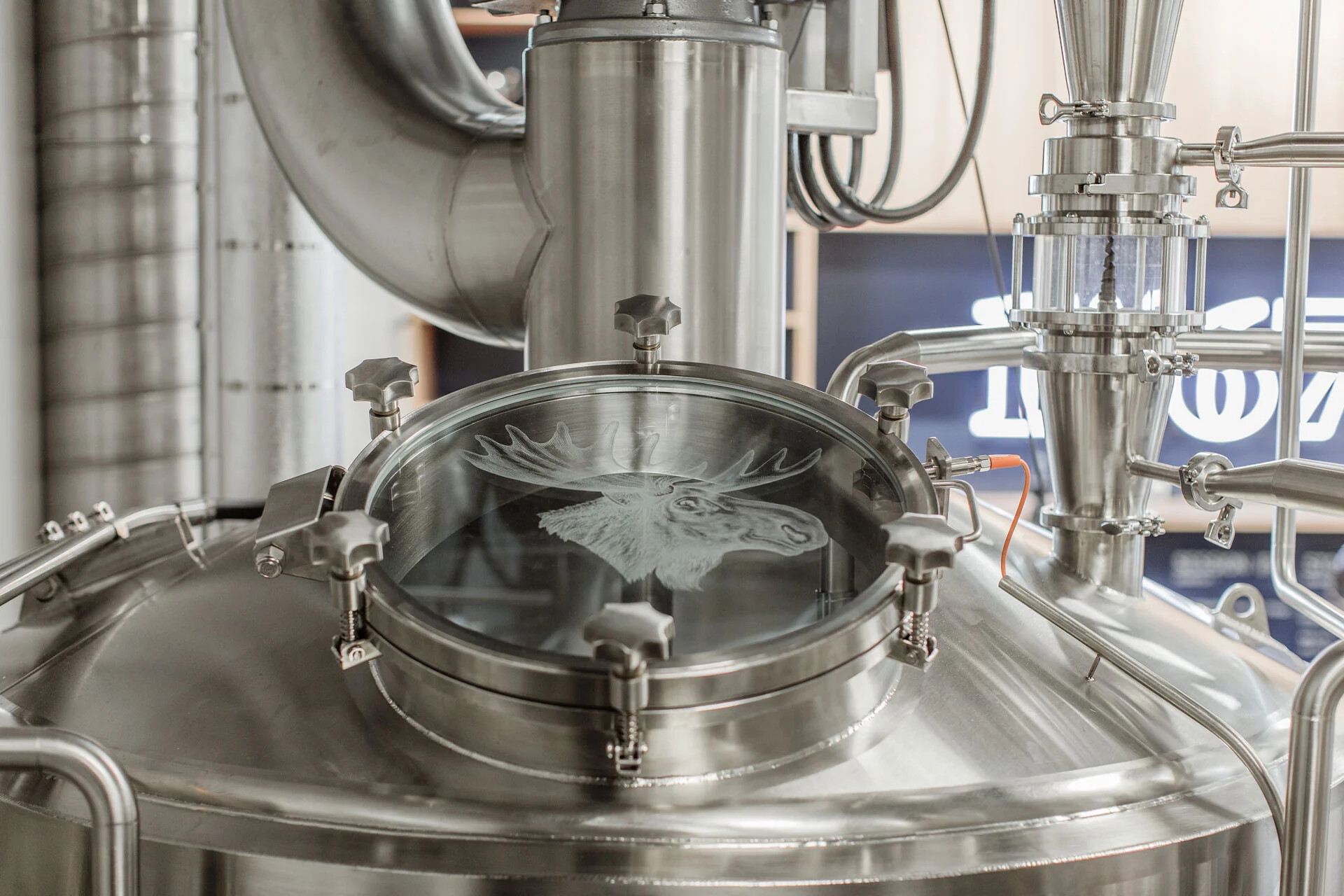
Moosehead has several ways to make that history physical. Its Saint John brewery runs tours. The taproom turns production into hospitality. Contract-brewing operations can package up to 25 million cases a year, linking a family narrative to industrial scale. Its portfolio stretches from the flagship lager to light beer, radlers, Cracked Canoe, Alpine, James Ready and small-batch releases. For a marketer, each format asks for a different balance of consistency and novelty.
Scale also changes the definition of craft. At a small taproom, the brewer can explain a release across the bar. At national scale, the explanation has to survive distance. A colour, a name, a package shape and a few words must stay coherent from the brewery to a warehouse, a retailer and a customer's refrigerator. The brand system becomes a way of protecting meaning while thousands of people handle it.
That is where sales and marketing stop looking like separate departments. Marketing creates the frame; sales sees whether the frame holds up in the field. A clever campaign that cannot be stocked, displayed or explained is unfinished. A distribution win without a clear consumer reason can disappear into the shelf. Jawanda's description of his work spans both disciplines, a pairing suited to a category where the final argument is often made in a physical space.
Jawanda's visible learning and creative trail
York University, with basketball, soccer and floor hockey among his listed activities.
Cloud-computing and front-end web-development credentials through Coursera.
Public launch announcement for PrintBlock across a network of social channels.
Shared Moosehead's partnership with Porter Airlines, where the flagship lager and Cracked Canoe joined the onboard service.
The Porter moment is an instructive example. In December 2024, Jawanda reposted news of the brewery's partnership with the Canadian airline and wrote that his next flight would feel “a little extra special.” The sentence is casual, but the underlying brand move is precise. An airline tray places a product inside a journey. It connects two Canadian companies, a service ritual and a captive moment of attention. The beer is available, but it is also framed.
Marketing people often talk about channels as if they are pipes. In practice, channels change the meaning of what passes through them. A lager in a grocery aisle competes with a wall of alternatives. The same lager served in the air becomes part of departure, destination and hospitality. The product is unchanged. The context does part of the storytelling.
Context also determines what a marketer can learn. A social post offers immediate signals but shallow commitment. A retail display can reveal whether an idea survives the clutter around it. A taproom visit stretches attention over an hour and lets production itself become part of the product. An airline partnership samples the beer in a controlled service moment. Each channel answers a different question, so judging all of them by the same number would miss the point.
The better discipline is to decide what each setting is meant to accomplish. Discovery, trial, recall and purchase are related, but they are not interchangeable. The marketer's job is to keep the sequence legible. The creative thought should still be recognizable when it reaches the sales floor, and the experience on the sales floor should deliver enough proof to justify the creative thought.
What to borrow from the pattern
Jawanda's career offers no public manifesto, and it does not need one. The useful idea is in the overlap: sales discipline, creative experimentation and technical curiosity. Each corrects a weakness in the others. Sales keeps creativity connected to a decision. Creative work keeps the system from becoming sterile. Technical literacy exposes what the system can and cannot deliver.
For people building brands, the steal is straightforward. Learn one layer below your title. If your work ends in a store, understand the display. If it ends on a page, understand the page. If it depends on a partnership, understand the moment both partners are trying to create. The goal is not to perform every job. It is to see enough of the chain to keep the promise intact.
That habit is especially valuable inside an old company. Heritage can encourage repetition because the established assets already work. Curiosity asks a more productive question: where else could this meaning travel? PrintBlock showed Jawanda thinking across design and platforms. His technical coursework showed interest in the infrastructure. Moosehead supplies a living test of how physical product, retail execution, ecommerce, tourism and partnership marketing can reinforce one another.
There is also a quieter lesson in the scale of his public presence. Not every operator builds a personal-media machine. Jawanda's footprint centers on work, learning and a handful of projects. The result is less a polished mythology than a set of clues. He likes the creative object. He studies the system around it. He notices when distribution becomes an experience.
A familiar brand still has to earn the next glance.The daily problem behind heritage marketing
A bottle remains a tiny stage. The family story may get it into the spotlight, but the contemporary work happens in what follows: the display that gives it shape, the partnership that changes its setting, the digital path that makes it findable and the idea that turns recognition into choice. James Jawanda's public trail suggests that he is learning each part of that route.