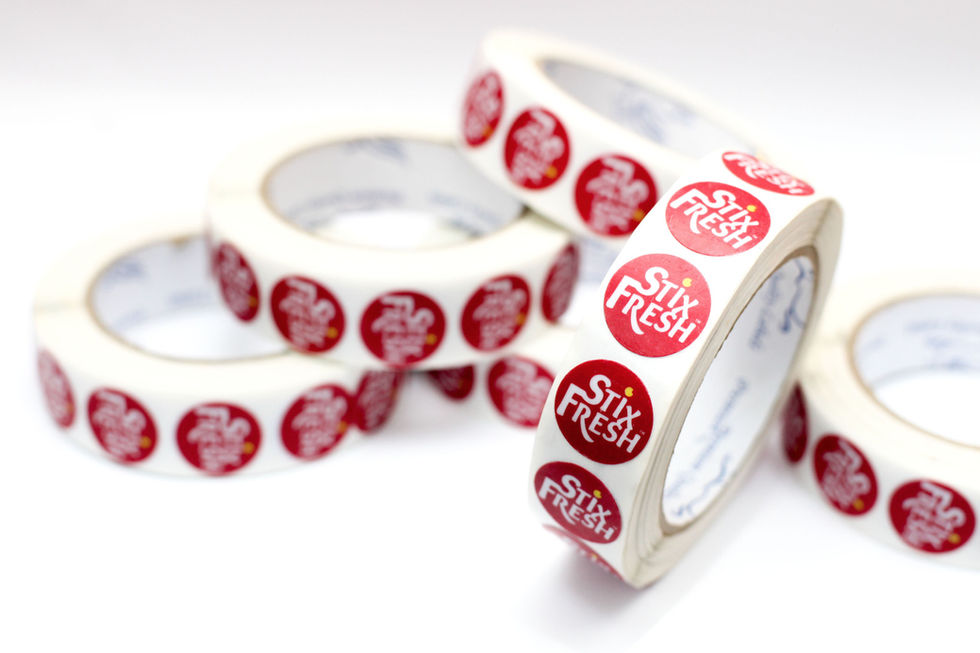
A fruit sticker is usually the least interesting object in the kitchen. It migrates from peach to thumb, from thumb to bin, taking a four-digit code and a little glue with it. Moody Soliman looked at that scrap of familiar infrastructure and saw somewhere to put years of science. The proposition behind Ryp Labs is compact enough to explain before an elevator reaches the next floor: use plant-inspired compounds, released from a sticker or package insert, to slow the forces that make fresh produce spoil.
The simplicity is deliberate. Soliman is an engineer by training, but his career has rarely rewarded engineering for showing off. Before produce, he worked across manufacturing, product development, operational excellence and commercialization in the medical-device and biotechnology industries. He learned to shepherd regulated products from concept toward the world, where every elegant diagram eventually meets a factory, a rulebook and a person who would rather not learn a new ritual.
That background explains the central idea behind his company. Ryp Labs tries to preserve fruit by fitting preservation into the choreography that already moves fruit. Stick the technology on the mango. Put it inside the strawberry clamshell. Drop a sachet into a shipping box. Make the science formidable and the instruction almost insultingly easy.
“If you try to do everything, you'll end up doing nothing.”Moody Soliman, on startup focus
The idea traveled before the fruit did
Ryp Labs began with an international relay. Zhafri Zainudin grew up near Kuala Lumpur and watched a local fruit seller lose produce before it could be sold. He developed an early proof of concept: an all-natural substance applied to the sort of sticker already found on fruit. In 2017, Soliman's brother met Zainudin at a conference in Dubai. The introduction reached Soliman and his colleague Steve Hulteng, two operators who had been looking for a technology with broad practical consequence.
The three perspectives matched neatly. Zainudin brought the original observation and experiment. Soliman and Hulteng brought experience turning technical ideas into manufacturable, commercial products. The group formed the business first known as StixFresh and later as Ryp Labs. Seattle supplied the company base. Malaysia supplied the initial spark. Dubai supplied the coincidence. Fruit, being fruit, supplied the deadline.
From observation to operating company
- A fruit seller's spoilage problem prompts an early sticker experiment in Malaysia.
- A 2017 conference encounter in Dubai connects the inventor with Soliman's network.
- A multidisciplinary team turns the proof of concept into controlled-release products.
- Trials, certifications and commercial partnerships take the idea into global supply chains.
The apparent neatness ends there. Soliman has recalled thinking the technology might be a year from readiness. It took about five years of research and development. Living produce behaves less like a standardized component than an unruly collaborator. Variety, temperature, humidity, packaging and pathogens all change the outcome. A sticker has little surface area. A useful formulation has to release the right compounds at the right rate, remain food-safe and work in conditions that refuse to hold still.
A plant cannot run away
Soliman's favorite plain-English explanation starts with a botanical inconvenience: plants are rooted to the ground. When challenged, they release volatile compounds, part of their own protective chemistry. Ryp Labs studies those naturally occurring compounds, identifies candidates suited to particular post-harvest problems, then works out how to trap and release them over time. The delivery matrix can be applied to a sticker, a label or a sachet.
This is biomimicry without the costume. The sticker works alongside the cold chain, buying time by slowing spoilage and mold. Ryp Labs develops different formulations for different produce and placements. A label touching a mango is a different design problem from a sticker inside a berry container. The company now markets solutions for mangoes, dragon fruit, strawberries and blueberries, with versions listed by the Organic Materials Review Institute for organic operations.
Soliman brought a regulated-product reflex to the work: consider compliance before falling in love with the final design. He has argued that a team should not develop a technology and only later inspect the regulatory path. Ryp Labs chose food-grade, natural compounds at the front end. The constraint narrowed the scientific playground, but it also made safety and organic compatibility part of the architecture rather than a retrofit.
“Break the engineer's pencil.”Soliman's shorthand for the moment a prototype needs a customer
The useful danger of shipping early
By 2021, the company had spent roughly three years in research and still needed market evidence. More refinement was possible. More refinement is always possible. Soliman decided the product had to leave the lab. His team was uneasy. The trial customer was a major global retailer, which made the decision more consequential and the learning more valuable.
The results were strong enough to validate the direction. In later reported trials, the company said its technology added two days to strawberries, doubled the measured shelf life of grapes in one program and added much longer windows to some citrus. The precise result depends on the fruit and conditions, which is why the trial mattered. Laboratory confidence had finally met the messier authority of a packing and retail environment.
“Break the engineer's pencil” is an amusing line because Soliman remains, unmistakably, an engineer. He moved the test into a customer environment. A disciplined trial can produce evidence that another immaculate internal iteration cannot. For deep-tech founders, the distinction is worth keeping: haste skips learning; a well-bounded launch accelerates it.
Reported gain in one retailer trial
Illustrative scale based on gains Soliman reported from a Costa Rica retailer program. Results vary by produce, formulation and conditions.The obvious market lacked urgency
Ryp Labs initially pursued distributors and packing houses in the United States and Europe. On a market map, the choice looked sensible. These regions buy enormous amounts of produce and possess sophisticated logistics. They also possess habits hardened over decades. A California strawberry moving to New York may suffer losses, but it usually travels through a relatively robust cold chain. The pain is real without necessarily being urgent enough to change behavior.
Interest from Central and South America told a different story. Exporters wanted access to higher-value markets in North America and Europe, but longer journeys and breaks in the cold chain put saleable fruit at risk. Soliman followed that pull. The company's go-to-market attention shifted toward customers for whom extra days were not a pleasant improvement but a route to an entirely different shipment, buyer or margin.
One South American dragon-fruit exporter later used Ryp Labs technology in a program that enabled a move from air freight to sea freight while maintaining quality, according to the company's 2026 commercial update. That is the economic promise in miniature. Extra shelf life can change the available mode of transportation and the radius of a market.
Soliman also chose the centralized end of the chain. Selling ten stickers each to thousands of households would create erratic storage conditions, expensive customer acquisition and a blame game conducted one refrigerator at a time. Selling into a packing house or distributor means controlled processes and volume. A single customer can apply the technology across a vast run of clamshells. The sticker is tiny. The purchase order need not be.
Capital with a point of view
In November 2023, Ryp Labs closed an $8.1 million Series A, exceeding its original $7.5 million goal. The investor group included King Philanthropies, Good Investors, BCP Ventures, Argosy Foundation and Ocean Born Foundation. Soliman has spoken about choosing investors for alignment as well as money, particularly when a long development cycle can tempt a company to chase every available application.
The company has collected the useful theater of startup competitions, too. It won the Energy Transition and Sustainability track and a sustainability prize at South Summit in 2022. In 2024, Ryp Labs won Lineage's Global Food Chain Innovation Challenge, receiving $50,000 and entry into an executive-led incubator. In 2025, Soliman presented Ryp Labs as a finalist in Tokyo's SusHi Tech Challenge. The awards create introductions and attention, but their strategic value is more concrete: access to partners who operate the infrastructure the technology hopes to enter.
By early 2026, Ryp Labs was discussing expanded commercial work and a dual-action sachet that combines its plant-inspired formulation with moisture control. The form factor changed; the principle did not. Put sophisticated protection into something growers, distributors and retailers can add without rebuilding the journey from field to shelf.
Small enough to disappear
There is a temptation in climate technology to make the invention look commensurate with the problem. Food waste is enormous, so the machine ought to be enormous too. Soliman's work suggests a more playful possibility. Scale can come from attaching an intervention to an object already repeated by the million.
The sticker is a delivery vehicle, but it is also a business philosophy. Start with a problem people already feel. Protect the hard-won invention. Put it in a customer's hands. Listen to the result instead of the hope. Focus on one product today before promising ten tomorrow. Then find the narrow point in the system where one small action can travel a very long way.
For Soliman, the ambition remains broader than berries. He has discussed applying the platform to more produce and, eventually, other perishable categories. Yet the discipline is to earn that expansion one application at a time. A company devoted to extending shelf life has learned not to rush its own ripening.